



Attention! To adjust the clearances, you will need a special device to press the valve tappets (see below).
Disconnect the battery from the ground, blow it with compressed air and unscrew the spark plugs. Remove the cylinder head cover (see subsection 3.1.4 or subsection 3.2.4). Set the piston of the 1st cylinder to TDC of the compression stroke.
4-cylinder engines
Checking valve clearances on 4-cylinder engines
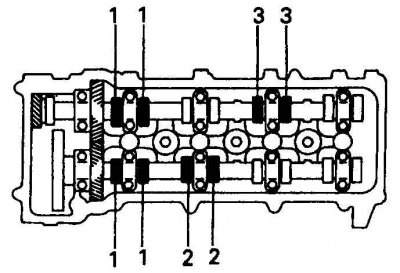
On 4-cylinder engines, check the valve clearances of cylinder 1, exhaust valves of cylinder 3, and intake valves of cylinder 2.
Checking the clearance between the camshaft cam and the valve using a feeler gauge
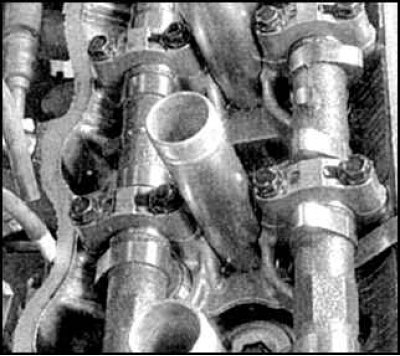
The feeler gauge should pass through with a little effort.
1. Measure the valve clearances with a feeler gauge. Record the results that deviate from the norm.
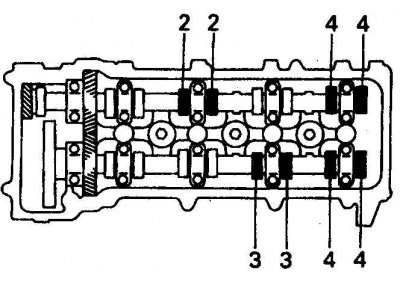
2. Rotate the crankshaft 360° and align the marks. Check the clearances of the remaining valves.
Engines 3.0L V6
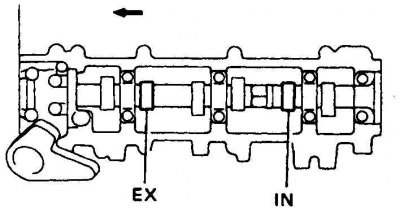
1. Set the piston of the 1st cylinder to TDC of the compression stroke and measure the clearances of the exhaust valve of the 2nd cylinder and the intake valve of the 6th cylinder with a feeler gauge (IN – intake, EX – exhaust). Record the results that differ from the norm.
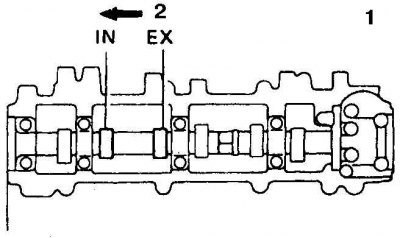
2. Turn the crankshaft 120° and check the clearances of the intake valve of the 1st cylinder and the exhaust valve of the 3rd cylinder (1 - right side, 2 - to the front of the engine, IN - intake, EX - exhaust).
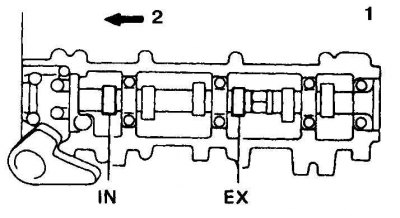
3. Turning the crankshaft another 120°, check the clearances of the intake valve of the 2nd cylinder and the exhaust valve of the 4th cylinder (1 - left side, 2 - to the front of the engine, IN - intake, EX - exhaust).
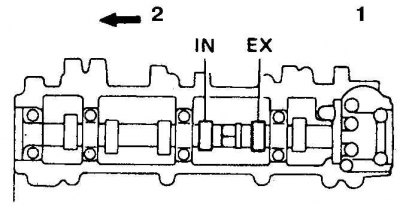
4. Further turning the crankshaft by 120°, check the clearances of the intake valve of the 3rd cylinder and the exhaust valve of the 5th cylinder (1 - right side, 2 - to the front of the engine, IN - intake, EX - exhaust).
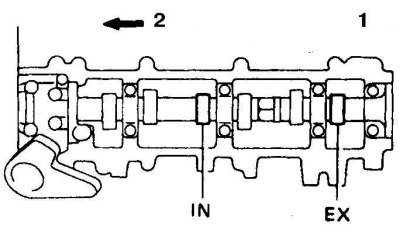
5. Turn the crankshaft 120°, check the clearances of the intake valve of the 4th cylinder and the exhaust valve of the 6th cylinder (1 - left side, 2 - to the front of the engine, IN - intake, EX - exhaust).
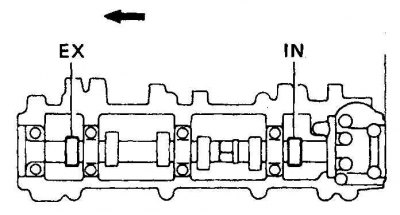
6. Turn the crankshaft 120°, check the clearances of the intake valve of the 5th cylinder and the exhaust valve of the 1st cylinder (IN – intake, EX – exhaust).
Engines 3.4L V6
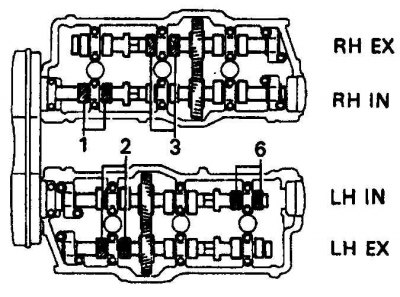
1. Measure the clearances in the specified valves (IN – intake, EX – exhaust, RH – right side, LH – left side) with a feeler gauge. Record the results that deviate from the norm.
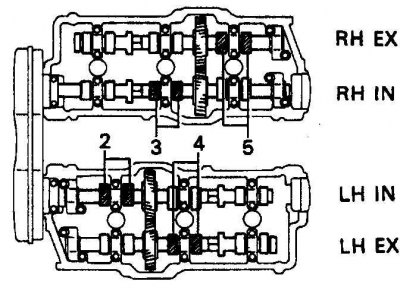 | 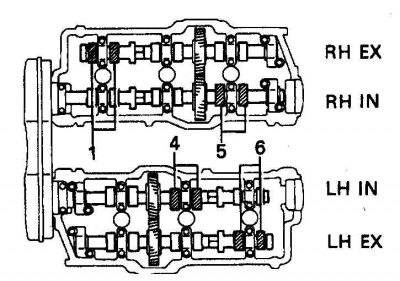 |
2. Rotate the crankshaft 240° (2/3 turn) and check the clearances in the specified valves (IN - intake, EX - exhaust, RH - right side, LH - left side). Measure the clearances in the remaining valves. Mark the intake or exhaust valves on which the measurements were taken.
All engines
1. After measuring the clearances, turn the crankshaft so that the camshaft cam of the first adjustable valve is facing away from the adjusting washer.
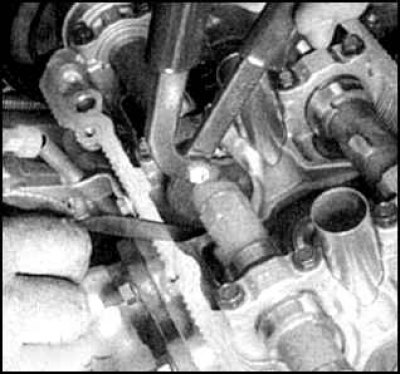
2. Align the groove on the plunger so that it faces the spark plug. Install the tool and press the plunger by squeezing the handles of the tool pliers. Insert the tool holder and remove the pliers (you can bring the handles together and fix them with a hook without using a holder).
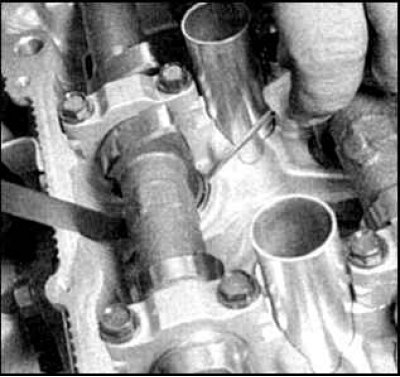 | 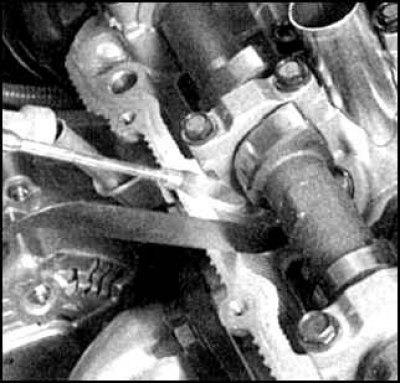 |
3. While squeezing the pusher with the holder, remove the adjusting washers by prying them up with a screwdriver or magnetic tweezers.
Caution! On 3.4L V6 engines, the washers for cylinders 1 and 6 are more difficult to reach. Therefore, tilt the tool slightly away from the intake camshaft.
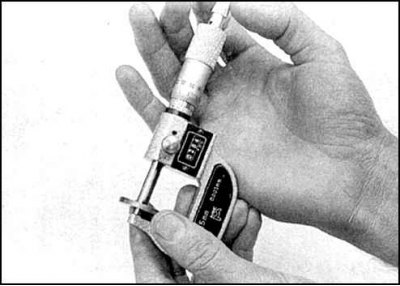
4. Use a micrometer to measure the thickness of the removed adjusting washer, then use the formula to determine the required thickness of the spacer (T is the thickness of the removed gasket, A is the measured gap, N is the required thickness of the new gasket, V is the standard gap): N = T (A-V).
5. The manufacturer supplies 17 size groups of adjusting washers with a thickness from 2.500 mm to 3.300 mm with a step of 0.050 mm. Select a washer so that its thickness is as close as possible to the calculated one.
Note! To save money, you can install a washer of a suitable thickness, removed from the adjacent valve.
6. Press the push rod with the tool and install a new washer. Check the clearance.
7. Repeat the described procedure for the remaining valves. Install all removed parts in reverse order.
Thickness of the adjusting washers supplied as spare parts
| Puck number | Thickness of new gasket, mm | Puck number | Thickness of new gasket, mm |
| 1 | 2,500 | 10 | 2,950 |
| 2 | 2,550 | 11 | 3,000 |
| 3 | 2,600 | 12 | 3,050 |
| 4 | 2,650 | 13 | 3,100 |
| 5 | 2,700 | 14 | 3,150 |
| 6 | 2,750 | 15 | 3,200 |
| 7 | 2,800 | 16 | 3,250 |
| 8 | 2,850 | 17 | 3,300 |
| 9 | 2,900 |
This material is taken from a resource: toyotaman.ru