



Removal
Note: Check the axial play of the camshafts before removing them.
Proceed with removal in the following order:
- turn off the ignition and disconnect the ground wire from the battery;
- remove the cylinder head cover;
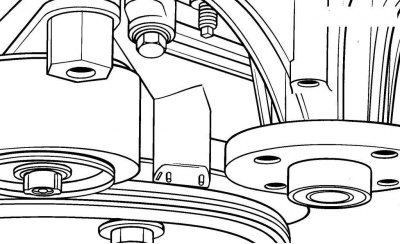
Figure 3.52. Aligning the mark on the vibration damper with the TDC or 0 mark on the front chain cover
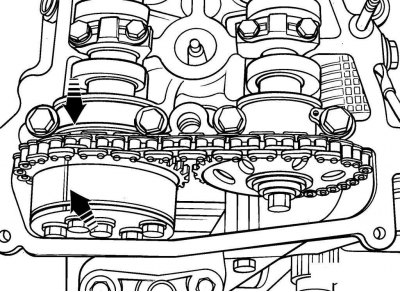
Figure 3.55. Alignment of marks on camshaft sprockets with marks on camshaft bearing caps (the VVT pulley/drive assembly is visible on the intake camshaft)
- set the piston of the first cylinder to TDC in the compression stroke, while the mark on the vibration damper should be aligned with the TDC or 0 sign on the front chain cover (see Figure 3.52), and the marks on the camshaft sprockets must be aligned with the marks on the camshaft bearing caps (see Figure 3.55);
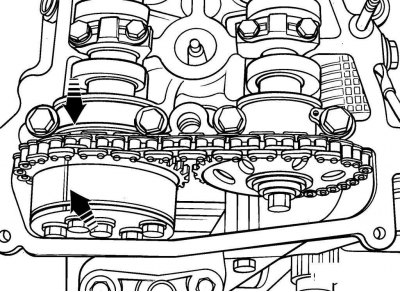
Figure 3.70. Places for applying timing marks on the chain, opposite the marks on the camshaft sprockets
- use paint to apply timing marks to the chain, located opposite the marks on the camshaft sprockets (figure 3.70);
Note: There are two marks on the camshaft sprockets. Some marks are intended for setting the camshafts at the TDC of the piston of the first cylinder, and others for alignment with the colored marks of the chain.
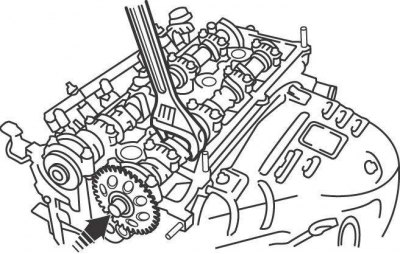
Figure 3.61. Using wrenches to hold the camshaft from turning and loosen the sprocket mounting bolt
- holding the camshaft by the hex key with a wrench to prevent it from turning, unscrew the bolt securing the sprocket to the camshaft a few turns (see Figure 3.61);
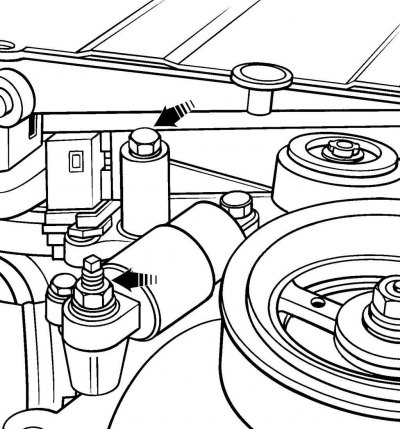
Figure 3.56. Location of chain tensioner mounting bolts
- remove the chain tensioner and crankshaft angle sensor from the front chain cover (see Figure 3.56);
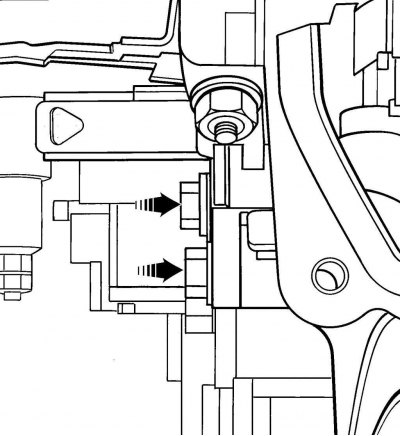
Figure 3.57. Location of chain tensioner mounting nuts
- unscrew the nuts and remove the chain tensioner from the back of the cover (see Figure 3.57);
- unscrew the bolts securing the sprockets to the camshafts. Remove the chain from the camshaft sprockets and remove the sprockets;
- check the axial clearance of the camshafts. Install a bracket with a dial indicator on the engine cylinder block so that the measuring tip of the indicator rests against the end of the camshaft;
- move the camshaft along the axis in one direction until it stops and set the indicator to 0. Move the camshaft along the axis in the other direction until it stops and record the value on the indicator. If the intake camshaft clearance exceeds the permissible value, check the condition of camshaft bearing No. 1. If the bearing running surface is worn, replace the bearing. If the clearance value of the exhaust camshaft exceeds the permissible value, it is necessary to replace the camshaft and/or the cylinder head;
- check if the variable valve timing (VVT) valve is located on the rear of the intake camshaft;
- after removing the sprockets, pull the chain out as far as possible and secure it to the engine compartment bulkhead with soft wire. This will prevent the chain from falling into the engine when performing the following operations. Also place a clean rag on top of the chain cover;
- check for marks on the camshaft bearing caps. The covers are numbered from 1 to 5 and the letters I and E. The letter I (Intake) indicates that the cover is installed on the intake camshaft, and E (Exhaust) - on the exhaust camshaft. There are also arrows on the covers that should point towards the chain when installing the covers;
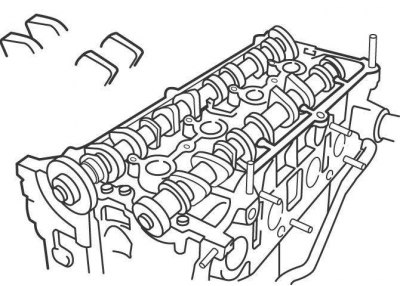
Figure 3.75. Sequence of tightening the camshaft bearing cap bolts
- in the reverse order of tightening, gradually loosen and then completely unscrew the camshaft bearing cap bolts in several passes (see Figure 3.75);
- remove the bearing caps and camshafts from the cylinder head. Mark the position of the camshafts, as they must be in the same positions during installation;
- wipe off any oil and mark the tappets, use a magnetized tool to remove them from the cylinder head and position them so that they fit into their proper places when installed.
Examination
Visually inspect the camshaft cams and bearing journals for wear, corrosion, metal galling, and discoloration that indicate localized overheating.
Check the condition of the teeth on the sprockets. The teeth on the sprocket are symmetrical and if the teeth on one side of the sprocket are worn out, it must be replaced along with the chain.
Check the condition of the camshaft bearings in the cylinder head for signs of corrosion, scratches and wear.
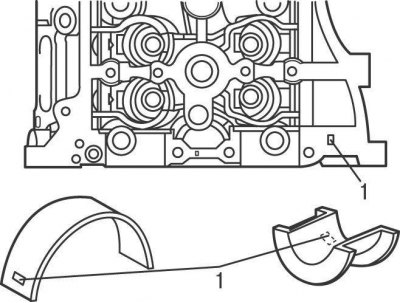
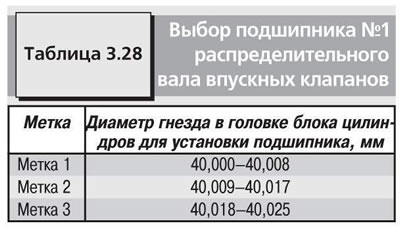
Figure 3.71. Location of bearing No. 1 of the intake camshaft and the locations (1) where the marking is applied
If the working surfaces of bearing No. 1 of the intake camshaft are damaged, replace it in accordance with the data given in Table 3.28 (figure 3.71).
Using a micrometer, measure the diameter of each camshaft bearing journal and record the values. Measure the necks at several points, both in diameter and in length, this will allow you to identify ovality and taper, if any. Nominal value of the camshaft bearing journal diameter: bearing No. 1–35.971–35.985;the rest are 22.959–22.975 mm. If the diameter of any journal is less than the nominal value, replace the camshaft.
Install the camshaft bearing caps onto the cylinder head and secure with bolts. Measure the inside diameter of each respective camshaft bearing and record the values. To determine the radial clearance, subtract the diameter of the corresponding camshaft journal from the bearing diameter. Compare the gap size with the technical data. If the clearance exceeds the maximum permissible value, replace the camshaft and/or cylinder head.
Use a micrometer to measure the height of the camshaft lobes. Compare the cam height with the technical data. If the cam lobe height is less than the maximum permissible value, replace the camshaft.
Measure the radial runout of the camshaft. Install the camshaft into the cylinder head. Install a bracket with a dial indicator on the cylinder head so that the measuring tip of the indicator rests against the middle journal of the camshaft, and set the indicator to 0. Slowly turn the camshaft and note the change in the indicator reading.
Move the camshaft along the axis in the other direction until it stops and record the value on the indicator. The maximum permissible radial runout value is 0.03 mm. If the radial runout exceeds the maximum permissible value, replace the camshaft.
Check each tappet for wear and burrs.
Measure the outside diameter of each tappet and the corresponding tappet sockets. To determine clearance, subtract the tappet diameter from the socket diameter. The nominal clearance value is 0.033–0.059 mm; the maximum permissible value is 0.079 mm. If the clearance exceeds the maximum permissible value, replace the tappets.
Installation
Perform installation in the following order:
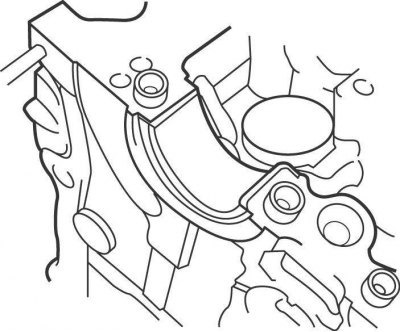
Figure 3.72. Installing bearing No. 1 of the intake camshaft into the cylinder head
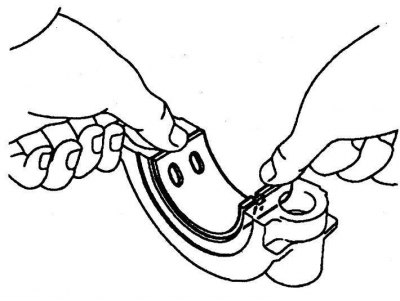
Figure 3.73. Installing bearing No. 1 of the intake camshaft into the bearing cap
- if bearing No. 1 of the intake camshaft was removed, install it in the cylinder head (figure 3.72) and the bearing cap (figure 3.73);
- lubricate the tappets with engine oil and install them in the places where they were before removal;
- lubricate the camshaft journals and cams with engine oil;
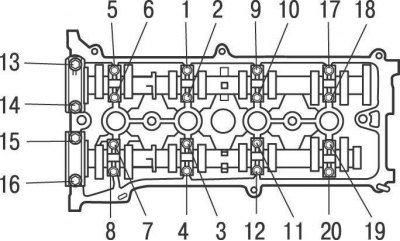
Figure 3.74. Installing the cams of the first cylinder
- install the camshafts so that the camshaft cams of the first cylinder are directed in different directions from each other, at an angle of 30° upwards from the horizontal plane (figure 3.74), and the mounting pins were facing upwards;
- install the camshaft bearing caps and secure them with the bolts, tightening them by hand at this stage;
- in the sequence shown in Figure 3.75, turning 1/4 turn at a time, screw in the cover mounting bolts and tighten them to the torques specified in the technical data;
- align the teeth of the camshaft sprockets with the chain links, aligning the marks made before removal, and install the sprockets on the camshafts so that the shaft pins enter the holes on the back of the sprockets;
- check that the piston of the first cylinder is set to TDC in the compression stroke, while the mark on the vibration damper should be aligned with the TDC or 0 sign on the front chain cover (see Figure 3.52), and the marks on the camshaft sprockets must be aligned with the marks on the bearing caps (see Figure 3.55). Make sure that the timing marks on the chain are aligned with the marks on the camshaft sprockets before removing (see Figure 3.70);
- one by one, holding the camshaft from turning with a wrench by the hexagon, screw in the bolts securing the sprockets to the camshafts (see Figure 3.61);
- install the chain tensioner.
Further installation is carried out in the reverse order of removal.