



Contents: Removal ↓ Installation ↓
1.6L petrol engine (4A-F, 4A-FE)
Removal
Remove the cylinder head cover together with the gasket.
Install the piston first cylinder at TDC.
Note: Do not change the position of the crankshaft any further.
Remove the timing belt.
Remove the ignition distributor.
Remove the mechanical fuel pump from the cylinder head, if it exists.
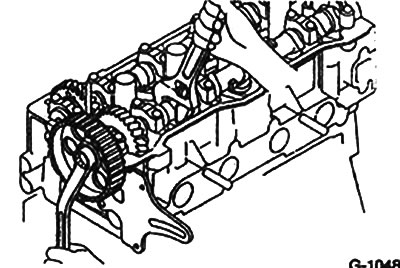
Loosen the camshaft wheel mounting bolt, holding the wheel from turning with an adjustable wrench, for example, HAZET 279-15. Remove the wheel, if necessary, use a rubber hammer for this.
Caution: When holding the camshaft from turning, be careful not to damage the cylinder head with the wrench.
Check the axial clearance of the camshafts. Its value should be within the range: intake valve shaft 0.03-0.08 5 mm; exhaust valve shaft 0.03-0.09 mm. The maximum permissible axial clearance should not exceed 0.11 mm. If the axial clearance exceeds the specified value, the camshaft, and possibly the cylinder head, must be replaced.
Caution: Since the axial play of the camshaft is very small, the shaft must be kept horizontal during disassembly. To ensure this, the following conditions must be met. If the camshaft is tilted during disassembly, it or the cylinder head may be damaged.
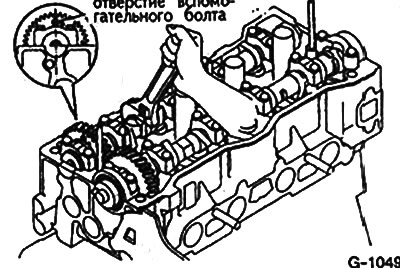
Turn the camshafts so that the hole for the auxiliary bolt on the inlet camshaft gear is in the position shown in the figure.
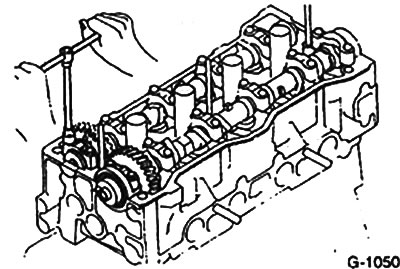
In several steps, unscrew the bolts securing the bearing caps No.1 of the intake and exhaust camshafts. Remove the caps.
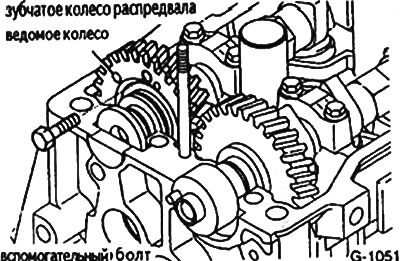
Tighten the additional gear wheel and the inlet camshaft gear with a 16-20 mm long M6x1.0 screw.
Caution: When removing the camshaft, make sure that the spring between the gears is fully compressed by the screw.
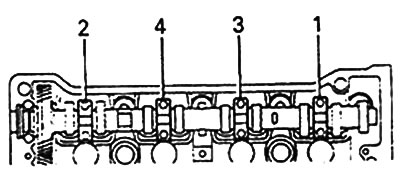
Remove the bearing caps by unscrewing them evenly in the sequence shown in the figure.
Caution: Do not use force or any tool to remove the camshaft. If the camshaft does not come out, reinstall the last bearing cap removed (Fig. G-1052, No.4) and tighten the bolts and fasteners again. Then, gradually loosen the bolts while simultaneously pulling the camshaft upward.
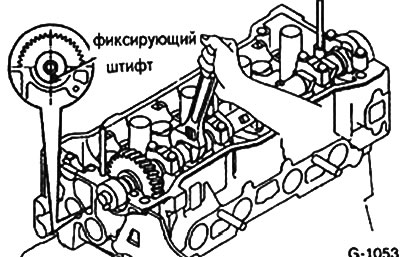
Turn the exhaust camshaft through an angle of 105° so that the locking pin occupies the position shown in Fig. G-1053.
Unscrew the bearing cap mounting bolts in several steps in the sequence shown in Fig. G-1052.
Remove the exhaust camshaft bearing caps and take out the shaft.
Caution: Do not remove the camshaft by force or using any tool. If the camshaft cannot be removed, reinstall the last removed bearing cap (Fig. G-1052 No.4) and tighten its mounting bolts. Then, gradually loosen the bolts while simultaneously pulling the camshaft upward.
Installation
Caution: Since the axial clearance of the camshaft is very small, the shaft must be kept horizontal during installation. To ensure this, the following conditions must be met. If the camshaft is tilted during installation, it may be damaged or the cylinder head may be damaged.
Lubricate all camshaft bearings with a thin layer of oil.
Install the camshaft so that the camshaft wheel centering pin is in the position shown in Fig. G-1053.
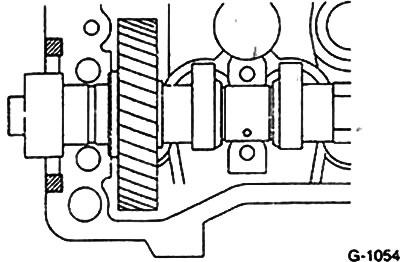
Apply sealant N 102 (ET-Nr.08826 00080) or any other sealant or silicone based as shown in Fig. Tighten the mounting bolts by hand.
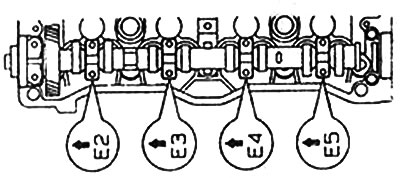
Install the camshaft bearing caps in accordance with the numbers stamped on them with arrows in the direction of the gear and secure them by hand with bolts.
The exhaust camshaft bearing caps are marked with the letter "E", the intake camshaft bearing caps are marked with the letter "T".
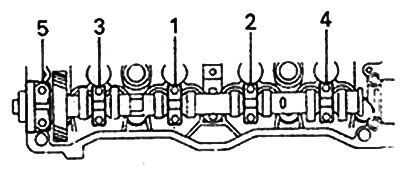
Tighten the bearing cap mounting bolts in two steps using a torque wrench in the sequence shown in the figure with the following forces:
- 1 step - 10 Nm
- 2nd step - 13 Nm
Install a new camshaft oil seal using light blows from a rubber hammer. Specialized TOYOTA workshops use a special tool SST 09223-46011 for this purpose. If this tool is not available, you can use a pipe with an outer and inner diameter equal to the diameter of the oil seal. Lightly lubricate the contact points with oil beforehand.
Caution: Do not tilt the seal during installation.
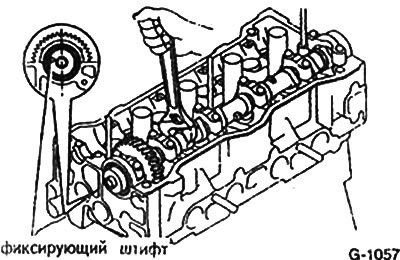
Set the exhaust camshaft locking pin to the position shown in Fig.
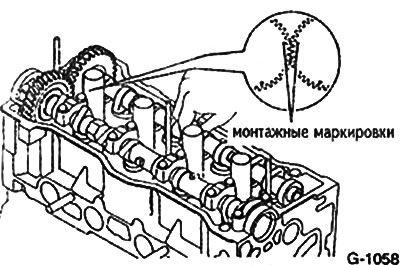
Insert the intake camshaft so that the gears of both shafts engage and the markings match.
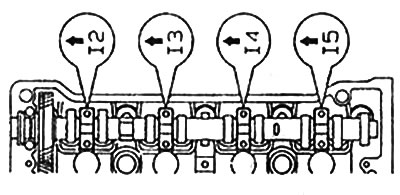
Install the bearing caps according to the markings stamped on them so that the arrows point towards the gear. Tighten the bolts by hand.
The covers installed on the bearings of the exhaust camshaft are marked "E", the covers of the intake camshaft are marked "T".
Caution: Do not confuse bearing caps.
Tighten the bearing cap bolts with a torque wrench, following the sequence shown in Fig. G-1056. Tightening is performed in two steps.
- 1 step - tightening force 10 Nm
- 2nd step - tightening force 13 Nm
Remove the auxiliary screw from the auxiliary gear and the main gear.
Install bearing caps No.1 in place. Secure them manually with bolts and tighten in two steps.
- 1 step - tightening force 10 Nm
- 2nd step - tightening force 10 Nm
Turn the camshaft one revolution from TDC to TDC of the first cylinder. The piston of the first cylinder is at TDC if the locking pin of the camshaft gear is vertical above the axis of the camshaft.
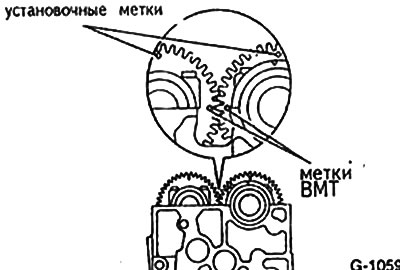
Check whether the TDC markings on the rear sides of the gears match. The markings on the front side of the gears should be vertical. If this condition is not met, the intake camshaft must be removed and reinstalled.
Clean the camshaft gear from water and oil.
Install the wheel so that the pin matches the hole. Tighten the bolt to 60 Nm, holding the camshaft from turning with an adjustable wrench.
Caution: Be careful not to damage the cylinder head with the key.
Install the camshaft wheel so that the hole in the wheel is vertically above the mounting bolt.
Put on the timing belt and tighten it.
Check valve clearances.
Install the cylinder head cover with gasket.