



Contents: Checking and adjusting the alignment ↓ Checking the wheel turning angles ↓ Checking the camber, longitudinal…↓ Camber adjustment (only for models…↓
Checking and adjusting the alignment
Check the toe-in value. If it does not meet the specified conditions, make adjustments.
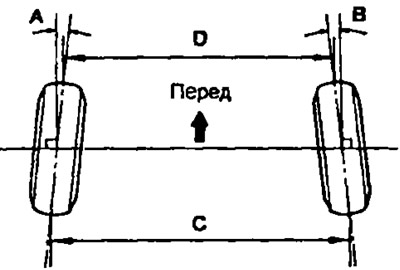
Convergence during inspection:
- Models up to 96:
- A + B = 0°±0.2°
- C - D = 0±2 mm
- Models since 1996:
- A + B = 0.1°±0.2°
- C - D = 1±2 mm
To adjust:
- a) Remove the cover clamps.
- 6) Loosen the tie rod end locknuts.
- c) Adjust the toe-in by turning the left and right tie rod ends the same number of turns.
Toe-in adjustment:
- Models up to 96:
- A + B = 0°±0.1°
- C - D = 0±1 mm
- Models since 1996:
- A + B = 0.1°±0.2°
- C - D = 1±2 mm
Note: Make sure the lengths of the right and left rods are the same. The difference in rod length is less than 1.5 mm.
- d) Tighten the tie rod end locknuts. Tightening torque 74 Nm.
- e) Reinstall the covers and secure them with clamps.
Note: When installing, make sure the covers are not twisted.
Checking the wheel turning angles
Check the wheel turning angles.
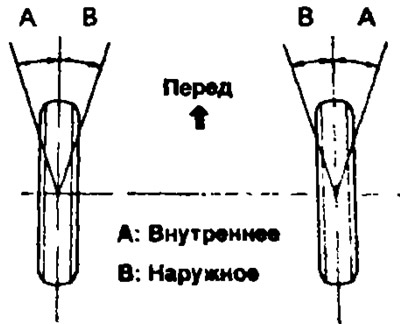
Models up to 96:
- With reinforced suspension:
- Inner wheel: 38°30'±2°
- Outer wheel: 32°15'
- Rest:
- Inner wheel: 38°05'±2°
- Outer wheel: 32°00'
Models since 1996:
- AT210, CT210:
- Inner wheel: 39°39'±1°
- Outer wheel: 33°14'
- AT211. ST210:
- Inner wheel: 37°48'±1°
- Outer wheel: 32°00'
- ST215, CT215:
- Inner wheel: 35°14'±1°
- Outer wheel: 30°40'
If the wheel turning angles differ from the standard ones, it is necessary to make sure that the lengths of the left and right steering rods are the same. The difference in rod lengths is less than 1.5 mm.
Checking the camber, longitudinal and transverse tilt of the steering axes
Check the camber of the front wheels, longitudinal and lateral tilt of the steering axes.
Models up to 96:
- With reinforced suspension:
- Camber: -0°05'±45'
- Longitudinal tilt of the pivot axis: 0°30'±45'
- Transverse tilt of the pivot axis 13°00'±45'
- Rest:
- Camber: -0°20'±45'
- Longitudinal tilt of the pivot axis 0°30'±45'
- Lateral tilt of the pivot axis: 13°25'±45'
Models since 1996:
- Collapse:
- 2WD: -0°25'±45'
- 4WD: -0°20'±45'
- Longitudinal tilt of the pivot axis:
- 2WD: 1°30'±45'
- 4WD: 1°15'±45'
- Transverse tilt of the pivot axis:
- 2WD: 13°30'±45'
- 4WD: 13°20'±45'
Difference in camber and longitudinal tilt of the steering axis of the right and left wheels: less than 30'
Note:
- The longitudinal and transverse tilt of the front wheel pivot axes is not adjustable, so if this value does not correspond to the specified conditions, it is necessary to check the condition and replace faulty suspension parts.
- For models up to 1996, the camber is also not adjustable, but for models from 1996, camber adjustment is provided.
Camber adjustment (only for models from 96.)
Note: After adjusting the camber, check the front wheel toe-in.
1. Remove the front wheels.
2. Unscrew the two nuts from the bottom of the rack.
3. Apply engine oil to the nut threads.
4. Temporarily install the nuts.
5. Adjust the camber by moving the lower part of the strut.
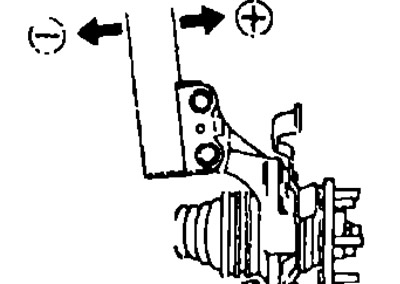
8. Tighten the nuts. Tightening torque 255 Nm.
7. Install the front wheels. Tightening torque 103 Nm.
8. Check the camber.
Note:
- Try to establish the average value of the camber value.
- When using a bolt without a mark, the camber adjustment is possible in the range from 0°06' to 0°30'.
If the camber does not meet the specified conditions, then, using the table, select a bolt and make the adjustment.
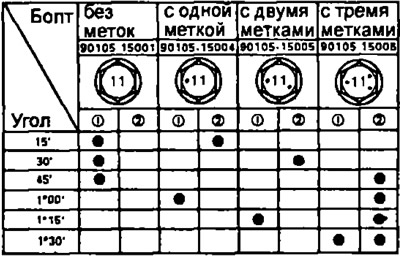
9. Repeat the adjustment. Between points "b" and "c" replace 1 or 2 selected bolts.
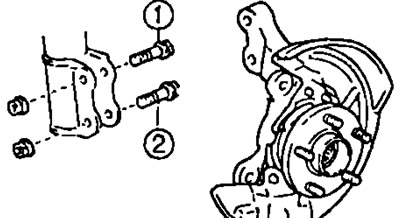
Note: If both bolts are being replaced, do not remove them at the same time.