Note: Checking and adjusting thermal clearances in valves is carried out on a cold engine.
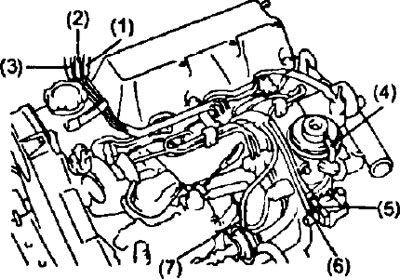
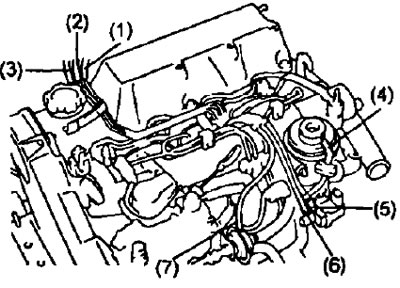
1. (2C) Remove the vacuum tube.
- a) Disconnect the following hoses from the vacuum tube:
- (1) - hose from the vacuum tube of the absolute pressure sensor (underpressure),
- (2) - hose from the vacuum tube (from the tee),
- (3) - hose from the vacuum tube (from the idle speed increase valve when the air conditioner is turned on),
- (4) - hose from the EGR valve,
- (5) - hose from the EGR pressure modulator (input channel),
- (6) - hose from the EGR pressure modulator (output channel),
- (7) - hose from the idle speed increase system drive when the air conditioner is turned on.
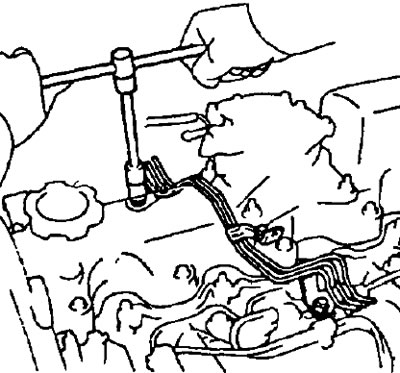
- b) Unscrew the three bolts and remove the vacuum tube.
2. Remove the vacuum pump
- a) Install the camshaft drive pulley with the mark facing the center of the crankshaft pulley.
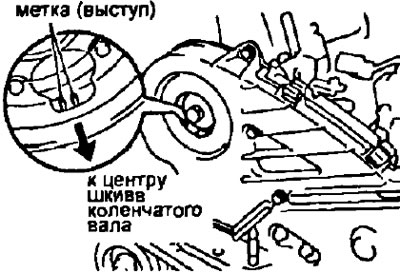
- b) Disconnect the vacuum hoses from the vacuum tube.
- c) After unscrewing the nuts, remove the vacuum pump and gasket.
[The original text is posted on: ToyotaMan]
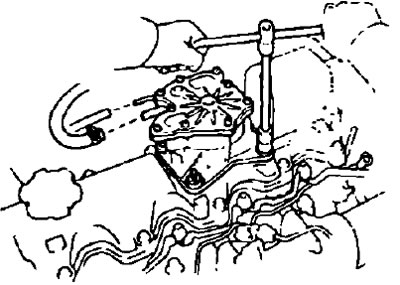
3. Loosen the bolts and remove the cylinder head cover and gasket.
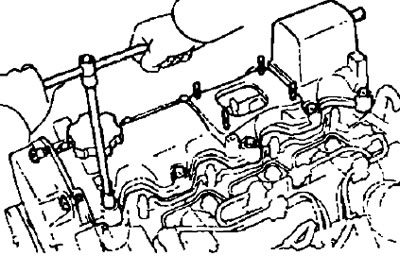
4. Set the piston of cylinder No.1 to TDC of the compression stroke.
- a) Turn the crankshaft pulley clockwise until its groove aligns with the injection advance angle indicator.
- b) Check that the valve tappets of cylinder #1 are free and the valve tappets of cylinder #4 are tight. If not, rotate the crankshaft one revolution (360°) and align the timing marks as described above.
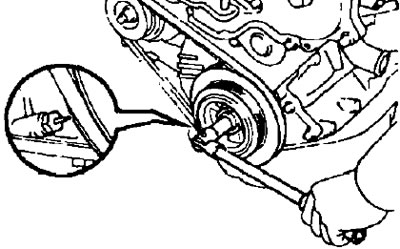
5. Check the valve clearance.
- a) Check only the clearances shown in the illustration. Using a flat feeler gauge, measure the clearance between the valve lifter and the camshaft.
Write down the measurement results. They will be used later to determine the required thickness of the new shim
- Valve clearances (measured on a cold engine):
- inlet valve - 0.20-0.30 mm
- outlet valve - 0.25-0.35 mm
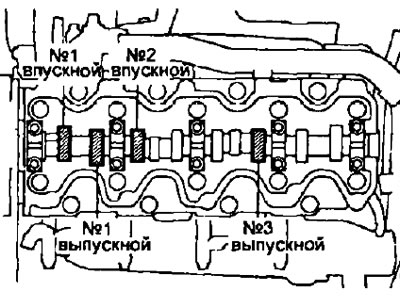
- b) Turn the crankshaft pulley one revolution (360°) until its groove aligns with the injection advance angle indicator.
- c) Check only those valves shown in the figure.
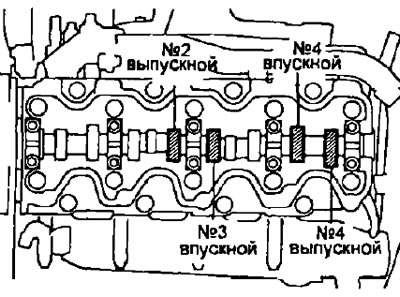
6. Adjust the valve clearances.
- a) Remove the adjusting washer. Turn the crankshaft so that the camshaft cam lobe points upward.
Position the notch in the valve lifter so that it faces the intake manifold.
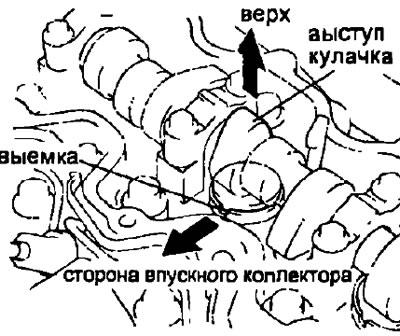
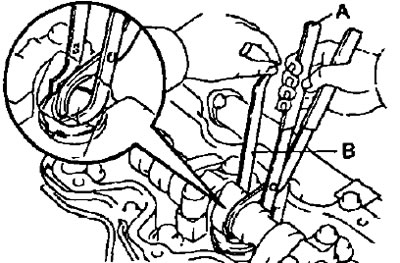
- b) Using the special tool (A), press down on the valve tappet and install the special tool (B) between the camshaft and the valve tappet.
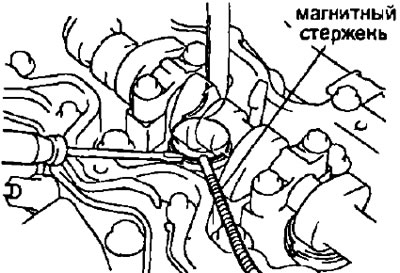
- c) Using a small screwdriver and a magnetic rod, remove the old adjusting washer.
- d) Measure the thickness of the removed adjusting washer with a micrometer. Calculate the thickness of the new adjusting washer so that the calculated clearance satisfies the values specified in the technical specifications:
- T — thickness of the removed washer, mm
- A - measured gap, mm
- N — thickness of new washer, mm
- Inlet valve - N=T+[A-0.25 mm]
- Exhaust valve - N=T+[A-0.30 mm]
Select an adjusting washer with a thickness closest to the calculated one.
Note: Adjusting washers come in 25 sizes, from 2.20 mm to 3.40 mm in 0.05 mm increments. The thickness is stamped on the washer.
- d) Install a new adjusting washer into the valve lifter.
- e) Using the special tool (A), press down on the valve tappet and remove the tool (B).
Check the valve clearance again.
7. Install the cylinder head cover.
8. Install the vacuum pump.
9. Install the vacuum tube.
10. (2C) Connect the following hoses to the vacuum tube:
- (1) - hose from the vacuum tube of the absolute pressure sensor (underpressure),
- (2) - hose from the vacuum tube (from the tee),
- (3) - hose from the vacuum tube (from the idle speed increase valve when the air conditioner is turned on),
- (4) - hose from the EGR valve,
- (5) - hose from the EGR pressure modulator (input channel),
- (6) - hose from the EGR pressure modulator (output channel),
- (7) - hose from the idle speed increase system drive when the air conditioner is turned on.