



Contents: Engines with rocker arms or levers ↓ Examination ↓ Adjustment ↓ Cylinder tappet engines ↓ Examination ↓ Adjustment ↓ Determining the thickness of the…↓ Valve clearances ↓
To compensate for temperature deformations during operation of the gas distribution mechanism, the mechanism must have a thermal gap.
If the clearance is small, the valve timing is disrupted, compression deteriorates, engine power decreases, and engine operation becomes uneven. In some cases, the valves may become deformed and burn out.
If the clearance is too large, mechanical knocking occurs and the valve timing is disrupted. Due to the reduced duration of the open state of the valves and poor ventilation of the cylinders, engine power decreases. Engine operation becomes uneven.
For proper adjustment of the valves, they must be well ground, the clearance in the guide bushings must not exceed the permissible value, and the end of the valve stem that mates with the rocker arm must not be work-hardened.
The gap in the valve timing mechanism is checked and adjusted during maintenance, see section "Maintenance" and after repairs, as well as if there is noise in the operation of the valve mechanism.
The gap is checked and adjusted when the engine is warmed up. The engine can be considered warmed up after the car has run 10-15 km and the temperature indicators on the control panel are in the middle position.
Engines with rocker arms or levers
(Publication Reprinted from a web portal toyotaman.ru)
Note: This describes how to check and adjust the clearance in a 1.3L petrol engine manufactured since 8/84. Features of clearance adjustment for 1.3L engines manufactured before 7/84 and 1.6L engines (4A-L,4A-LC) are described separately. Engine designation.
Examination
Remove the cylinder head cover.
Set the piston of the first cylinder to TDC.
To turn the crankshaft, engage fifth gear and move the car on a level surface. There is another way to turn the crankshaft. Raise one of the front wheels, engage fifth gear and turn the wheel by hand.
Check if the levers of the first cylinder are pressed. They should have some clearance at the point of mating with the valve. The levers of the fourth cylinder should be pressed against the valve. If this condition is not met, then it is necessary to turn the crankshaft a full revolution.
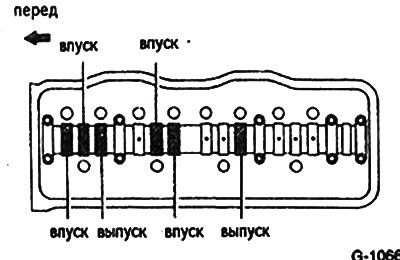
Check the clearance of the valves shown in the figure with a feeler gauge between the lever and the camshaft and adjust if necessary. The specified clearance values are given in the table. EX: exhaust valve IN: inlet valve.
Engines with a working volume of 1.3 liters for 7/84 year of release, engines with a working volume of 1.6 liters (4A-L, 4A-LC)
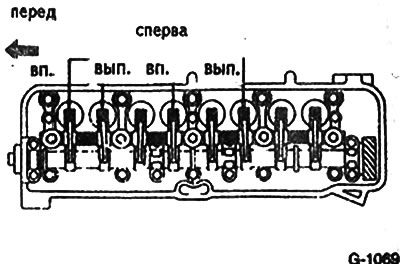
Check the clearance between the rocker arms and the ends of the valve stems shown in Fig. G-1069 and adjust if necessary. The specified clearance values are given in the table.
The feeler gauge should bite slightly when checking the gaps. Otherwise, the gap must be adjusted.
Turn the engine through a full revolution until the marking on the pulley matches the marking on the timing cover.
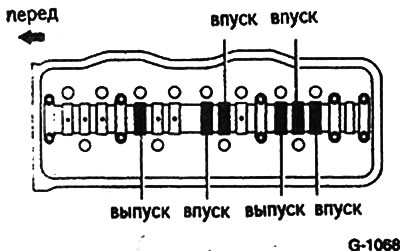
Check the clearance between the rocker arms and the camshaft for the valves shown in Fig. G-1068 and adjust if necessary. The specified clearance values are given in the table.
Engines with a working volume of 1.3 l up to /84 of production 1.6 l (4A-L, 4A-LC)
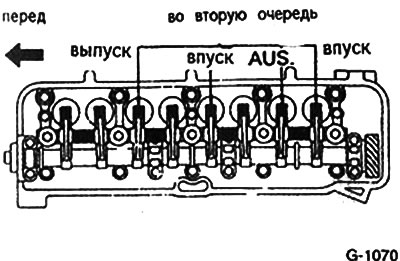
Check the clearance of the valves shown in Fig. G-1070 with a feeler gauge between the rocker arms and the ends of the valve stems and adjust if necessary. The specified clearance values are given in the table.
The feeler gauge should bite slightly when checking the gaps. Otherwise, the gap must be adjusted.
Adjustment
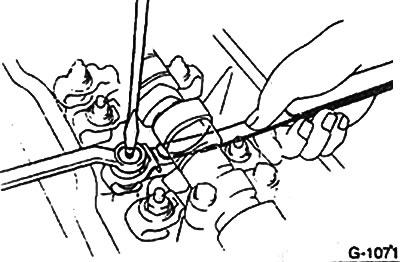
If the gap does not correspond to the specified value, loosen the lock nut with a ring spanner approximately 1 turn, holding the adjusting screw from turning with a screwdriver.
Turn the adjusting screw with a screwdriver to adjust the valve clearance.
Lock the adjusting screw with a nut.
Check the valve clearance again.
Adjust the clearances in all valves in the same way.
Note: It is advisable to mark with chalk the valves whose clearances have already been adjusted.
After adjusting the valves, check the tightness of the rocker arm mounting bolts.
Install the cylinder head cover.
Cylinder tappet engines
Note: This section describes how to check and adjust clearances for 1.6L petrol engines (4A-PE). The clearance adjustment features for other 1.6L engines with four-valve cylinder heads and for 1.8L diesel engines are described separately.
Examination
Remove the cylinder head cover.
Set the piston of the first cylinder to TDC.
To turn the engine, engage the gear and move the car on a flat surface. There is another way to turn the engine. You need to lift one of the five wheels, engage the fifth gear and turn the wheel by hand.
In this position, the cylindrical tappets of the first cylinder should be free and the tappets of the fourth cylinder should be pressed by the cams. If this condition is not met, the crankshaft must be turned one revolution.
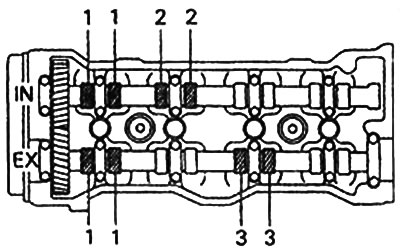
Check the valve clearances between the tappets and the camshaft for the valves shown in the figure and adjust if necessary. The specified clearance values are given in the table.
Diesel engine with a working volume of 1.8 l
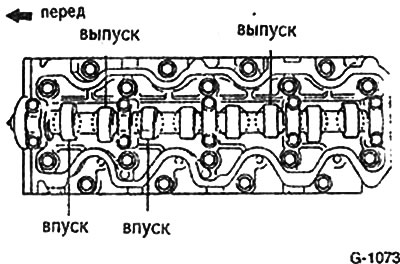
Check the valve clearances between the tappets and the camshaft for the valves shown in Fig. G-1073 and adjust if necessary. The specified clearance values are given in the table.
The feeler gauge should bite slightly when checking the gaps.
Turn the engine one revolution until the marking on the pulley matches the marking on the timing mechanism drive cover.
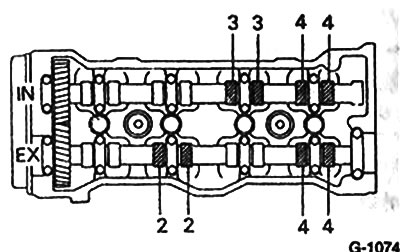
Check the clearance between the tappets and the camshaft for the valves shown in Fig. and adjust if necessary. The specified clearance values are given in the table.
Diesel engine with a working volume of 1.8 l
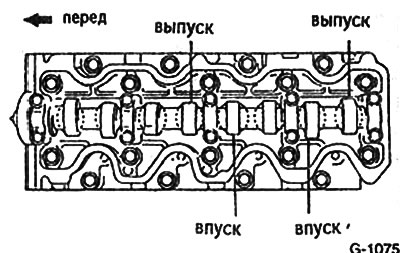
Check the clearance between the tappets and the camshaft for the valves shown in Fig. G-1075 and adjust if necessary. The specified clearance values are given in the table.
The feeler gauge should bite slightly when checking the gaps.
When checking the gaps, it is necessary to select the thickness of the feeler gauge until the actual gap value is determined. Record the measured gap value.
Adjustment
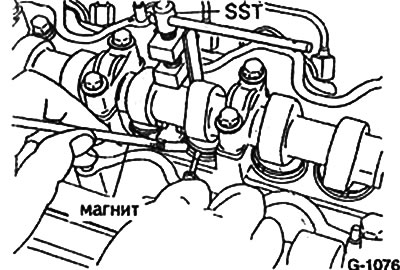
The clearance in the valve mechanism is adjusted by selecting adjustment washers. To do this, the cylindrical tappets are pressed down.
Note: Special clamps can be used for this purpose, in particular SST09248-64010 (for diesel) and SST 09248-55010 (for engines 4A-GE, 4AGEL, 4A-F, 4A-FE).
Press the cylindrical pusher, remove the adjusting washer with a magnet and insert another one in its place.
Determining the thickness of the adjusting washer
Measure the thickness of the removed adjusting washer with a micrometer. Record the result.
To determine the thickness of the newly installed adjusting washer, the formula is used:
N = T + (A - S), where
N = thickness of new washer
T = thickness of the removed washer
A = measured valve clearance
S = clearance, see table
The thickness of the adjusting washer is engraved on its bottom side.
Insert a new adjusting washer. The thickness of the washers is in the range of 2.5-3.3 mm with an interval of 0.05 mm (for diesel in the range of 2.2-3.4 mm).
In this way, adjust all valves.
Install and secure the cylinder head cover with bolts.
Valve clearances
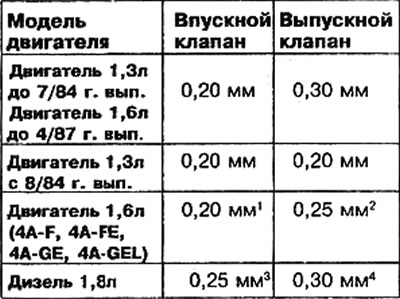
1) installation value; control value 0.15-0.25 mm.
2) installation value; control value 0.20-0.30 mm.
3) installation value; control value 0.20-0.30 mm.
4) installation value; control value 0.25-0.35 mm.