



Checking functionality
1. Press the brake pedal several times with the engine off and check that there is no change in the pedal travel.
2. Press the pedal and start the engine. If the pedal drops slightly, the vacuum booster is working properly.
Checking for leaks
3. Start the engine and turn it off after one or two minutes. Slowly press the brake pedal several times. If the pedal moves down less each time, the booster is sealed.
4. Depress the brake pedal with the engine running, and then stop the engine with the pedal depressed. If no change in pedal travel is observed after holding the pedal for 30 seconds, the booster is sealed.
Removal
Note: On 2003 and earlier Highlander models with ABS and traction control (traction control system) removing and installing the brake booster requires special tools and procedures. The ABS and traction control actuator must be removed and then bled during installation (under pressure), using special tools. It is recommended to entrust the removal and installation of the brake booster to specialists from the dealership or other specialized service station.
5. The brake booster should not be disassembled. This requires special tools that are usually not available at non-specialized service stations or auto parts stores. The brake booster is quite complex in design and, due to its significant impact on brake performance, it should not be repaired, but replaced with a new or reconditioned one.
6. On 2004 and later Lexus models, remove the air intake box deflector from the engine compartment (see chapter 11).
7. Remove the air filter housing (see chapter 4).
8. Remove the brake master cylinder (see paragraph 6). To allow room to remove the booster, on some models it may be necessary to completely remove the brake lines that run in front of the master cylinder, rather than just disconnecting them from the master cylinder. Other brake lines that run in front of the brake booster can be separated from the bulkhead and carefully pushed aside.
9. Carefully disconnect the vacuum hose from the brake booster.
10. In the car interior, remove the knee bolster and the clamp located behind it.
11. Remove the brake pedal return spring near the top edge of the pedal. Using pliers, remove the pin clamp and then remove the pin (Fig. 9.11).
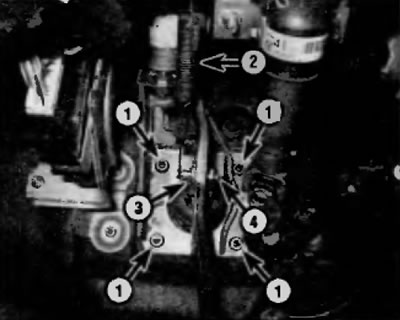
Fig. 9.11. Installing the brake booster
1. Nuts
2. Return spring
3. Pin clamp
4. Pin
12. Unscrew the four nuts securing the brake booster to the bulkhead. Then move the booster away from the bulkhead until the studs are completely out of the mating holes (Fig. 9.11).
Installation
13. Installation is performed in the reverse order of removal. Tighten the booster mounting nuts to the prescribed torque specified in Specifications at the beginning of this chapter.
14. If a new brake booster is installed, check the clearance between the brake booster rod and the master cylinder piston (fig. 9.14, a-g), proceeding as follows:
- a) Measure how far the piston rod protrudes from the front of the brake booster relative to the mating surface of the master cylinder, including the gasket (if available) (fig. 9.14,a). Write down the result. This is size A
- b) Measure the distance from the main cylinder support flange to its end (fig. 9.14, b). Write down the result. This is size B.
- c) Measure the distance from the end of the eye cylinder to the bottom of the recess in the piston (fig. 9.14, a). Write down the result. This is size C.
- d) Subtract dimension B from dimension C, and then subtract dimension A from the difference between B and C. This is the clearance between the rod and the piston.
- d) Compare the clearance you have calculated with the value given in the Specifications at the beginning of this chapter. If necessary, adjust the length of the rod to ensure the correct clearance (fig. 9.10, g).
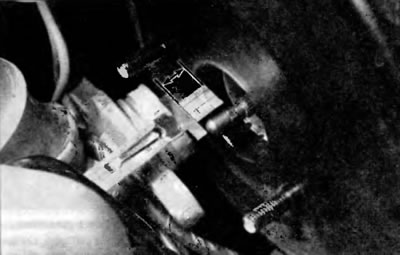
Fig. 9.14, a. Measure how much the piston rod protrudes from the front of the brake booster relative to the surface mating with the master cylinder, including the gasket
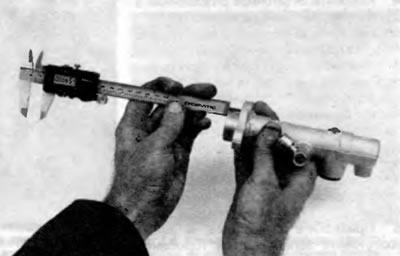
Fig. 9.14, b. Measure the distance from the main cylinder support flange to its end
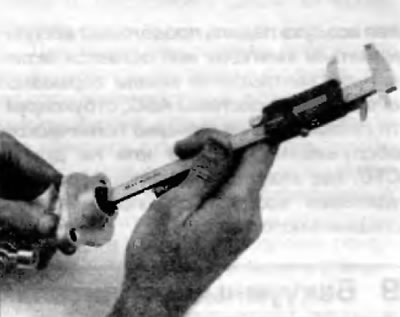
Fig. 9.14, c. Measure the distance from the end of the master cylinder to the bottom of the recess in the piston
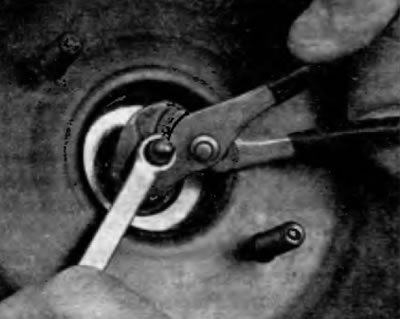
Fig. 9.14, d. To adjust the length of the amplifier rod, grasp the knurled part of the rod with pliers and screw or unscrew the adjustment sheet, achieving the desired setting
15. After final installation of the master cylinder and brake hoses and lines, adjust the brake pedal height and free play and bleed the system. For a description of these procedures, refer to the appropriate sections of this chapter.