



Piston ring joint arrangement
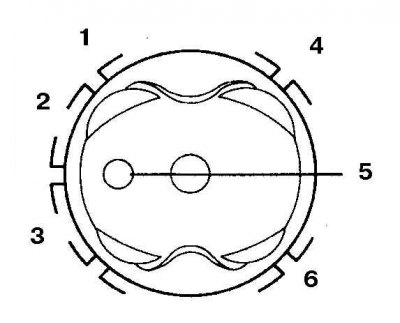
1. Upper compression ring; 2. Oil scraper ring expander; 3. Lower compression ring; 4. Upper disc of oil scraper ring; 5. Notches (facing the front of the engine); 6. Lower disc of oil scraper ring
Before installing the pistons together with the connecting rods, the cylinder surface must be absolutely clean, the edges of the cylinders must be chamfered, and the crankshaft must be installed in the cylinder block.
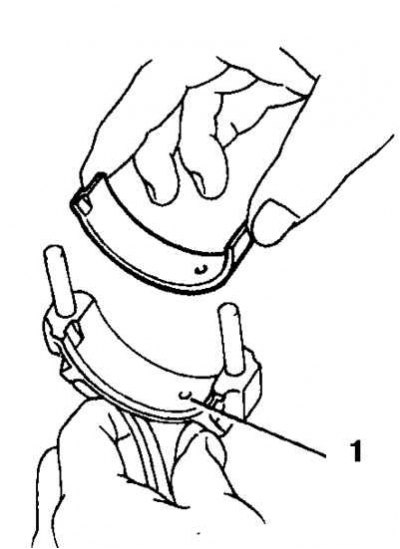
1. Wipe the back surface of the new upper connecting rod bearing and place it in the connecting rod. Make sure that the projection on the bearing fits into the groove in the connecting rod and that the lubrication holes (1) match. Do not lubricate the bearing. Install the lower bearing into the connecting rod cap in the same way.
2. Arrange the piston ring joints according to the diagram.
3. Lubricate the pistons and rings with clean engine oil, compress the rings with a tool, leaving a protruding section of the piston.
4. Turn the crankshaft to BDC in the first cylinder, lubricate the cylinder walls with engine oil.
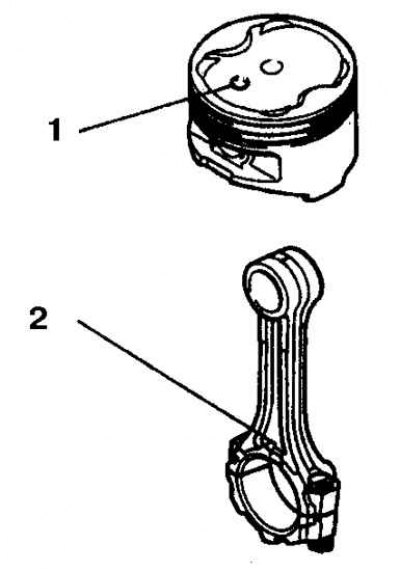
5. Orient the piston so that the recess (1) faces the front of the engine (2 – protrusion).
6. Carefully insert the lower part of the piston with the connecting rod into the first cylinder until the device stops against the cylinder block. Lightly tap the upper edge of the mandrel for uniform contact with the plane of the cylinder block.
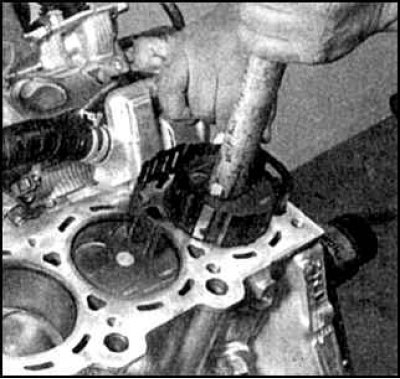
7. Insert the piston into the cylinder by gently tapping the bottom of the piston with the wooden handle of the hammer. Do not apply too much force.
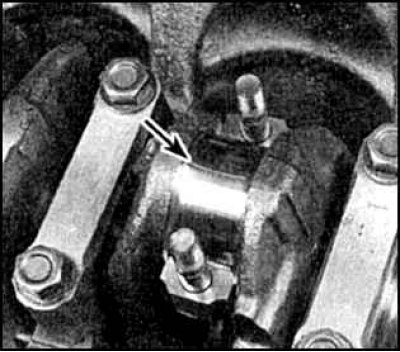
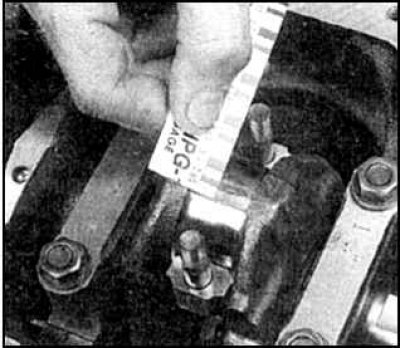
8. Pull the connecting rod to the crankshaft journal and check the clearance in the connecting rod bearing using a piece of gauge (indicated by the arrow). The inspection procedure is no different from the procedure for main bearings (see subsection 3.3.9.3). Rotation of the crankshaft or the slightest contact of oil with the bearings during measurements are not permitted.
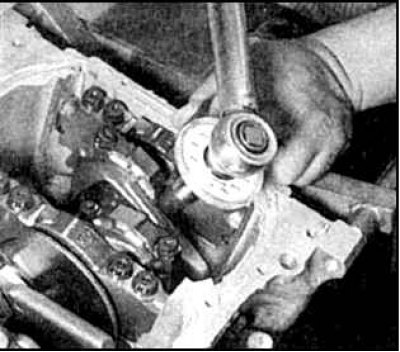
9. Tighten the connecting rod cap nuts to the specified torque.
[The original source is located on the website: toyotaman]
10. Determine the clearance size. If the clearance is not within the norm, make sure there is no grease or dirt and recheck the journal diameter and the correct selection of the liner.
11. Carefully remove the remaining gauge, lubricate the bearings and crankshaft journal, install the cover and tighten the nuts evenly to the specified torque.
12. Repeat these operations for the remaining connecting rods. Check the freedom of rotation of the assembled crankshaft.
13. After final installation of the pistons with connecting rods, check the freedom of rotation of the crankshaft.
14. Check the connecting rod axial play (see subsection 3.3.8). Keep in mind that after installing new parts, the play of the connecting rod may be less than normal and grinding of the connecting rods will be required.
15. Assemble and install the engine following the relevant sections