



Note: Checking and adjusting thermal clearances in valves is carried out on a cold engine.
1. Remove the cylinder head cover in the following sequence:
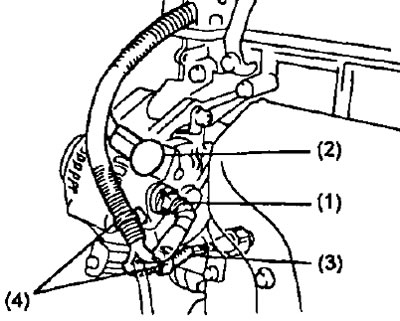
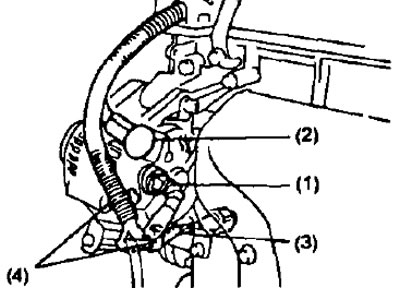
- a) Disconnect: generator connector (1), generator wire (2), oil pressure sensor connector (3), two wire clamps (4).
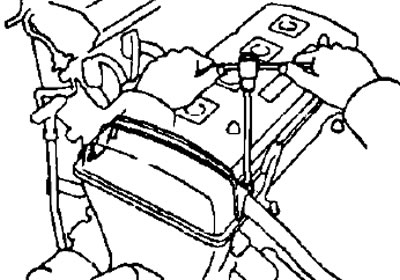
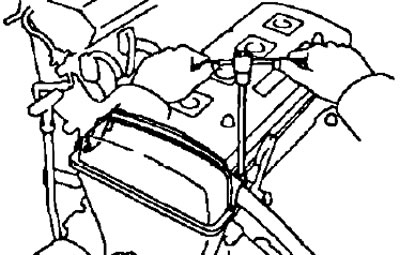
- b) After unscrewing two bolts, remove the protective cover of the engine electrical wiring and disconnect the electrical wiring from the cylinder head cover.
- c) Disconnect the high-tension wires from the spark plugs (see the procedure in the chapter "Ignition system / Checking high voltage wires").
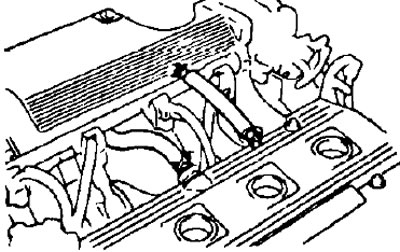
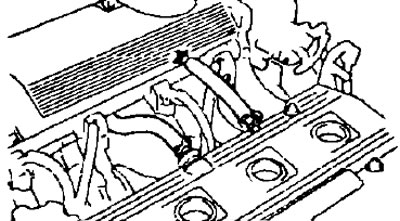
- d) Disconnect the positive crankcase ventilation hoses from the cylinder head cover.
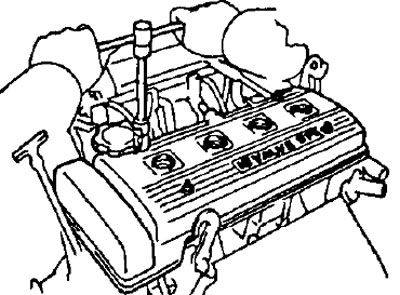
- d) After unscrewing 4 nuts, remove the cylinder head cover together with the gasket.
2. Set the piston of the 1st cylinder to the TDC position in the compression stroke.
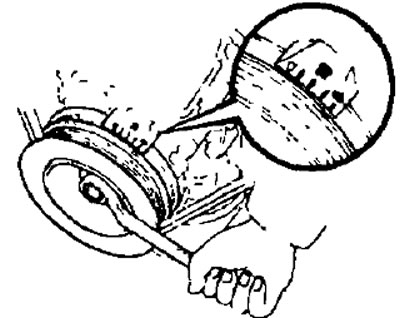
- a) Turn the crankshaft pulley clockwise and align the groove on the pulley with the "0" mark on the No.1 camshaft drive belt cover.
- b) Make sure that the hole on the camshaft drive pulley is aligned with the mark on the bearing cap.
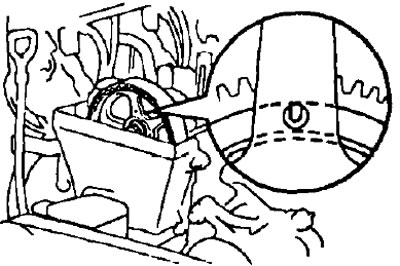
If this condition is not met, then turn the crankshaft clockwise by 1 revolution (360°) and again align the groove on the pulley with the corresponding mark.
3. Check the thermal clearance in the valves marked in the figure:
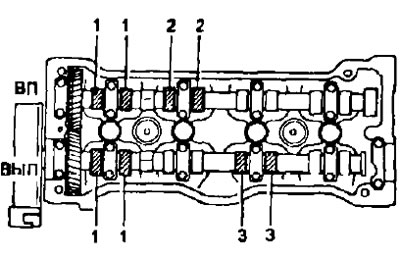
- a) Using a feeler gauge, measure the clearance between the valve tappet and the back of the camshaft cam.
- b) Record the values of the clearance values that are outside the specified limits. These values will be used to select the required size of the adjusting washer.
- Nominal thermal clearance in valves (on a cold engine):
- inlet - 0.15-0.25 mm
- outlet - 0.25-0.35 mm
4. Turn the crankshaft 1 revolution (360°) and again align the groove on the pulley with the corresponding mark as shown in paragraph 2, and check the valve clearances marked in the figure by repeating the procedure in paragraph 3.
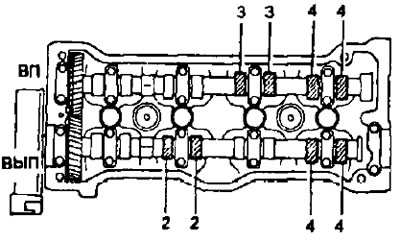
5. Adjust the valve clearance:
Notes:
- In these engines, adjusting the valve clearance requires dismantling the camshafts.
- Since the axial clearance of the camshaft is very small, it should be held horizontally when dismantling the shaft. Otherwise, the seat of the camshaft thrust washer in the cylinder head may be damaged, which may cause the camshaft to seize or break. Similar requirements must be observed when installing camshafts.
- The methods for adjusting the clearance of the intake and exhaust valves differ slightly from each other.
6. 1 Adjust the thermal clearances in the intake valves.
6.1 1. Remove the intake camshaft.
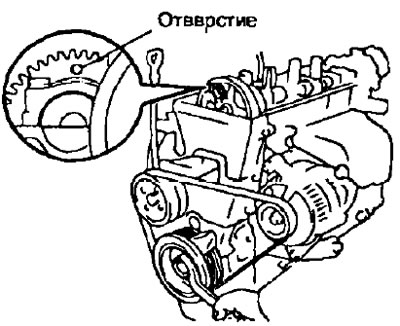
- a) Turn the crankshaft pulley so that the hole in the auxiliary gear (by which the auxiliary gear is installed on the driving gear of the camshaft) ended up on top. This allows the cams of the 1st and 3rd cylinders to press equally on the tappets of the corresponding valves.
- b) Unscrew 2 bolts and remove the cover of the 1st camshaft bearing.
- c) Attach the camshaft auxiliary gear to the mounting bolt.
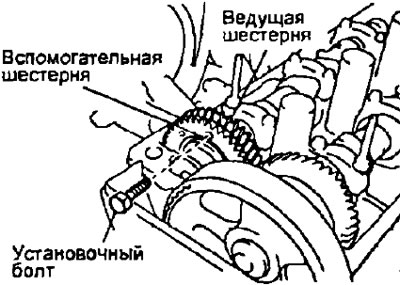
Recommended mounting bolt dimensions:
- diameter - 6 mm,
- thread pitch - 1.0 mm,
- length - 16-20 mm.
Note: When removing the camshaft, make sure that the torsional force transmitted to the auxiliary gear from the spring is removed by the above operation.
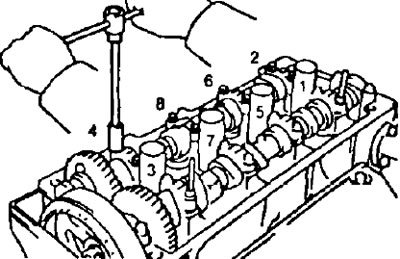
- d) Loosen and remove the 8 camshaft bearing cap bolts evenly in several passes in the sequence shown in the figure. Then remove the bearing caps and camshaft.
Note:
- If the camshaft cannot be removed after performing the above operations, reinstall bearing cap No.3 and tighten it with two bolts.
- Then, sequentially loosen and unscrew the bolts, while simultaneously trying to pull the camshaft by the gear.
- Do not attempt to remove the camshaft by applying great force or using additional levers or tools.
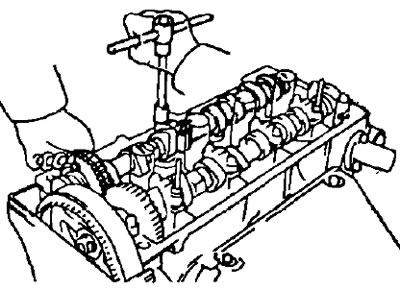
6.1.2 Remove the adjusting washer using a small screwdriver.
6.1.3. Determine the size (thickness) of the adjusting washer to ensure clearance in accordance with the specifications.
- a) Use a micrometer to measure the thickness of the removed adjusting washer.
- b) Using the formula, determine the thickness of the new adjusting washer, which will provide the required thermal clearance in the valves:
- For intake valves: N=T + (A- 0.20) mm
- N - thickness of the new washer
- T thickness removed (worked out) washers
- A - measured clearance in this valve
- c) Select the adjusting washer whose thickness most closely matches the calculated value.
Note: There are 16 sizes of adjusting washers (thickness values) from 2.55 mm to 3.30 mm in 0.05 mm increments
6.1.4. Install a new adjusting washer onto the valve tappet.
6.1.5 Install the intake camshaft.
- a) Turn the crankshaft pulley and set the exhaust camshaft in such a position that its installation pin is above the cylinder head cut-off.
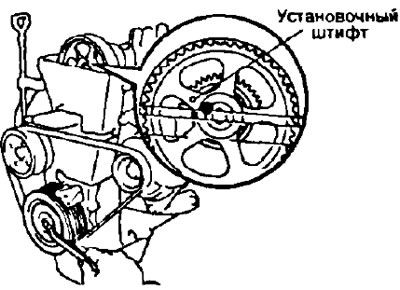
- b) Apply grease to the camshaft thrust surfaces.
- c) Connect the intake camshaft gear with the exhaust camshaft gear, aligning the timing marks on both gears.
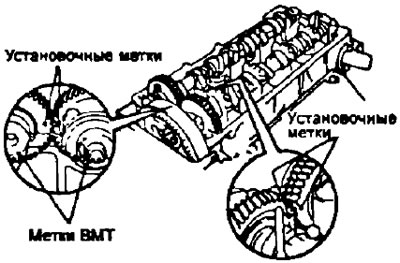
Note: It is necessary to distinguish between timing marks and TDC marks and do not use the latter in this case.
- d) After this, place the camshaft in the bearing bed, maintaining the engagement of the gears.
Note: This position of the camshaft allows the cams of the first and third cylinders to press evenly on the tappets of the corresponding valves.
- d) Install the four camshaft bearing caps.
- e) Apply a thin coat of engine oil to the threads and under the heads of the camshaft bearing cap bolts
- g) Install and tighten the 8 bearing cap bolts evenly in several passes in the sequence shown.
- Tightening torque - 13 Nm
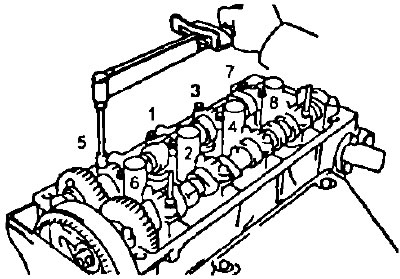
- c) Remove the mounting bolt.
- i) Install the cover of the 1st bearing with the mark ("arrow") facing forward.
Note: If the 1st bearing cap does not fit into place, use a screwdriver to move the camshaft back.
- k) Apply a thin coat of engine oil to the threads and under the heads of the camshaft bearing cap bolts
- l) Install and tighten the 2 front bearing cap bolts evenly in several passes.
- Tightening torque - 13 Nm
6.1.6. Check valve clearances.
6.2. Adjust the thermal clearances in the exhaust valves.
6.2.1. Remove the adjusting washers.
- a) Turn the crankshaft so that the cam lobe of the adjustable valve is oriented upward.
- b) Position the valve lifter recess toward the front of the vehicle.
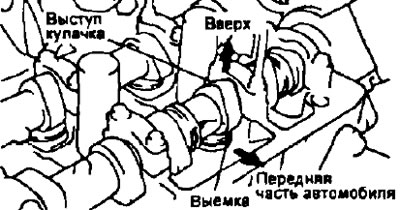
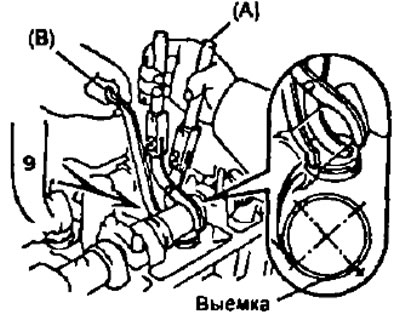
- c) Using tool (A), press the tappet and install tool (B) between the camshaft and the tappet. Then remove tool (A).
Note:
- Insert the tool (B) at a slight angle from the side marked with the number "9" as shown in the figure. The recess should be in the position shown in the figure.
- Do not insert the tool (B) too deeply to avoid pinching the adjusting washer. To prevent jamming, insert the tool smoothly from the intake camshaft side as shown in the figure.
- The cam profile makes it difficult to install the tool (B) under the 3rd cam on the intake side of the camshaft. To replace this adjusting shim, the tool (B) must be installed on the exhaust side.
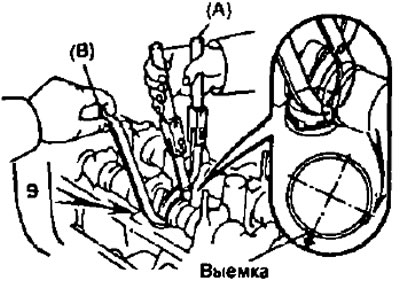
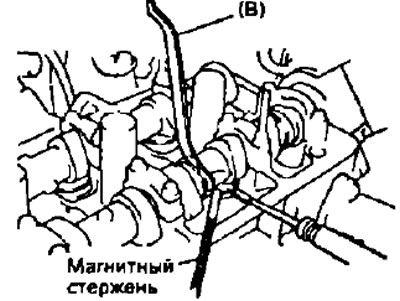
- d) Remove the adjusting washer using a small screwdriver and a magnetic rod.
6.2.2. Determine the size (thickness) of the adjusting washer that provides clearance in accordance with the specifications.
- a) Use a micrometer to measure the thickness of the removed adjusting washer.
- b) Using the formula, determine the thickness of the new adjusting washer that will provide the required thermal clearance in the valves:
- For exhaust valves: N=T + (A-0.30) mm.
- N - thickness of the new washer
- T - thickness of the removed (worked out) washers
- A - measured clearance in this valve.
- c) Select the adjusting washer whose thickness most closely matches the calculated value.
Note: There are 16 sizes of adjusting washers (thickness values) from 2.55 mm to 3.30 mm in 0.05 mm increments.
6.2.3. Install a new adjusting washer.
- a) Install the washer on the valve tappet.
- b) Using tool (A), press on the pusher and remove tool (B).
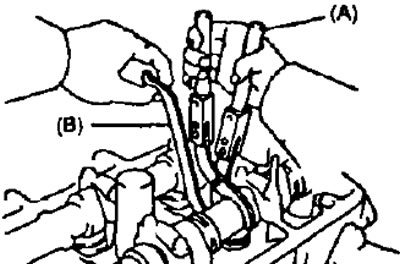
6.2.4. Check the thermal clearance in the valves.
7. Install the cylinder head cover (valve cover)
- a) Remove old sealant.
- b) Apply a layer of fresh sealant in the areas shown in the figure.
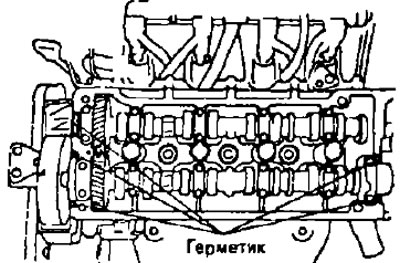
- c) Install the gasket under the cylinder head cover
- d) Install the cylinder head cover, securing it with 4 nuts installed on sealing washers.
- Tightening torque of nuts - 6 Nm
- d) Connect 2 positive crankcase ventilation hoses to the valve cover.
- e) Install the engine wiring harness and its protective cover, securing them with two bolts.
- g) Connect the following wires and clamps: generator connector (1), generator wire (2), oil pressure sensor connector (3), two clamps (4).
8. Connect the high-voltage wires to the spark plugs.