
Company Honda Company Ford Company Skoda Company Kia Company Mazda Company Mercedes Company Renault
English Русский
Български
Беларускі
Український
Српски
Hrvatski
Română
Polski
Slovenský
Magyar
Bookmark Articles Sitemap Contacts
ToyotaMan.ru


Camry Corolla Corona Carina Land Cruiser Highlander 4Runner RAV4 Others
4Runner N120 (1989-1995)

Checking the condition of connecting rods and pistons [Toyota 4Runner N120]

  • Main
  • 4Runner
  • N120 (1989-1995)
  • Power unit
  • Engine overhaul
  • Checking the condition of connecting rods and pistons
0
1. Carefully clean the pistons from carbon deposits and carefully remove the rings.


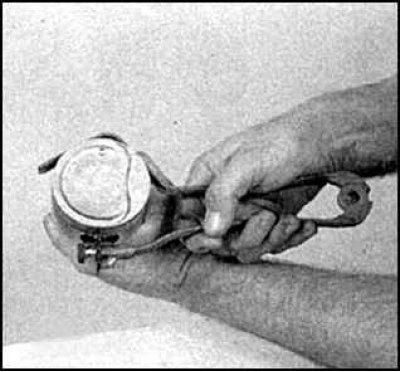
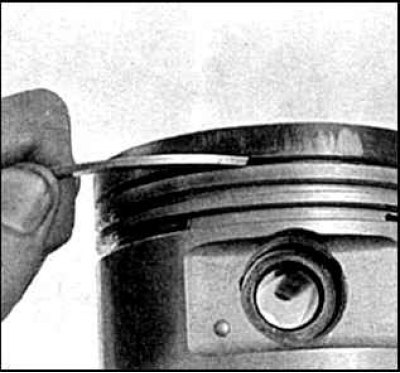
2. Remove carbon deposits from piston ring grooves using a tool (photo on the left) or an old piston ring (photo on the right).

3. Wash the pistons and connecting rods with solvent, thoroughly clean the oil drainage holes in the piston grooves and the hole in the connecting rod.

4. If there are no significant signs of wear and if the cylinders do not require boring, then the pistons should not be replaced. Normal wear is manifested in the form of traces of uniform vertical wear on the piston friction surface and in the form of a slight weakening of the fit of the upper compression ring. However, replacement of piston rings is mandatory.

5. Carefully check for cracks in the piston skirt, piston pin bosses and piston ring seats.

6. If there are chips and scuffs on the piston, this indicates frequent overheating of the engine. In this case, a thorough check of the lubrication and cooling systems is required. Burning of the piston bottom indicates that the engine is running with an incorrect ignition timing setting. The cause of burning of the piston bottom at the edges is usually abnormal combustion (detonation). If the above defects are detected, their cause must be found and eliminated.


7. Piston corrosion in the form of small pits (pitting) indicates penetration into the combustion chamber (and also in the crankshaft housing) coolant.
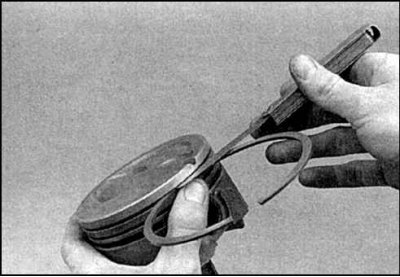


8. Measure the gap between the groove and the new ring. If the gap exceeds the specified limit, the piston should be replaced.

9. Check the clearance between the piston and the cylinder by measuring the cylinder diameter (see subsection 3.3.10) and the piston diameter of a given cylinder.
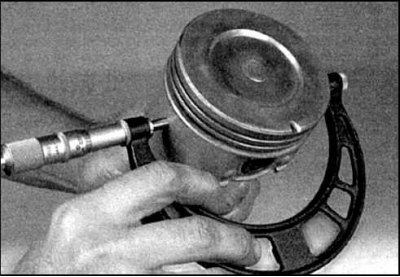


10. The piston diameter is measured perpendicular to the axis of the piston ring directly under the pin. If the gap exceeds the established limit, the cylinder block must be bored, and the pistons and rings must be replaced with repair ones.

10. Check the clearance between the piston pin and the connecting rod head by rocking the piston and connecting rod in opposite directions. If the clearance is noticeable, then this connection needs to be repaired.


11. Checking the connecting rod heads and their deformation, as well as the corresponding repairs, are carried out in a car service.

12. Check the connecting rods for cracks and other damage. Remove the connecting rod bearing caps, take out the bearings, wipe the seating surfaces on the cap and on the connecting rod, check for cracks, scratches and burrs. After checking, assemble the connecting rod, install the bearings in place, tighten the nuts by hand.

The material was taken from a resource: ToyotaMAN.ru

Attention! If the engine is disassembled due to seizure, the connecting rods must be replaced.
This article is available at: russian, bulgarian, belarusian, ukrainian, serbian, croatian, romanian, polish, slovak, hungarian
The article material has been checked: Gribkov Vladimir
Share information:
◀ Previous
4Runner N120: Engine overhaul
Next ▶

Cylinder honing
Cylinder Block — Cleaning and Checking
Installation and checking of clearances in crankshaft main bearings
Checking the condition of the crankshaft
Removal the crankshaft
Installing and checking clearances in connecting rod bearings
Main and connecting rod bearings — inspection and selection
Balance shafts — removal, inspection and installation
Engine assembly procedure
Installing piston rings
Similar articles on other Toyota models

➥ Installing pistons and connecting rods, checking bearing… Toyota Camry XV10 (1991-1996)
➥ Checking pistons and connecting rods Toyota Carina T170 (1988-1992)
➥ Assessment of the technical condition of connecting rods,… Toyota Cruiser 70 (1985-1996, diesel)
➥ Assessment of the technical condition of connecting rods,… Toyota Dyna Y50/Y60 (1984-1995)
➥ Checking the condition of the piston and connecting rod Toyota Corona T190 (1992-1997)
➥ Pistons and connecting rods — removal Toyota Highlander 1 (2000-2007, petrol)
Link in different formats to this article
Comments and feedback from visitors
No comments yet


Add two numbers 17 + 22


4Runner N120 (1989-1995) 
  • General information
  • User manual
  • Maintenance
  • Power unit
  • 4-cylinder engines
  • 6-cylinder engines
  • Engine overhaul
  • Cooling and heating
  • Fuel system
  • Transmission
  • Mechanical gearbox
  • Automatic gearbox
  • Transfer case
  • Clutch
  • Transmission line
  • Chassis, running gear
  • Brake system
  • Car suspension
  • Steering
  • Body and interior
  • Exterior (external elements)
  • Interior (internal elements)
  • Doors, locks and windows
  • Electrical equipment
  • Equipment and devices
  • Ignition system
  • Power devices
  • Electrical circuits
ToyotaMan.ru © 2018–2026 • Mobile version • Interesting about Toyota • Administration • Sitemap: EN BG BY UA RS HR RO PL SK HU • Search system • Bookmark
Camry Vista-V40 • Camry XV10 • Camry XV20 • Camry XV30 • Corolla Verso-AR10 • Corolla E80 • Corona T190 • Carina T170 • Carina T190 • Land Cruiser J70 (diesel) • Land Cruiser J60 (petrol) • Land Cruiser J100 • Highlander XU20 (petrol) • 4Runner N120 • RAV4 XA10 • RAV4 XA20 • Duet M100 • Dyna Y50 •
We require cookies to enable some interactive features. Is that ok with you?