



Correction of deformation surfaces
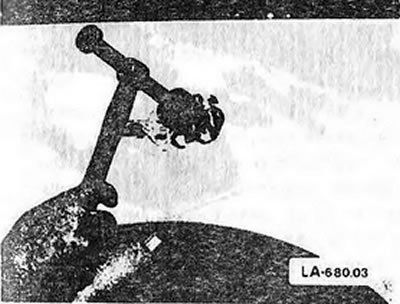
Small dents are straightened with a straightening hammer with a lining on the back of the sheet of a hand anvil. Do not apply strong blows, otherwise the sheet will stretch, which excludes obtaining smooth surfaces. Straightening should be carried out from the edges of the damaged area to the center.
Constantly check the quality of the corrected surface with your hand until you get the desired result. Small irregularities are later corrected with putty.
Carefully remove traces of rust and varnish residue after straightening from the damaged area with coarse sandpaper (grain size 120), glued to a block or a disc of abrasive paper on a cloth polishing wheel. Seal the adjacent body trim panels with adhesive tape for protection.
(The original can be found on this resource: ToyotaMan.ru)
Sand the areas of through rust with a grinding disc. Trim the sharp edges and bend them slightly inward.
Repair of corrosion damage with fiberglass: This method is a temporary repair method, because after some time the damaged area begins to deteriorate again. This method is used to repair only unloaded elements of the body structure. Repair of a pre-primed area is carried out in the following order:
1. Make a temporary lining from wood or thick cardboard and press it from behind to the area damaged by corrosion. The shape of the lining should match the convexity of the area in the body being repaired. Without using a lining, repairs using fiberglass are difficult. The surface of the lining should be covered with a release agent.
2. The fiberglass is applied in three layers. The first layer should only slightly overlap the edges of the hole, and the last layer should overlap the edges by approximately 30 mm.
3. Mix the polyester resin with the hardener according to the instructions, observing the specified ratios of the components. Otherwise, the hardening process occurs either too quickly or too slowly. A plaster cup can be used as a container. Excess resin can lead to the composition drying out already in the container.
4. Install the lining, coat it with polyester resin. After that, apply the first layer of fabric and soak it with a brush.
5. Allow the composition to dry for 24 hours. Remove the lining. Remove excess fiberglass with a file.
6. Finally, apply the paint coating.