
Company Honda Company Ford Company Skoda Company Kia Company Mazda Company Mercedes Company Renault
English Русский
Български
Беларускі
Український
Српски
Hrvatski
Română
Polski
Slovenský
Magyar
Bookmark Articles Sitemap Contacts
ToyotaMan.ru


Camry Corolla Corona Carina Land Cruiser Highlander 4Runner RAV4 Others
Highlander 1 (2000-2007, petrol)

Positive Crankcase Ventilation (PCV) System — Description and Replacement of Elements [Toyota Highlander XU20]

  • Main
  • Highlander
  • XU20 (2000-2007)
  • Power unit
  • Control system
  • Positive Crankcase Ventilation (PCV) System — Description and Replacement of Elements
0
1. Positive crankcase ventilation system (PCV) (fig. 20.1, a-c) reduces hydrocarbon emissions by directing blow-by gases and vapors into the intake manifold where they mix with the intake air before the latter enters the combustion chambers. There, the gases are used together with the air-fuel mixture. The PCV system provides a supply of fresh air from the air cleaner housing through a set of hoses into the engine crankcase, where the fresh air mixes with blow-by gases before the latter are drawn out of the crankcase by the vacuum in the intake system through the PCV valve and on to the intake manifold.


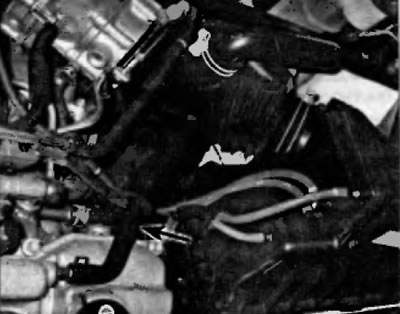
Fig. 20.1, a. On all engines, a fresh air intake hose connects the air intake manifold to a branch pipe on the cylinder head cover through which fresh air is drawn into the engine crankcase (this is a V6 model, but the 4 cylinder models use a similar hose)
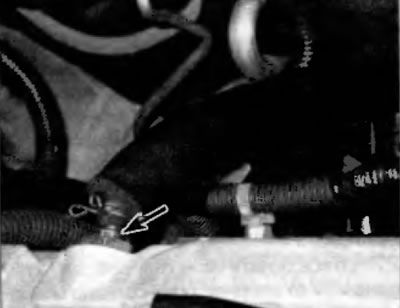


Figure 20.1, b. On four-cylinder engines, the PCV valve is located on the right rear corner of the cylinder head cover, and the crankcase ventilation system hose (PCV hose) connects the PCV valve to the intake manifold on the rear side of the engine
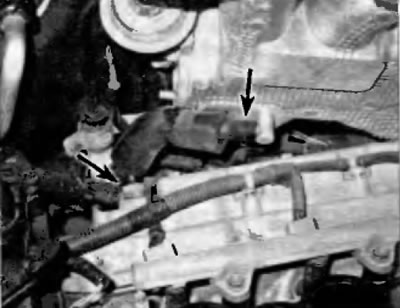


Figure 20.1, B. On V6 engines, the PCV valve is located at the right rear corner of the rear cylinder head cover, and the crankcase ventilation system hose (PCV hose) connects the PCV valve to a branch pipe on the underside of the manifold (In this picture the manifold is disconnected and lifted up so that the connection to the manifold can be seen)


2. When the engine is idling and partially throttled, the vacuum in the intake manifold is high. Crankcase gases and vapors exit the engine crankcase through the PCV valve and the crankcase ventilation hose (also known as PCV hose) into the intake manifold. The strong vacuum in the intake manifold also causes fresh air to be drawn from the intake air duct or air cleaner housing through the fresh air intake hose into the engine crankcase.


3. There are no scheduled service intervals for the PCV valve or PCV hoses. However, over time, the PCV system can become less effective as the amount of oil sludge inside the valve and PCV hoses increases. One sign of a clogged system is leaking seals. When blow-by gases cannot escape, the pressure in the lower area increases, eventually causing the crankshaft seals to leak. Therefore, it is recommended that you disconnect the PCV hoses and inspect them whenever you change the oil filter, air filter, fuel filter, spark plugs, etc. If the hoses are clogged, remove and clean them. If they are cracked, torn, or otherwise damaged, replace them.

4. Checking and replacing the PCV valve is covered in chapter 1.
This article is available at: russian, bulgarian, belarusian, ukrainian, serbian, croatian, romanian, polish, slovak, hungarian
The article material has been checked: Kondratyeva Ulyana
Share information:
◀ Previous
Highlander 1: Control system
Next ▶

Fuel Evaporative Emissions (EVAP) System — Replacement of Elements
Fuel Evaporative Absorption (EVAP) System — Design Description
Catalytic converters — design description, testing and replacement of…
Idle Air Control Valve (IAC) — Replacement
Air Intake Control System — Design Description
 
Similar articles on other Toyota models

➥ Positive Crankcase Ventilation (PCV) system Toyota RAV 4 XA10 (1994-2000)
➥ Crankcase ventilation system Toyota Camry XV20 (1996-2001)
➥ Positive crankcase ventilation Toyota Carina T170 (1988-1992)
➥ Controlled Crankcase Ventilation (PCV) System Toyota Cruiser 100 (1998-2007)
➥ Ventilation system control Toyota Corolla E80 (1983-1990)
➥ Crankcase ventilation valve — inspection and replacement Toyota 4Runner N120 (1989-1995)
Link in different formats to this article
Comments and feedback from visitors
No comments yet


Add two numbers 16 + 18


Highlander 1 (2000-2007, petrol) 
  • General information
  • Introduction to the guide
  • Troubleshooting
  • Maintenance
  • Power unit
  • 4-cylinder engine
  • 6-cylinder engine
  • Overhaul of engines
  • Cooling and heating
  • Supply and exhaust system
  • Engine electrical equipment
  • Control system
  • Transmission
  • Automatic gearbox
  • Drive shafts and cardan
  • Chassis, running gear
  • Brake system
  • Car suspension
  • Steering
  • Body and interior
  • Exterior (external elements)
  • Interior (internal elements)
  • Doors, locks and windows
  • Electrical equipment
  • Equipment and devices
  • Electrical circuits
ToyotaMan.ru © 2018–2026 • Mobile version • Interesting about Toyota • Administration • Sitemap: EN BG BY UA RS HR RO PL SK HU • Search system • Bookmark
Camry Vista-V40 • Camry XV10 • Camry XV20 • Camry XV30 • Corolla Verso-AR10 • Corolla E80 • Corona T190 • Carina T170 • Carina T190 • Land Cruiser J70 (diesel) • Land Cruiser J60 (petrol) • Land Cruiser J100 • Highlander XU20 (petrol) • 4Runner N120 • RAV4 XA10 • RAV4 XA20 • Duet M100 • Dyna Y50 •
We require cookies to enable some interactive features. Is that ok with you?