



Note: The crankshaft can only be removed after the engine has been removed from the vehicle. This assumes that the faceplate, crankshaft pulley, timing belt/chain, oil pan, oil pump, oil filter and piston/connecting rod assemblies have already been removed. On V6 engines, the rear crankshaft oil seal housing must be removed by unscrewing the corresponding bolts before attempting to remove the crankshaft.
Note: V6 engines have main bearing caps that are secured with four bolts each and are provided with side bolts (one on each side), which pass through the cylinder block and are screwed into the installed main bearing caps.
1. Before removing the crankshaft, measure its axial clearance. Install the dial indicator so that its plunger is coaxial with the crankshaft and is in contact with the end of the crankshaft (Fig. 11.1).
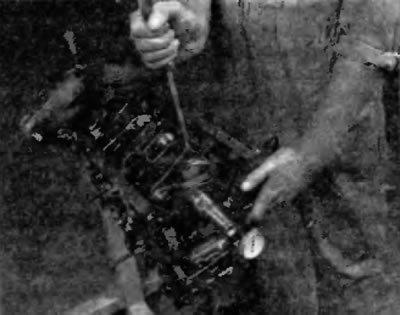
Ryas. 11.1. Checking the axial clearance of the crankshaft using a dial indicator
2. Using a screwdriver, push the crankshaft back as far as it will go and reset the dial indicator to zero. Then push the crankshaft forward as far as it will go and read the dial indicator. The distance the shaft moves is the axial clearance. Typical crankshaft axial clearance is between 0.075 and 0.250 mm. If the clearance exceeds this value, inspect the crankshaft thrust surfaces for wear after removing the crankshaft. If no wear is detected, installing new main bearings should correct the clearance.
3. If there is no dial indicator, feeler gauges can be used. Carefully press the crankshaft until it stops towards the front end of the engine. To determine the clearance, insert a feeler gauge between the crankshaft and the front side of the thrust bearing or washer (Fig. 11.3). Select the thickness of the feeler gauge so that it enters with a tight sliding fit.
The article was copied from the portal www.toyotaman.ru
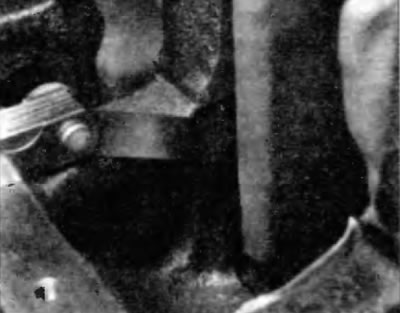
Fig. 11.3. Checking the axial clearance of the crankshaft using a feeler gauge in the journal of the thrust bearing
4. Loosen the main bearing cap bolts, loosening each one ¼ turn at a time until they can be unscrewed by hand (fig. 11.19, a). On V6 engines, first remove the side bolts (in the prescribed sequence) (fig. 11.19, in), and then the inner bolts (fig. 11.19, b).
5. Gently tap the main bearing caps with a soft-faced hammer. Pull the main bearing cap straight up and off the cylinder block. Be careful not to drop the bearing shells if they are removed with the cap.
6. Carefully remove the crankshaft from the engine. It is recommended to involve an assistant for this, as the crankshaft is quite heavy and bulky. Having positioned the bearing shells in their regular places in the cylinder block and in the main bearing caps, install the main bearing caps on the cylinder block and tighten the bolts by hand. The main bearing caps should be installed so that the arrow faces the front of the engine.