



- switches large currents remotely from the circuit in which that current flows, allowing the use of thinner wires and switch contacts in the main circuit;
- unlike a mechanical switch, which has one control input, it can perform switching on several control inputs;
- timer and thus sets the interval for the windshield wipers to operate.
If the electrical circuit controlled by the relay fails and the relay is likely the cause of the fault, listen for the relay to operate with the system on. If the relay is working properly, you should hear a click when it is turned on. If the relay is working properly, then the cause of the malfunction lies in the elements or connecting wires. If the relay does not work, it means that it is not receiving main power or control pulse, or the relay itself is faulty.
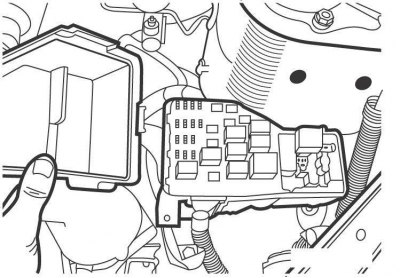
Figure 15.8. Location of the fuse and relay box in the engine compartment on models from 2001
Most relays are located in the fuse and relay box in the engine compartment (see Figure 5.8).
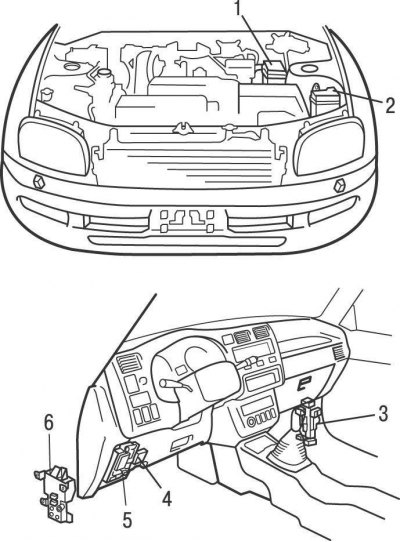
Figure 15.10. Location of specialized relays in models before 2001: 1 – relay block No. 2; 2 – relay block No. 6; 3 – connection block No. 4; 4 – fuse box; 5 – connection block No. 1; 6 – relay block No. 6
Some specialized relays are located separately or in separate blocks under the instrument panel and in the engine compartment (figure 15.10).
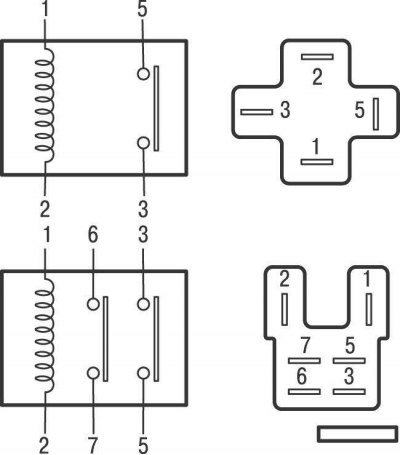
Figure 15.11. Relay with permanently open contacts: A - when voltage is applied to the relay coil (1 and 2), relay contacts 3 and 5 close; B - when voltage is applied to the relay coil (1 and 2), actuator contacts 3 and 5, and 6 and 7 close in pairs
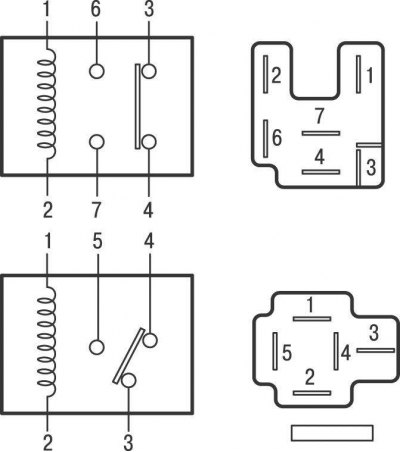
Figure 15.12. Relay with changeover contacts: A - when voltage is applied to the relay coil (1 and 2), relay contacts 3 and 4 open, and contacts 6 and 7 close
There are four types of relays used in cars: those with permanently closed or open contacts and changeover contacts (figure 15.11, 15.12). Some relay housings have an electrical diagram of the relay with contact numbers.
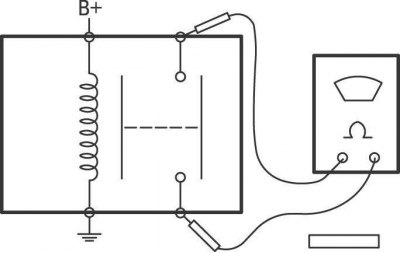
Figure 15.13. Relay test circuit with permanently open contacts
To check the relay, connect an ohmmeter to its contacts; the ohmmeter should show an open circuit (figure 15.13). Then, with one additional wire, connect the relay coil contact to ground, and with the second additional wire, connect the second contact of the relay coil to the positive terminal of the battery. The relay should turn on (click) and the ohmmeter should show a short circuit (resistance 0 Ohm). Otherwise, the relay is faulty and must be replaced.