Company Honda Company Ford Company Skoda Company Kia Company Mazda Company Mercedes Company Renault
English Русский
Български
Беларускі
Український
Српски
Hrvatski
Română
Polski
Slovenský
Magyar
Bookmark Articles Sitemap Contacts
ToyotaMan.ru


Camry Corolla Corona Carina Land Cruiser Highlander 4Runner RAV4 Others
Duet (1998-2004) Dyna Y50/Y60 (1984-1995)

Heater and air conditioner control [Toyota Duet M100]

  • Main
  • Toyota
  • Duet (1998-2004)
  • General information
  • User manual
  • Heater and air conditioner control
0
The operation of the air conditioner and heater is controlled from the control panel.

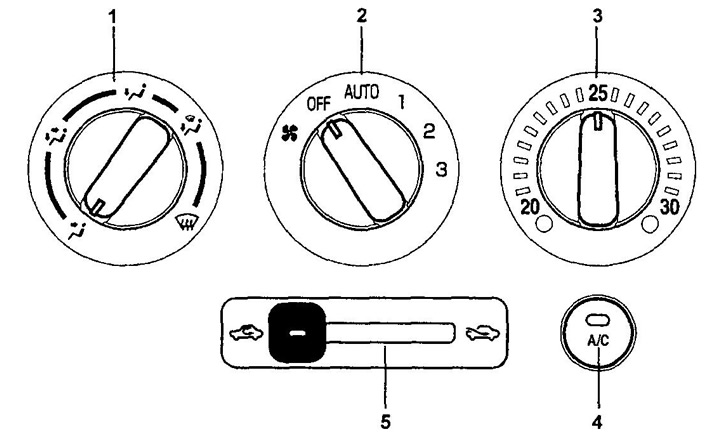
1. To turn on the heater, move the heater fan speed switch (2) from the "OFF" position to any other. To turn on the air conditioner, press the "A/C" air conditioner switch (4). When the air conditioner is turned on, the indicator on the switch lights up.

Attention: blinking of the indicator during operation of the air conditioning system means that the system is not working properly, and the air conditioner will automatically turn off.


Heater and air conditioner control panel (type 1).
1 - air flow direction switch,
2 - heater fan speed switch,
3 - air flow temperature regulator,
4 - air conditioner switch,
5 - air intake adjustment switch (ventilation/recirculation).
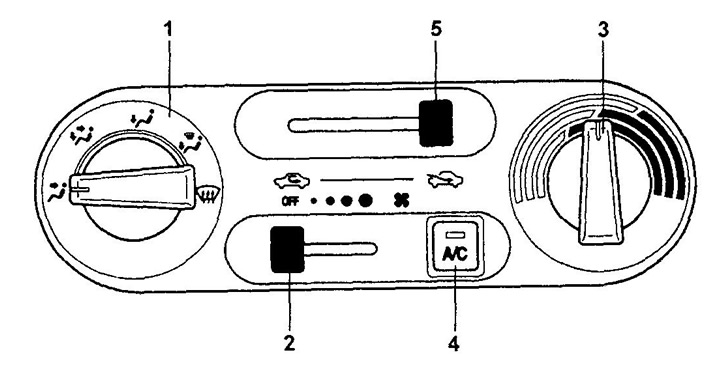


Heater and air conditioner control panel (type 2).
1 - air flow direction switch,
2 - heater fan speed switch,
3 - air flow temperature regulator,
4 - air conditioner switch,
5 - air intake adjustment switch (ventilation/recirculation).


If the air conditioning mode was on before the last shutdown, then when you move the heater fan speed switch (2) from the "OFF" position, the air conditioning mode will immediately start working. When you press the "A/C" switch (4) again, the air conditioning mode will turn off and the heater will work. The heater works if the air conditioning mode is off.


2. The air flow direction switch (1) is designed to change the air flow direction.

To switch the blowing mode, move the switch to the required position.

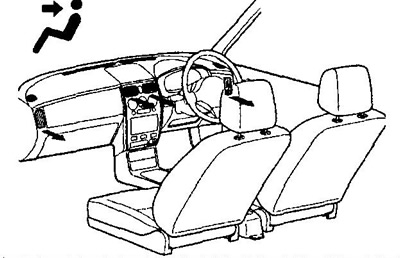
In this position, the air flow is directed towards the head area.


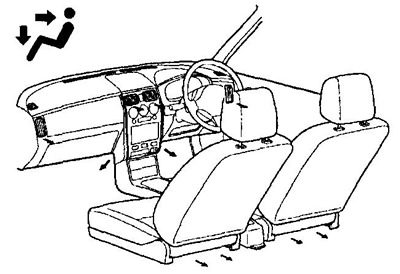
In this position, the air flow is directed towards the head and floor area at the same time.

The official source is on the portal: www.ToyotaMAN.ru


In this position, the air flow is directed entirely towards the floor.


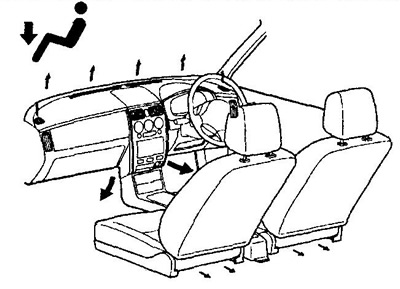
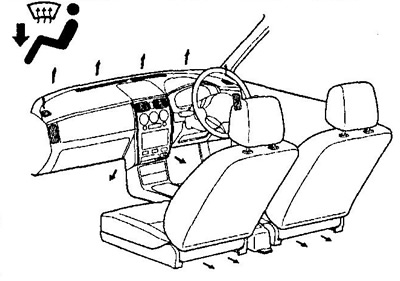
In this position, the air flow is directed to the windshield, front door windows, outside mirror area and floor.


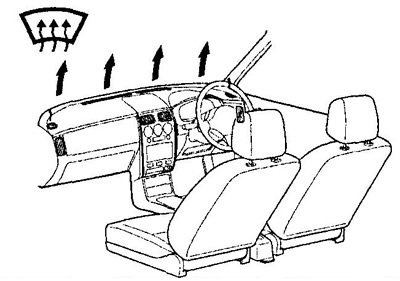
In this position, the air flow is directed towards the windshield and is used in case of fogging of the windshield.


3. Air intake adjustment switch (ventilation/recirculation) (5) allows air to be taken either from outside the vehicle or from the passenger compartment.

Note: If the recirculation mode is used for a long period of time, the windows may fog up.


4. The air flow force is controlled by the switch (2).

5. The temperature regulator (3) is used to set the air temperature in the car interior within the range from 18° to 32=C.

6. If the windshield fogs up, move the air flow direction switch (1) to the extreme right position. In this case, the air will only blow onto the windshield.
This article is available at: russian, bulgarian, belarusian, ukrainian, serbian, croatian, romanian, polish, slovak, hungarian
The article material has been checked: Kolokoltsev Grigory
Share information:
◀ Previous
Duet: User manual
Next ▶

Precautions when operating vehicles equipped with the SRS system
Seat belts
Seats — General Information
Mirror control
Rear door glass defroster switch
Radio tape recorder — main points of operation
Anti-lock braking system (ABS)
Electronic Brakeforce Distribution (EBD)
Traction Control System (TCS)
Vehicle Stability Control (VSC)
Similar articles on other Toyota models

➥ Heater and Air Conditioner Control Panel Toyota Camry XV20 (1996-2001)
➥ Heater and air conditioner control Toyota Carina T190 (1992-1996)
➥ Removal and installation the heater and air conditioner… Toyota Cruiser 100 (1998-2007)
➥ Heater and air conditioner control unit — removal and… Toyota Highlander 1 (2000-2007, petrol)
➥ Heater/Air Conditioner Control Unit — Removal,… Toyota RAV 4 XA20 (2000-2005)
➥ Removal, installation and adjustment of heater control rods Toyota Corolla E80 (1983-1990)
Link in different formats to this article
Comments and feedback from visitors
No comments yet


Add two numbers 43 + 40


Duet (1998-2004) 
  • General information
  • User manual
  • Maintenance
  • Power unit
  • Petrol engines 1.0 l
  • Petrol engines 1.3 l
  • Engine overhaul
  • Cooling system
  • Lubrication system
  • Fuel injection system
  • Starting and charging system
  • Transmission
  • Clutch
  • Mechanical gearbox
  • Automatic gearbox
  • Drive shafts and cardan
  • Chassis, running gear
  • Car suspension
  • Steering
  • Brake system
  • Body and interior
  • Body elements
  • Heating and air conditioning
  • SRS security system
  • Electrical equipment
  • Equipment and devices
  • Electrical circuits
Dyna Y50/Y60 (1984-1995) 
  • Petrol engines «Y»
  • Checks and adjustments
  • Overhaul engine
  • Cooling and lubrication system
  • Fuel system
  • Starting and charging system
  • Ignition system
  • Diesel engines «L»
  • Engine repair
  • Cooling and lubrication system
  • Fuel system
  • Starting and charging system
  • Transmission
  • Clutch
  • Manual gearbox
  • Cardan shaft
  • Chassis, running gear
  • Car suspension
  • Brake system
  • Steering
  • Electrical equipment and body
  • Body elements
  • Equipment and devices
  • Electrical diagrams
ToyotaMan.ru © 2018–2026 • Mobile version • Interesting about Toyota • Administration • Sitemap: EN BG BY UA RS HR RO PL SK HU • Search system • Bookmark
Camry Vista-V40 • Camry XV10 • Camry XV20 • Camry XV30 • Corolla Verso-AR10 • Corolla E80 • Corona T190 • Carina T170 • Carina T190 • Land Cruiser J70 (diesel) • Land Cruiser J60 (petrol) • Land Cruiser J100 • Highlander XU20 (petrol) • 4Runner N120 • RAV4 XA10 • RAV4 XA20 • Duet M100 • Dyna Y50 •
We require cookies to enable some interactive features. Is that ok with you?