



- Nominal voltage - 10-14 V
2. Check the ABS indicator.
a) Turn on the ignition.
b) Make sure the indicator lights up for three seconds. If not, repair or replace (if necessary) fuse, indicator lamp and wiring harness.
3. Read the fault code.
a) Turn on the ignition.
b) Short-circuit the T terminalswith and E ₁ diagnostic connector.
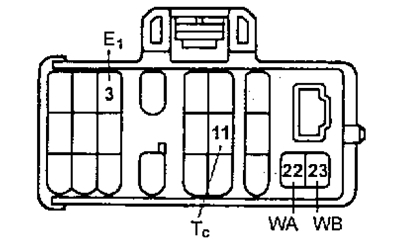
c) Make sure that the jumper on the "WA" and "WB" terminals of the diagnostic connector is removed.
Note: On some models, the ABS system will only be diagnosed with the jumper installed.
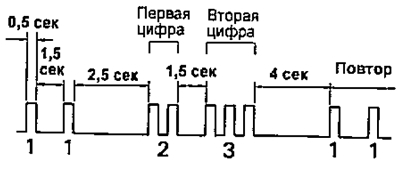
d) If there is a malfunction, the indicator will start flashing after 4 seconds. Count the number of flashes.
Note:
- - The fault code consists of two digits, the first digit is determined by the initial series of flashes, then after a pause of 1.5 seconds, a second series of flashes follows, which corresponds to the second digit of the code.
- - If there are two or more fault codes, the lowest code will be displayed first, followed by the remaining codes in ascending order. There will be a 2.5 second pause between codes.
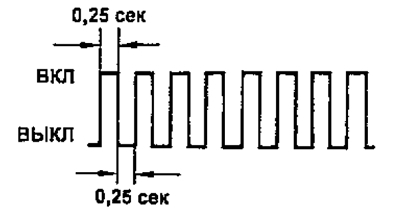
d) If there is no fault, the indicator will flash at 0.5 second intervals.
e) After troubleshooting, erase the codes stored in the electronic control unit.
Note: If the battery is disconnected, all fault codes stored in the electronic control unit will be erased.
g) Disconnect the terminals Twith and E ₁ diagnostic connector.
c) Install a jumper across terminals "WA" and "WB".
i) Turn on the ignition and make sure that the ABS indicator comes on for three seconds and goes out.