



Share information:
Electrical equipment of the car engine Toyota Carina 6 (T190)

Precautions when working with the ignition system
1. Do not leave the ignition on for more than 10 minutes when the engine is not running. 2. When connecting the tachometer to the ignition system, connect the tachometer live lead to the IG (-) terminal of the ignition...
1. Do not leave the ignition on for more than 10 minutes when the engine is not running. 2. When connecting the tachometer to the ignition system, connect the tachometer live lead to the IG (-) terminal of the ignition...

Checking the ignition coil
Note: The terms "cold" and "hot" state refer to the temperature of the windings: "cold" - from -10°C to +50°C "hot" - from +50°C to +100°C These definitions are further retained also in relation to inductive coils of...
Note: The terms "cold" and "hot" state refer to the temperature of the windings: "cold" - from -10°C to +50°C "hot" - from +50°C to +100°C These definitions are further retained also in relation to inductive coils of...

Checking the ignition system distributor
Disconnect the distributor connector, remove the distributor cap and the spark distributor rotor. 1. Using a feeler gauge, check the air gap between the teeth of the angular pulse sensor rotor and the protrusion of the...
Disconnect the distributor connector, remove the distributor cap and the spark distributor rotor. 1. Using a feeler gauge, check the air gap between the teeth of the angular pulse sensor rotor and the protrusion of the...

Integrated ignition unit — device
1 - wire fastening bracket, 2 - capacitor, 3 - gasket of the cover of the combined ignition unit, 4 - switch, 5 - housing of the combined ignition unit, 6 - cover of the combined ignition unit, 7 - distributor rotor, 8...
1 - wire fastening bracket, 2 - capacitor, 3 - gasket of the cover of the combined ignition unit, 4 - switch, 5 - housing of the combined ignition unit, 6 - cover of the combined ignition unit, 7 - distributor rotor, 8...

Combined Ignition Unit — Removal
The combined ignition unit was installed on engines 4A-FE (since 08.1994), 5A-FE, 7A-FE, 3S-FE. 1. Remove the cable from the negative terminal of the battery. 2. Disconnect the high-voltage wires from the cover. a) Use...
The combined ignition unit was installed on engines 4A-FE (since 08.1994), 5A-FE, 7A-FE, 3S-FE. 1. Remove the cable from the negative terminal of the battery. 2. Disconnect the high-voltage wires from the cover. a) Use...

Integrated ignition unit — disassembly
The combined ignition unit was installed on engines 4A-FE (since 08.1994), 5A-FE, 7A-FE, 3S-FE. 4A-FE, 5A-FE, 7A-FE 1. Remove the cover with the gasket by unscrewing 3 bolts. 2. Remove the ignition distributor rotor. 3....
The combined ignition unit was installed on engines 4A-FE (since 08.1994), 5A-FE, 7A-FE, 3S-FE. 4A-FE, 5A-FE, 7A-FE 1. Remove the cover with the gasket by unscrewing 3 bolts. 2. Remove the ignition distributor rotor. 3....

Integrated Ignition Unit — Assembly
The combined ignition unit was installed on engines 4A-FE (since 08.1994), 5A-FE, 7A-FE, 3S-FE. 4A-FE, 5A-FE, 7A-FE 1. Install the capacitor. 2. Install the distributor wire and wire holder. 3. (Besides Lean Burn)...
The combined ignition unit was installed on engines 4A-FE (since 08.1994), 5A-FE, 7A-FE, 3S-FE. 4A-FE, 5A-FE, 7A-FE 1. Install the capacitor. 2. Install the distributor wire and wire holder. 3. (Besides Lean Burn)...

Integrated Ignition Unit — Installation
The combined ignition unit was installed on engines 4A-FE (since 08.1994), 5A-FE, 7A-FE, 3S-FE. 1. Set the piston of the first cylinder to TDC (see section " Timing belt " chapters devoted to the relevant engine). 2....
The combined ignition unit was installed on engines 4A-FE (since 08.1994), 5A-FE, 7A-FE, 3S-FE. 1. Set the piston of the first cylinder to TDC (see section " Timing belt " chapters devoted to the relevant engine). 2....
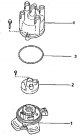
Ignition system distributor device
The distributor was installed on 4A-FE engines (until 08.1994) and 4S-PE. 1 - distributor housing assembly, 2 - distributor rotor, 3 - O-ring seal for distributor cover, 4 - distributor cap.
The distributor was installed on 4A-FE engines (until 08.1994) and 4S-PE. 1 - distributor housing assembly, 2 - distributor rotor, 3 - O-ring seal for distributor cover, 4 - distributor cap.

Ignition system distributor — disassembly and assembly
The distributor was installed on 4A-FE engines (until 08.1994) and 4S-PE. Disassembly 1. Remove the distributor cap and gasket by unscrewing the 3 bolts. 2. Remove the ignition distributor rotor. Examination Rotate the...
The distributor was installed on 4A-FE engines (until 08.1994) and 4S-PE. Disassembly 1. Remove the distributor cap and gasket by unscrewing the 3 bolts. 2. Remove the ignition distributor rotor. Examination Rotate the...

Ignition system distributor — removal and installation
The distributor was installed on 4A-FE engines (until 08.1994) and 4S-PE. Removal 1. Disconnect the cable from the negative terminal of the battery. 2. Disconnect the high voltage wires from the distributor cap. 3....
The distributor was installed on 4A-FE engines (until 08.1994) and 4S-PE. Removal 1. Disconnect the cable from the negative terminal of the battery. 2. Disconnect the high voltage wires from the distributor cap. 3....

Starter — General Information
On Carina cars (produced in 1992-96.) the following types of starters were installed: 0.8 kW (with planetary gear) (a series engines), 1.2 kW (a-series and S-series engines), 1.4 kW (engine 2C), 2.2 kW (engine 2C).
On Carina cars (produced in 1992-96.) the following types of starters were installed: 0.8 kW (with planetary gear) (a series engines), 1.2 kW (a-series and S-series engines), 1.4 kW (engine 2C), 2.2 kW (engine 2C).
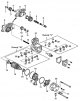
Starter device
Starter with a conventional gearbox 1.2; 1.4 kW 1 - retaining ring, 2 - limiting sleeve, 3 - drive gear, 4 - spring, 5 - spring holder, 6 - drive side cover, 7 - overrunning clutch, 8 - coupling shaft, 9 - cover...
Starter with a conventional gearbox 1.2; 1.4 kW 1 - retaining ring, 2 - limiting sleeve, 3 - drive gear, 4 - spring, 5 - spring holder, 6 - drive side cover, 7 - overrunning clutch, 8 - coupling shaft, 9 - cover...

Disassembly and assembly of a starter with a conventional gearbox
Note: Use high temperature grease to lubricate the bearings and gears when assembling the starter. Remove the dust cover. Remove the starter housing assembly with the starter winding and the anchor from the traction...
Note: Use high temperature grease to lubricate the bearings and gears when assembling the starter. Remove the dust cover. Remove the starter housing assembly with the starter winding and the anchor from the traction...

Disassembly and assembly of the starter (with planetary gear)
Disassembly 1. Remove the traction relay. a) Unscrew the nut and disconnect the wiring harness from the traction relay terminal. b) Loosen the 2 nuts securing the traction relay to the starter cover on the gear side and...
Disassembly 1. Remove the traction relay. a) Unscrew the nut and disconnect the wiring harness from the traction relay terminal. b) Loosen the 2 nuts securing the traction relay to the starter cover on the gear side and...

Replacing the traction relay terminals
1. Remove the three bolts and remove the wiring clamp, back cover, gasket and plunger. 2. Check the wear of the contact plate. Use a caliper to measure the wear of the plate. Maximum wear limit: 0.9 mm If wear exceeds...
1. Remove the three bolts and remove the wiring clamp, back cover, gasket and plunger. 2. Check the wear of the contact plate. Use a caliper to measure the wear of the plate. Maximum wear limit: 0.9 mm If wear exceeds...

Checking the starter anchor
1. Using an ohmmeter, check for conductivity between the collector lamellas. If not, replace the anchor. 2. Check if the armature winding is shorted to ground. Using an ohmmeter, check for conductivity between the...
1. Using an ohmmeter, check for conductivity between the collector lamellas. If not, replace the anchor. 2. Check if the armature winding is shorted to ground. Using an ohmmeter, check for conductivity between the...

Checking the starter manifold
1. Inspect the working surfaces of the collector lamellas; if they are dirty or burnt, clean the working surfaces with #400 sandpaper or turn the collector on a lathe. 2. Mount the anchor on the prisms and measure the...
1. Inspect the working surfaces of the collector lamellas; if they are dirty or burnt, clean the working surfaces with #400 sandpaper or turn the collector on a lathe. 2. Mount the anchor on the prisms and measure the...

Checking the starter stator
1. Using an ohmmeter, check for continuity between the wire terminal and the brush wire as shown in the figure. Otherwise, replace the starter housing assembly with the stator winding. Except for the 2.2 kW starter...
1. Using an ohmmeter, check for continuity between the wire terminal and the brush wire as shown in the figure. Otherwise, replace the starter housing assembly with the stator winding. Except for the 2.2 kW starter...

Disassembly and assembly of the traction relay
1 - bolt, 2 - contact plate, 3 - output isolator, 4 - nut, 5 - wave washer, 6 - output isolator, 7 - O-ring seal, 8 - plunger, 9 - gasket, 10 - lid, 11 - wiring clamp, 12 - terminal, 13 - O-ring seal, 14 - seal, 15 -...
1 - bolt, 2 - contact plate, 3 - output isolator, 4 - nut, 5 - wave washer, 6 - output isolator, 7 - O-ring seal, 8 - plunger, 9 - gasket, 10 - lid, 11 - wiring clamp, 12 - terminal, 13 - O-ring seal, 14 - seal, 15 -...
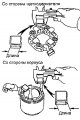
Checking the brushes, brush holder and starter brush springs
Checking the brushes Use a caliper to measure the height of the brushes. Nominal brush height: starter 0.8 kW - 14.0 mm starter 1.2 kW - 15.5 mm starter 1.4 kW - 15.0 mm starter 2.2 kW - 16.5 mm Minimum allowable brush...
Checking the brushes Use a caliper to measure the height of the brushes. Nominal brush height: starter 0.8 kW - 14.0 mm starter 1.2 kW - 15.5 mm starter 1.4 kW - 15.0 mm starter 2.2 kW - 16.5 mm Minimum allowable brush...

Checking the overrunning clutch and starter gears
1. Inspect the working surfaces of the satellite teeth, epicycle and overrunning clutch gear for excessive wear or chips. If there is wear or damage, replace the gears. If there are any scoring or chips on the surfaces...
1. Inspect the working surfaces of the satellite teeth, epicycle and overrunning clutch gear for excessive wear or chips. If there is wear or damage, replace the gears. If there are any scoring or chips on the surfaces...

Checking the starter bearings
1. Check the front bearing. Rotate each bearing by hand while simultaneously applying axial force towards the center of the anchor. If excessive resistance is felt when rotating the bearing or if the bearing binds,...
1. Check the front bearing. Rotate each bearing by hand while simultaneously applying axial force towards the center of the anchor. If excessive resistance is felt when rotating the bearing or if the bearing binds,...

Checking the starter traction relay
1. Checking the pull-in winding of the traction relay. Using an ohmmeter, check for continuity between the starter terminals "50" and "C". Otherwise, replace the traction relay. Except for the 2.2 kW starter Starter 2.2...
1. Checking the pull-in winding of the traction relay. Using an ohmmeter, check for continuity between the starter terminals "50" and "C". Otherwise, replace the traction relay. Except for the 2.2 kW starter Starter 2.2...

Checking the carrier and bearings (starter with planetary gearbox)
1. Check the planet carrier and bearings. a) Using a micrometer, measure the outside diameter of the carrier seating surface for the bearing. Nominal diameter - 14.035-15.000 mm b) Measure the inner diameter of the...
1. Check the planet carrier and bearings. a) Using a micrometer, measure the outside diameter of the carrier seating surface for the bearing. Nominal diameter - 14.035-15.000 mm b) Measure the inner diameter of the...

Checking the starter operation
Note: Please perform this test for 3-5s to avoid damaging the stator winding. 1. Checking the pull-in winding of the traction relay. a) Disconnect the winding wire from the starter terminal "C". b) Connect the wires...
Note: Please perform this test for 3-5s to avoid damaging the stator winding. 1. Checking the pull-in winding of the traction relay. a) Disconnect the winding wire from the starter terminal "C". b) Connect the wires...

Start assist system (2C) — check on the vehicle
Note: If the test is repeated, turn off the ignition for more than 1 minute. 1. Check the time the control lamp burns after the ignition is turned on (ignition key in the "ON" position). Compare the data with the graph....
Note: If the test is repeated, turn off the ignition for more than 1 minute. 1. Check the time the control lamp burns after the ignition is turned on (ignition key in the "ON" position). Compare the data with the graph....

Glow plugs
Removal glow plugs Note: - When checking the glow plug resistance, the glow plug connector must be disconnected. - Be careful not to drop the glow plugs, otherwise they cannot be used. 1. Disconnect the vacuum tubes....
Removal glow plugs Note: - When checking the glow plug resistance, the glow plug connector must be disconnected. - Be careful not to drop the glow plugs, otherwise they cannot be used. 1. Disconnect the vacuum tubes....

Glow Plug Main Relay
1. Check the glow plug relay. a) Using an ohmmeter, check the resistance between the terminals. Nominal resistance between terminals (at 20°C): "g" and "e" - 6.9-7.5 Ohm "+B" and "G" - infinity b) Apply battery voltage...
1. Check the glow plug relay. a) Using an ohmmeter, check the resistance between the terminals. Nominal resistance between terminals (at 20°C): "g" and "e" - 6.9-7.5 Ohm "+B" and "G" - infinity b) Apply battery voltage...

Additional glow plug relay
1. Check the glow plug relay. a) Using an ohmmeter, check the resistance between the terminals. Nominal resistance between terminals (at 20°C): "g" and "e" - 52.2-80.0 Ohm "+B" and "G" - infinity b) Apply battery...
1. Check the glow plug relay. a) Using an ohmmeter, check the resistance between the terminals. Nominal resistance between terminals (at 20°C): "g" and "e" - 52.2-80.0 Ohm "+B" and "G" - infinity b) Apply battery...
Precautions when working with the charging system
1. Make sure the battery cables are connected to the correct terminals. 2. When fast charging the battery, disconnect the wires from its terminals. 3. When measuring, do not use a high voltage tester with large input...
1. Make sure the battery cables are connected to the correct terminals. 2. When fast charging the battery, disconnect the wires from its terminals. 3. When measuring, do not use a high voltage tester with large input...

Generator device
1 - pulley, 2 - generator cover on the drive side, 3 - bearing holder, 4 - bearing cover, 5 - washer, 6 - front bearing, 7 - rotor, 8 - bearing cover, 9 - rear bearing, 10 - rectifier block housing, 11 - terminal, 12 -...
1 - pulley, 2 - generator cover on the drive side, 3 - bearing holder, 4 - bearing cover, 5 - washer, 6 - front bearing, 7 - rotor, 8 - bearing cover, 9 - rear bearing, 10 - rectifier block housing, 11 - terminal, 12 -...

Charging system — on-car checks
1. Check the density and level of electrolyte in each section of the battery. a) Check the specific gravity of the electrolyte in a fully charged battery at 20°C. Density - 1.25-1.27 kg/dm³ If the density is lower,...
1. Check the density and level of electrolyte in each section of the battery. a) Check the specific gravity of the electrolyte in a fully charged battery at 20°C. Density - 1.25-1.27 kg/dm³ If the density is lower,...

Disassembling the generator
1. Remove the generator cover from the rectifier block side. a) Unscrew the nut and remove the terminal insulator. b) Remove the rectifier plate. c) Unscrew the 3 cover fastening nuts and remove the generator cover from...
1. Remove the generator cover from the rectifier block side. a) Unscrew the nut and remove the terminal insulator. b) Remove the rectifier plate. c) Unscrew the 3 cover fastening nuts and remove the generator cover from...

Checking the generator rotor
1. Check if there is a break in the excitation winding. Using an ohmmeter, measure the resistance between the slip rings. Nominal resistance (in a cold state) — 2.7-3.1 Ohm If the resistance tends to infinity, i.e. the...
1. Check if there is a break in the excitation winding. Using an ohmmeter, measure the resistance between the slip rings. Nominal resistance (in a cold state) — 2.7-3.1 Ohm If the resistance tends to infinity, i.e. the...

Checking the generator stator
1. Check if there is a break in the starter winding. Using an ohmmeter, measure the resistance between the terminals of the stator winding coils. If the resistance tends to infinity, i.e. the circuit is open, then...
1. Check if there is a break in the starter winding. Using an ohmmeter, measure the resistance between the terminals of the stator winding coils. If the resistance tends to infinity, i.e. the circuit is open, then...

Checking the generator brushes
1. Measure the length of the protruding part of the brushes. Nominal length - 10.5 mm Minimum allowable - 1.5 mm
1. Measure the length of the protruding part of the brushes. Nominal length - 10.5 mm Minimum allowable - 1.5 mm

Checking the generator rectifier block
1. Checking the positive valve. a) Connect the negative probe of the ohmmeter to the positive terminal of the rectifier block, and connect the positive probe in series to each of the other three terminals. Make sure...
1. Checking the positive valve. a) Connect the negative probe of the ohmmeter to the positive terminal of the rectifier block, and connect the positive probe in series to each of the other three terminals. Make sure...

Checking the generator bearings
1. Check the front bearing. Check that the front bearing moves smoothly and without sticking. 2. Replace the bearing if necessary. a) Unscrew 4 screws and remove the bearing holder. b) Using a press and a socket of the...
1. Check the front bearing. Check that the front bearing moves smoothly and without sticking. 2. Replace the bearing if necessary. a) Unscrew 4 screws and remove the bearing holder. b) Using a press and a socket of the...

Generator assembly
1. Install the drive side generator cover onto the rotor. 2. Install the washer. 3. Lightly tap with a plastic-headed hammer to install the rectifier housing. Secure the housing with four nuts. 4. Install the pulley. a)...
1. Install the drive side generator cover onto the rotor. 2. Install the washer. 3. Lightly tap with a plastic-headed hammer to install the rectifier housing. Secure the housing with four nuts. 4. Install the pulley. a)...
This section is available on: russian, bulgarian, belarusian, ukrainian, serbian, croatian, romanian, polish, slovak, hungarian
Similar sections for other Toyota models
➥ Engine electrical equipment Toyota Cruiser 100 (1998-2007)
➥ Engine electrical equipment Toyota Highlander 1 (2000-2007, petrol)
➥ Engine electrical equipment Toyota Camry XV20 (1996-2001)
➥ Engine electrical equipment Toyota RAV 4 XA20 (2000-2005)
➥ Engine electrical equipment Toyota Corona T190 (1992-1997)
Link in different formats to this article
TEXTHTMLBB Code
- General information
- User manual
- Maintenance
- Power unit
- Engines 4A-FE, 5A-FE, 7A-FE
- Engines 3S-FE, 4S-FE
- Diesel engines 2C
- Engine repair
- Cooling system
- Lubrication system
- Fuel system
- Control system (diesel)
- Fuel injection system
- Engine electrical equipment
- Transmission
- Clutch
- Mechanical gearbox
- Automatic gearbox
- Drive shafts
- Chassis, running gear
- Car suspension
- Steering
- Brake system
- Body and interior
- Exterior (external elements)
- Interior (internal elements)
- Air conditioning and heater
- Electrical equipment
- Equipment and devices
- Headlights and lighting
- Breakers and switches
- Electrical circuits
- General information
- Introduction to the manual
- Power unit
- Gasoline engines
- Diesel engines
- Lubrication system
- Cooling system
- Fuel system (carburetor)
- Fuel system (injector)
- Ignition system
- Transmission
- Clutch
- Car gearbox
- Drive shafts
- Chassis, running gear
- Front suspension
- Rear suspension
- Steering
- Brake system
- Electrical equipment
- Power devices
- Electrical circuits