Contents: Checking the solenoid valve ↓ Checking the pneumatic diode ↓ Checking the vacuum receiver ↓
Checking the solenoid valve
1. Remove the solenoid valve.
2. Using an ohmmeter, make sure that there is no break in the valve winding circuit by measuring its electrical resistance.
- Nominal resistance (at 20°C) - 33-39 Ohm
Otherwise, replace the valve.
3. Using an ohmmeter, one wire of which is alternately connected to the terminals of the valve connector, and the other to the valve body, make sure that the valve winding is not shorted to the body ("ground").
If the ohmmeter registers any resistance other than infinity, replace the valve.
The information was taken from a web portal: ToyotaMan.ru
4. Check the valve operation:
a) Make sure that air does not pass from port "E" to port "F" through the valve.
b) Apply voltage from the battery to the terminals of the valve connector.
c) Make sure that air flows through the valve from port "E" to port "F".
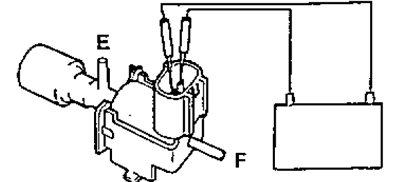
If the valve does not work properly, replace the valve.
5. Reinstall the valve.
Checking the pneumatic diode
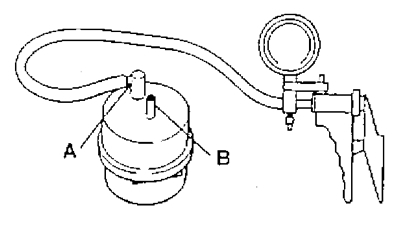
1. Apply a vacuum of 500 mmHg to port "A" of the pneumatic diode and make sure that the vacuum does not decrease within a minute.
2. Apply vacuum to port "B" and make sure it drops.
Checking the vacuum receiver
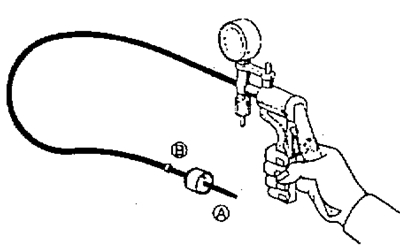
1. Apply a vacuum of 500 mmHg to port "A" of the pneumatic diode and make sure that the vacuum does not decrease within a minute.
2. Apply vacuum to port "B" and make sure it drops.