



If the frequency of the signal from one side of the indicator is higher than the frequency of the signal from the other side, this is a consequence of damage to the incandescent lamp or a break in the power supply wire.
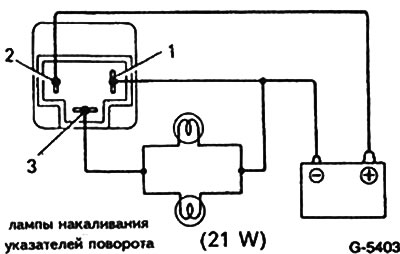
In many other cases, the turn signal failure is caused by the flasher relay. To check, remove the relay. Connect contacts 1 and 2 of the relay to the battery with auxiliary wires, see Fig. G-5403. Then connect 2 incandescent lamps (21 W) in parallel between terminals 1 and 3. The lamps should flash at a frequency of 60-120 cycles per minute. If only one lamp is connected, the cycle frequency increases to 140 per minute. Otherwise, replace the flasher relay.
If there is no new relay, insert a thin wire between terminals 2 and 3 into the relay plug.
Attention: Be careful with the sensitive relay contacts and do not damage them. Bend the ends of the wire before installation. Install the defective relay in place.
Turn on the ignition. Now, after pressing the switch, the corresponding turn signal lights up, but does not blink. Turn on the turn signal with the switch lever, reproducing the rhythm of the turn signal. Replace the flasher relay with a new one at the first opportunity.
If the turn signal does not light up despite the jumper being installed, then the fault is in the relay-breaker or in the supply wires.
See the source on the internet resource toyotaman