



Caution: Wait until the engine has cooled down completely before starting this procedure.
Note: 2004 and later vehicles are equipped with exhaust manifold assemblies with catalytic converters, while 2003 and earlier vehicles are equipped with separate catalytic converters.
1. Disconnect the ground cable from the battery (see paragraph 1 of chapter 5).
2. Apply penetrating oil to the exhaust manifold mounting elements and allow it to soak in.
3. If you remove the rear (closest to the partition) exhaust manifold, lift the front of the car and install reliable supports under it, then remove the lower engine protection (fig. 6.3, a, b).
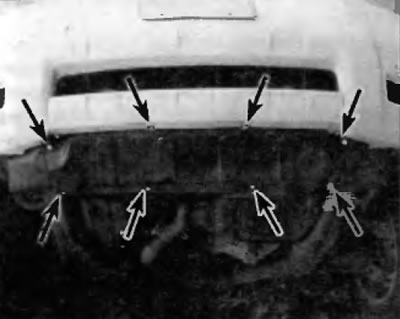
Fig. 6.3,a. Location of the lower engine protection fastening elements (Hightlander)
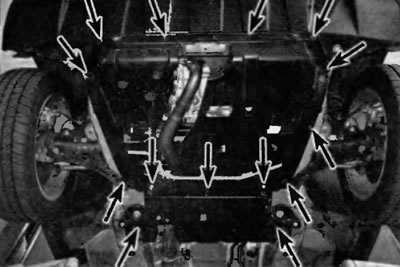
Fig. 6.3, b. Location of fastening elements of the main and rear sections of the lower protection (RX 300/330)
Caution: If the vehicle is equipped with electronically controlled air suspension, turn off the ride height control switch.
The article was copied from the portal ToyotaMan
4. Remove the heated oxygen sensors from the manifold (see chapter 6).
5. Remove the bolts and heat shield over the exhaust manifold (if available) (Fig. 6.5).
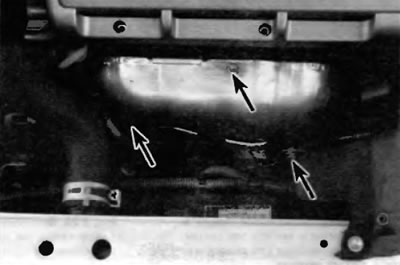
Fig. 6.5. Unscrew the bolts securing the exhaust system heat shield (not all models have a heat shield!
6. Remove the exhaust manifold clamp (if available) (Fig. 6.6).
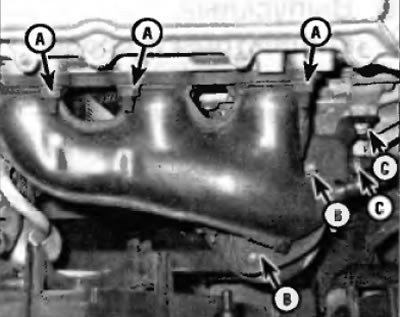
Fig. 6.6. Location of front exhaust manifold mounting nuts (A), exhaust system flange nuts (B) and tie bolts (C) (the lower exhaust manifold mounting nuts are not visible)
7. Unscrew the nuts securing the exhaust pipe(s) to the exhaust manifold.
8. Unscrew the bolts securing the exhaust manifold to the cylinder head, moving from the edges to the middle. Remove the manifold from the studs.
9. Carefully inspect the manifold and mounting elements for cracks and damage.
10. Use a scraper to remove all traces of old gasket material and carbon deposits from the mating surfaces of the cylinder head and manifold. If the gasket has been leaking, check the surface of the manifold mating with the cylinder head for deformation. To do this, apply a straight, rigid ruler to the surface being measured and try to insert a feeler gauge. If the gap exceeds the limit value specified in Specifications at the beginning of this chapter, regrind the mating surface of the manifold, for which you should contact a service station.
11. Install a new gasket, using the studs on the cylinder head as a guide.
12. Install the manifold and tighten the nuts
13. Working from the center outward, tighten the nuts in three or four stages to the specified torque shown in Specifications at the beginning of this chapter.
14. Reinstall the remaining components in the reverse order of removal. Use new gaskets when connecting the exhaust pipes.
15. Start the engine and check for leaks in the exhaust system.