



Contents: Removal ↓ Installation ↓
Caution: Wait until the engine has cooled down completely before starting this procedure.
Removal
1. Disconnect the ground cable from the battery (see paragraph 1 of chapter 5).
2. Drain the coolant from the cooling system, including the cylinder block (see chapter 1).
3. Remove the upper and lower intake manifolds (see paragraph 5).
4. Remove the exhaust manifold (see paragraph 6).
5. Remove the generator (see chapter 5). Remove the bolts and move the power steering pump to the side (refer to chapter 10).
6. Remove the timing belt, camshaft sprockets and upper idler pulley (see paragraph 7).
7. Unscrew the bolts securing the rear timing belt cover and remove it from the cylinder block and cylinder heads.
8. Disconnect the electrical connectors of the coolant sensor and remove the coolant distribution housing (Fig. 11.8).
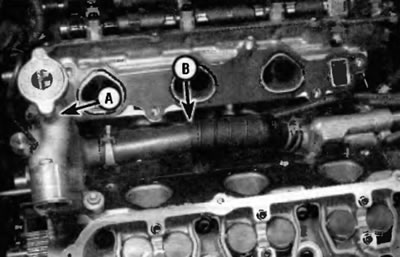
Fig. 11.8. Unscrew the bolts and remove the coolant distribution housing (A), the connecting hose (B) should be replaced each time the intake manifold is removed
9. Remove the camshaft from the head you intend to remove (see paragraph 10). Disconnect the electrical connectors of the camshaft position sensor and the VVT oil control valve (see paragraph 8).
10. Remove the bolts at the rear of the cylinder heads and move the engine wiring harnesses away from the heads.
11. Using a hex bit or 8mm Allen key, remove the corresponding bolts (one in each head) (fig. 11.11).
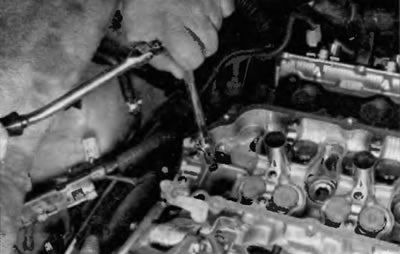
Fig. 11.11. Remove the bolt using an 8 mm hex bit
12. Using a 12-point socket, loosen the remaining cylinder head bolts ¼ turn at a time until they can be removed by hand. Unscrew and remove them along with the hardened washers. Follow the reverse of the recommended tightening sequence (fig. 11.23).
13. Remove the cylinder head from the cylinder block. If the head does not come off, apply a wooden block to it and hit the block with a hammer.
Caution: Do not insert any improvised levers between the head and the cylinder block. This may damage the sealing surfaces and result in leaks.
14. If necessary, repeat the procedure for the other head.
Installation
15. Before installing the heads, thoroughly clean the mating surfaces of the heads and cylinder blocks.
16. Use a scraper to remove all traces of carbon deposits and old gasket material, then clean the mating surfaces with lacquer thinner or acetone. If there is oil on the mating surfaces when the cylinder head is installed, the gasket may not seal properly and leaks will occur. When working on the block, pack the cylinders with clean rags to prevent dirt from getting into them. Use a vacuum cleaner to remove dirt that has gotten into the cylinders.
17. Check the mating surfaces of the block and cylinder head for nicks, deep scratches and other damage. If the damage is minor, it can be removed with a file; if it is large, mechanical treatment may be the only option.
18. Using a tap of the correct size, calibrate the threads in the holes for the cylinder head bolts, then blow out the holes with compressed air. Check that nothing remains in the holes.
Caution: Always wear eye protection when working with compressed air.
19. Clamp each bolt in a vice and "run" the threads with a die to remove traces of corrosion and restore the threads. Dirt, corrosion products, sealant and thread damage will affect the tightening torque value. Measure the diameter of the shoulder area of the head of each bolt and torque the results to the value specified in Specifications at the beginning of this chapter. Replace any bolts that are too tight.
20. Install new gaskets, using the mounting pins in the block as a guide (fig. 11.20).
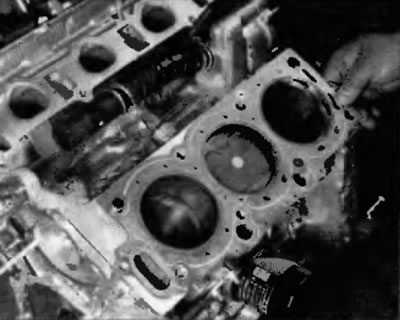
Fig. 11.20. Install new cylinder head gaskets with the correct side facing up (check the correct alignment of all holes and coolant vinyls), using the block pins as a guide
21. Carefully install the cylinder head on the block without displacing the gasket.
22. Before installing the cylinder head bolts, apply a small amount of clean engine oil to the threads.
23. Screw in the bolts according to their original position and tighten them by hand. Following the recommended sequence, tighten the bolts to the prescribed torque specified in Specifications at the beginning of this chapter (fig. 11.23). Do not tighten the Allen key bolt at this stage.
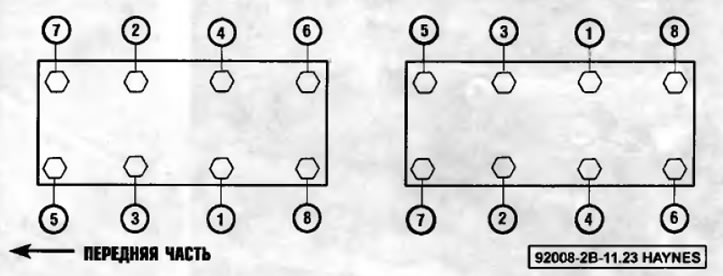
Fig. 11.23. Cylinder head bolt tightening sequence
24. Mark the front face of each bolt head with paint. Alternatively, you can mark the socket head you are using.
25. Following the same sequence, tighten each 12-point head bolt an additional ¼ turn (90°) (fig. 11.23).
26. Tighten the Allen key cap screw to the specified torque as shown in Specifications at the beginning of this chapter.
27. Repeat the entire procedure to install the other cylinder head.
28. The rest of the installation is carried out in the reverse order of removal.
29. Fill the cooling system. Replace the engine oil and filter (see chapter 1). Start the engine and check for leaks.