



Contents: Removal ↓ Installation ↓
Removal
1. Remove the hood (see chapter 11).
2. Disconnect the ground cable from the battery (see paragraph 1 of chapter 5).
3. Raise the vehicle and place secure supports underneath it.
Caution: If the vehicle is equipped with electronically controlled air suspension, turn off the ride height control switch.
4. Remove the lower engine protection sections (fig. 6.3).
5. Drain the engine oil and remove the oil filter. The oil pan is a two-piece assembly. The aluminum section is mounted to the cylinder block and the transaxle. The stamped steel section is mounted underneath.
6. Disconnect the exhaust pipe from the catalytic converter and support bracket and remove the nuts securing the pipe to the exhaust manifolds/catalytic converter of the front and rear cylinder banks.
7. Remove the faceplate cover (Fig. 12.7).
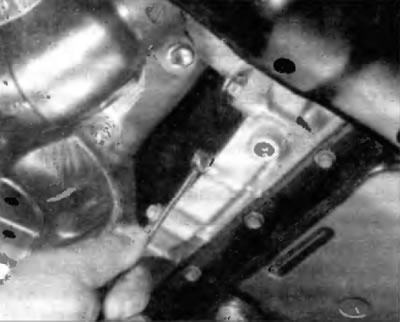
Fig. 12.7. Unscrew the two bolts and remove the faceplate cover
8. Remove the two bolts securing the aluminum section of the oil pan to the gearbox in the block with the drive axle (Fig. 12.8).
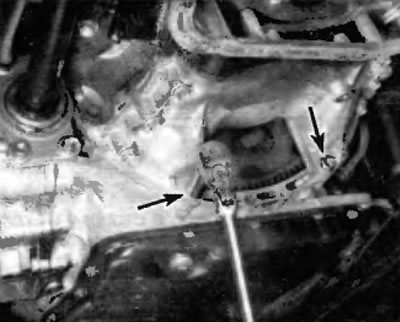
Fig. 12. 8. Remove the two bolts securing the upper aluminum section of the sump to the gearbox in the block with the drive axle
9. Remove the ten bolts and two nuts securing the oil pan base section and detach the section (Fig. 12.9). If it does not come off, carefully pry it off with a small screwdriver or spatula. Do not damage the mating surfaces of the pan, as this may cause oil to leak.
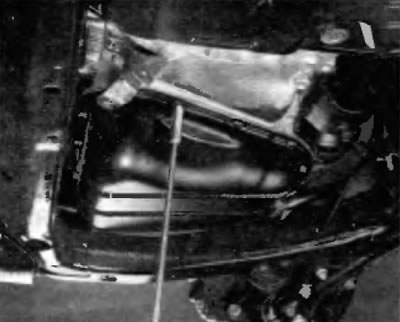
Fig. 12.9. Remove the stylish section of the oil pan
10. Remove the oil pump strainer/oil receiver (fig. 13.4).
11. Remove the bolts securing the aluminum section of the oil pan to the block.
Application: Some bolts are located in an area previously covered by a steel tray.
12. Remove the oil pan deflector plate (if available).
Installation
13. Use a scraper to remove any remaining old sealant from the cylinder block and oil pan. Clean the mating surfaces with lacquer thinner or acetone.
14. Clean the threaded holes for the bolts in the cylinder block.
15. Check the flange of the steel section of the pan for deformation, especially around the bolt holes. If necessary, place the pan on a wooden block and use a hammer to straighten and restore the shape of the sealing surface.
16. If the oil deflector was removed, install it in place.
17. Clean the mating surfaces of the cylinder block and aluminum oil pan section, being careful not to damage the soft metal surface which could cause leaks.
18. Apply a 4mm wide bead of RTV sealant to the aluminum section of the tray (fig. 12.18).
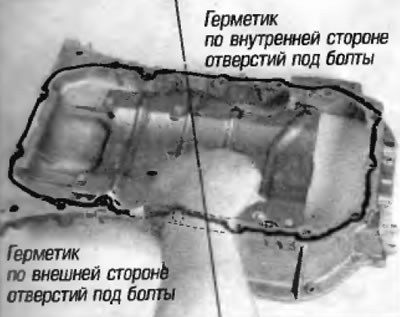
Fig. 12.18. Apply a bead of RTV sealant around the perimeter of the aluminum pan section as shown
19. Install the aluminum section of the tray; this should be done within five minutes after applying the sealant evenly, in several stages tighten the bolts with the prescribed force indicated a Specifications at the beginning of this chapter. Work from the center to the edges of the pallet.
20. Inspect the oil pick-up tube/oil pump strainer for cracks and blockages. If the oil pick-up tube has been removed, clean it thoroughly with solvent and now install it using a new gasket (see paragraph 13). Tighten the nuts/bolts to the specified torque as specified in Specifications at the beginning of this chapter.
21. Apply a 3-4mm wide bead of RTV sealant to the flange of the steel section of the oil pan.
Note: The steel pan section must be installed within five minutes of applying the sealant.
22. Carefully place the steel pan section on the aluminum section and tighten the bolts. Working from the center outward, tighten them in three to four stages to the specified torque specified in Specifications at the beginning of this chapter.
23. The rest of the installation is carried out in the reverse order of removal. Allow the sealant at least 2 hours to cure before adding new oil and installing a new oil filter.
24. Start the engine and check for oil pressure and leaks.