



Contents: Removal ↓ Inspection ↓
Application: Before starting this procedure, prepare two M6 x 1.0 mm bolts of 16 to 20 mm length. They are referred to in the text as process bolts.
Removal
1. Set the engine to TDC position (see paragraph 3), then remove the cylinder head covers (see paragraph 4), timing belt and camshaft toothed pulleys (see paragraph 7).
2. The descriptions in the following points apply to the removal of each of the four camshafts. Not each cylinder head is first fixed with the auxiliary gear of the exhaust camshaft, the intake camshaft is removed, and then the exhaust camshaft.
3. Align the timing marks of the camshafts on the driving and driven gears (Fig. 10.3).
Note: On the right (rear) cylinder head, align the two dots on the intake camshaft gear with the two dots on the exhaust camshaft gear. On the left (front) cylinder head, align one dot on the intake camshaft gear with one dot on the exhaust camshaft gear.
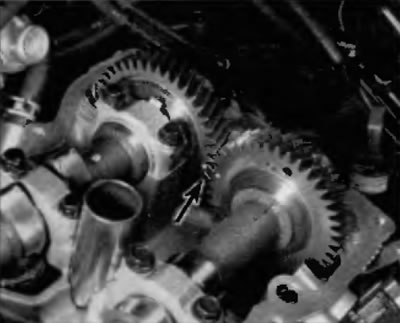
Fig. 10.3. Timing marks on the back side of the timing gears (typical marks)
4. Fix the auxiliary gear of the exhaust camshaft relative to the driven gear using a technological bolt screwed into the provided technological hole (fig. 10.12).
Caution: Since the axial clearances of the camshafts are minimal, the camshafts must be held horizontally when removed. If this is not done, cracks may occur in the cylinder head area near the camshaft gears or damage may occur due to gear meshing. Before removing the camshaft from the head, make sure that the torsional spring force from the auxiliary gear is eliminated using the service bolt.
5. Loosen the intake camshaft bearing cap bolts ¼ turn at a time until they can be removed by hand. Start with the outer caps and work your way to the inner ones.
6. Remove the bearing caps and carefully remove the intake camshaft. Keep it horizontal.
7. Loosen the exhaust camshaft bearing cap bolts ¼ turn at a time until they can be removed by hand. Start with the outer caps and work your way to the inner ones.
8. Remove the exhaust camshaft bearing caps and seal, and carefully remove the exhaust camshaft. Keep it horizontal.
9. Repeat these steps on the other cylinder head.
10. Store the bearing caps in the correct order.
Application: Now, if necessary, you can remove the tappets and valve adjusting shims with a magnetic tool. Store them separately so that you can install them in their original places (fig. 10.10).
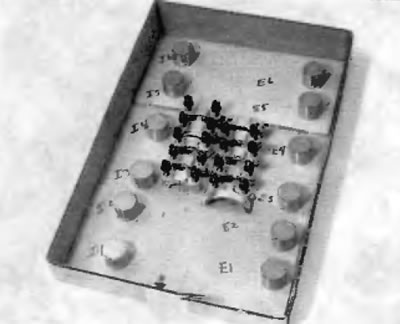
Figure 10.10. Mark the sled storage box for pushrods/gaskets and camshaft bearing covers. Use a separate box for each kit and mark the front (arrow), intake (I) and exhaust (E) points.
11. To remove the gear from the exhaust camshaft, clamp the shaft in a vice by the large hex section.
12. Insert the second access bolt into the unthreaded hole along the camshaft auxiliary gear. Press a screwdriver against the access bolt just installed, turn the auxiliary gear clockwise and remove the first access bolt. The second bolt is not required if you have a two-pin wrench (fig. 10.12).
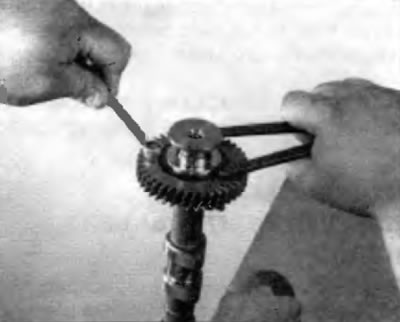
Fig. 10.12. Clamp the camshaft in a vice by the hex section, use a two-pin wrench, remove the tension from the auxiliary gear and unscrew the process bolt, and then release the auxiliary gear
13. Remove the auxiliary gear retaining ring (fig. 10.13).
View the full text on the portal www.TOYOTAMAN.ru
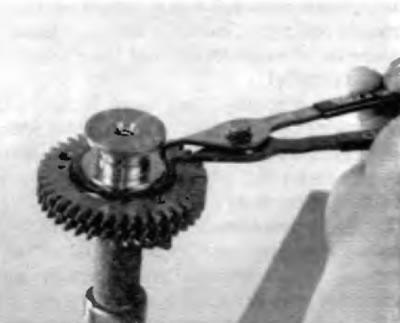
Fig. 10.13. Remove the retaining ring using special pliers
14. The warp washer, auxiliary gear and camshaft gear spring can now be removed from the exhaust camshaft (fig. 10.14). Keep the rear cylinder head camshaft components separate from the front cylinder head camshaft components. The VVT actuator is mounted on the front end of the intake camshaft and secured to the shaft with a large nut. To remove the VVT unit, clamp the camshaft in a vice by the hex section and use an extension and a 46 mm socket.
Note: The nut has left-hand threads. Do not remove the nut or VVT unit unless you are replacing the camshaft or VVT unit.
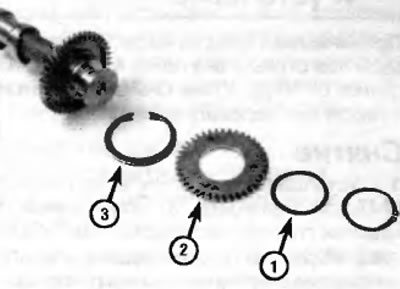
Fig. 10.14. Remove the warped washer (1), camshaft auxiliary gear (2) and gear spring (3) (showed the exhaust camshaft)
Inspection
15. For inspection procedures for camshafts, lifters and related components, refer to Chapter 2A. Refer to the Specifications at the beginning of this chapter.