



Application: The following procedures apply to the oil control valve, oil filter, or intake camshaft timing pulley/actuator on any of the cylinder heads.
1. The WT system changes the angular position of the intake camshaft in order to change the valve timing of the intake valves in the direction of advancing or retarding their opening/closing moments by supplying oil pressure to the actuator of the toothed pulley of the intake camshaft. Changing the valve timing of the intake valves under certain engine operating conditions causes an increase in engine torque, a decrease in fuel consumption and a decrease in the level of harmful emissions.
2. The system components include the powertrain control module (PCM), an oil control valve (OCV) in each cylinder head, an oil filter for each oil valve, and an intake camshaft timing pulley and actuator assembly.
3. The PCM uses input signals from the following sensors to turn the oil control valve on and off:
- a) vehicle speed sensor (VSS),
- b) throttle position sensor (TPS),
- c) mass air flow sensor (MAF),
- d) engine coolant temperature sensor (ECT).
4. When the oil control valve is activated by the PCM, it directs the specified oil pressure from the engine to initiate advance or retard valve opening/closing timing to the intake camshaft timing pulley actuator.
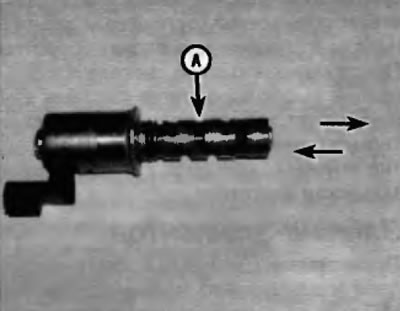
Ryas. 9.4. When voltage is applied, the OCV plunger (A), which you can put on through the grooves in the housing, should come out; when the voltage is stopped the plunger should go inside
5. The intake camshaft timing pulley with actuator assembly has an inner hub that is fixed to the camshaft. The inner hub contains a set of fixed vanes that are acted upon by oil pressure to rotate the camshaft. The higher the oil pressure, the faster the actuator will rotate, causing the camshaft to advance or retard. Higher oil pressure causes the angular position of the camshaft to change by supplying oil to the advance or retard side of the fixed vanes.
(The material is reprinted from an online resource: www.toyotaman.ru)
6. When oil is supplied to the vanes from the advance side, the actuator can advance the valve timing. Up to 21 degrees clockwise. When oil is supplied to the vanes from the retard side, the actuator begins to rotate the camshaft counterclockwise to 0 degrees, which corresponds to the normal position of the actuator when the engine is running without load or in idle mode. In addition, the PCM can send a signal to the oil control valve to stop the oil supply to both channels (advances or delays), to maintain the valve timing advance in the current position.
7. Under light engine load, the VVT system initiates camshaft retardation to reduce valve overlap and stabilize engine power. Under moderate engine load, the VVT system initiates camshaft advancement to increase valve overlap, thereby reducing fuel consumption and reducing harmful emissions. Under heavy engine load at low rpm, the VVT system initiates camshaft advancement to ensure faster closing of the intake valves, which helps increase torque in the low and mid rpm range. Under heavy engine load at high rpm, the VVT system initiates camshaft retardation to slow the closing of the intake valves to increase engine power.