



Camshaft Drive Parts (3.0L)
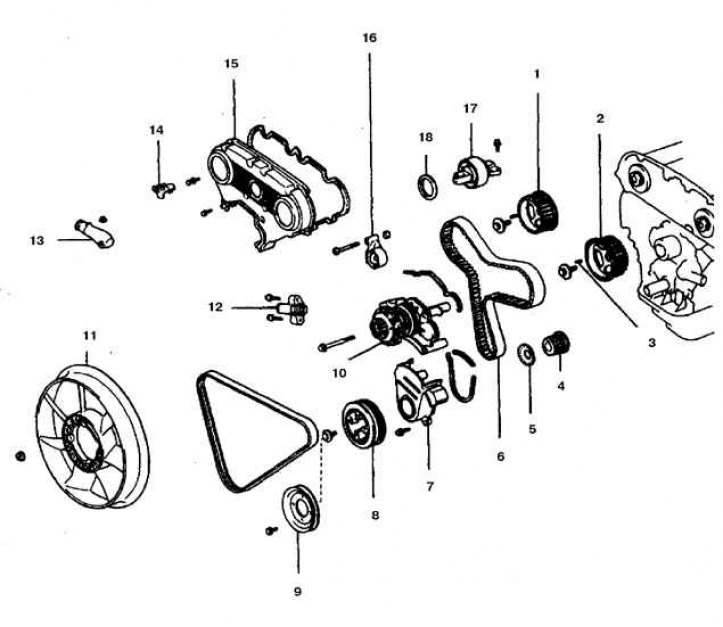
1. Camshaft sprocket (right); 2. Camshaft sprocket (left); 3. Pin; 4. Leading sprocket; 5. Cup; 6. Toothed belt; 7. Cover N1; 8. Crankshaft pulley; 9. Power steering belt pulley; 10. Fan bracket; 11. Impeller; 12. Tensioner; 13. Branch pipe; 14. High-voltage wire clamp; 15. Cover N₂; 16. Tensioner roller N1; 17. Tensioner roller N₂; 18. Gasket
Camshaft Drive Parts (3.4L)
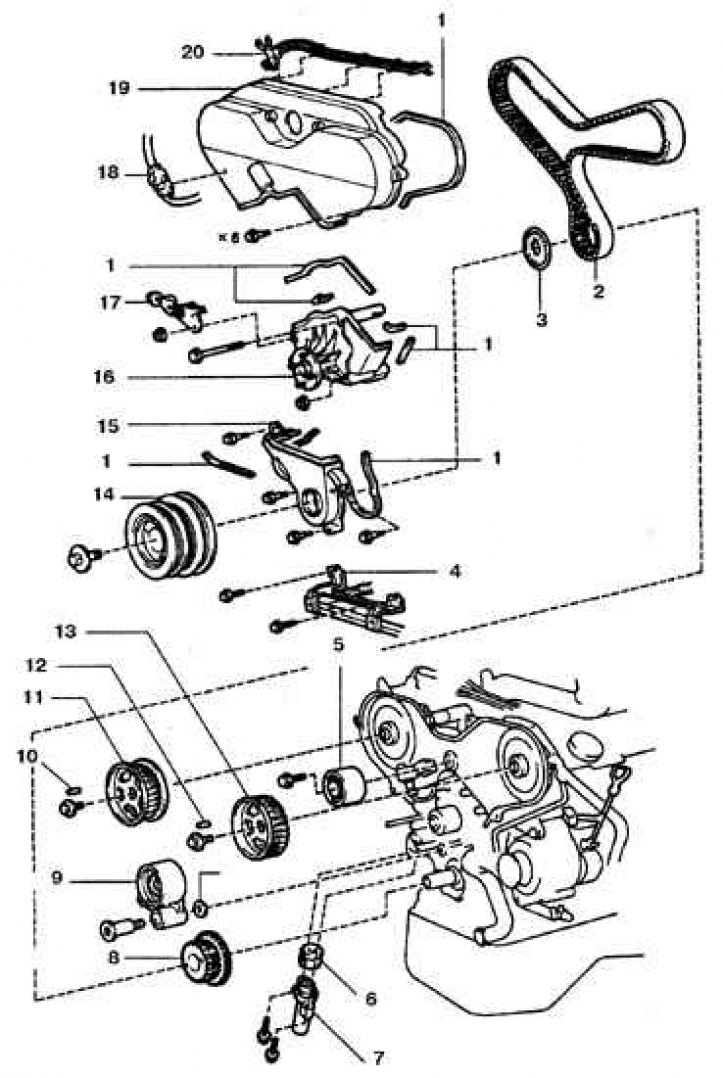
1. Gasket; 2. Toothed belt; 3. Guide; 4. Starter wire bracket; 5. Tensioner roller N₂; 6. Protective case; 7. Tensioner; 8. Leading sprocket; 9. Tensioner roller N1; 10, 12. Pin; 11. Camshaft sprocket (right); 13. Camshaft sprocket (left); 14. Crankshaft pulley; 15. Lid; 16. Fan bracket; 17. Power steering belt pulley; 18. Crankshaft speed sensor connector; 19. Cover N₂; 20. High-voltage wire clamp
Removal
1. Disconnect the battery from ground.
2. Remove the lower engine shield.
3. Remove the casing and fan.
4. Drain the fluid and remove the radiator.
5. Remove the alternator and power steering pump belts.
6. Disconnect the wires from the spark plugs.
7. Raise the front of the car and block the rear wheels.
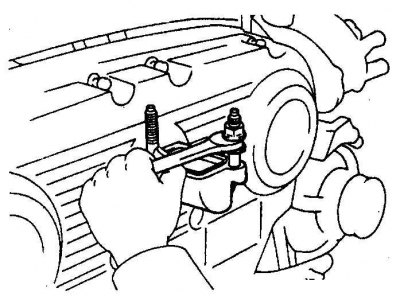
8. On 3.0L engines, remove the studs from the coolant hose.
9. On 3.4L engines, remove the power steering pump and set it aside.
10. Remove the air conditioning compressor (see subsection 4.13).
11. Remove the spark plugs.
12. Remove the upper belt cover and gasket. On 3.4L engines, remove the fan hub and bracket.
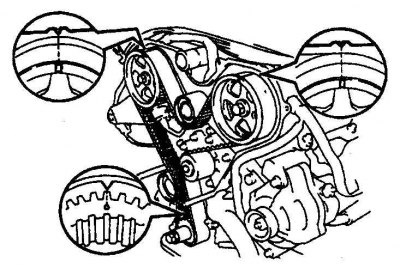
13. Set the piston of the 1st cylinder to TDC of the compression stroke.
14. Check for timing marks on the timing belt. Apply marks if necessary.
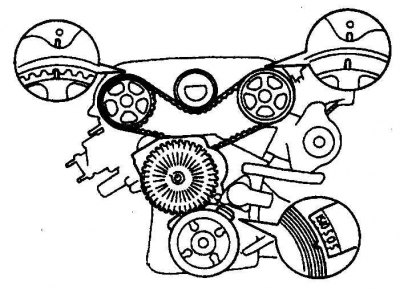 |  |
15. Make sure that the marks on the camshaft gear are aligned (left - marks on the 3.0 L engine, right - marks on the 3.4 L engine).
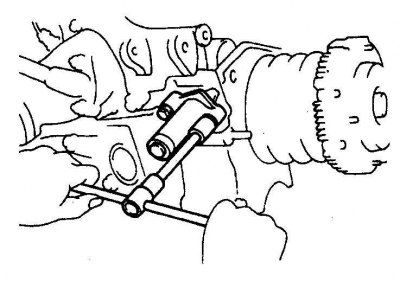 | 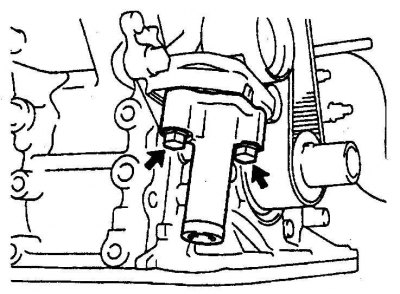 |
16. Remove the tensioner and the boot (on the left is the timing belt tensioner on the 3.0L engine, on the right is the timing belt tensioner on the 3.4L engine, the tensioner bolts are indicated by arrows).
17. If the timing belt is not going to be changed, then mark its position on the exhaust camshaft sprocket.
18. Remove the timing belt from the camshaft sprockets.
19. Inspect the camshaft sprockets and replace if necessary. To do this, remove the cover(s) and, holding the camshaft by the flats with a wrench, unscrew the bolt and remove the sprocket.
20. Remove tensioner roller No.2.
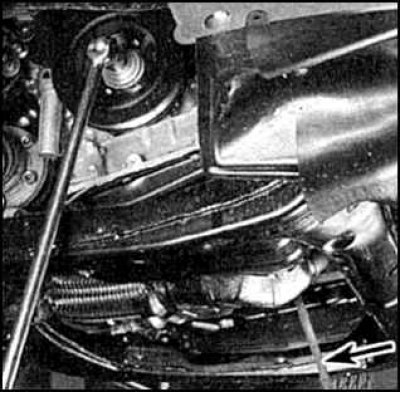
21. Loosen the crankshaft bolt, securing (arrow) the flywheel ring (or holding the torque converter disc bolt).
22. Check again the alignment of the TDC marks on the crankshaft pulley and the fixed scale.
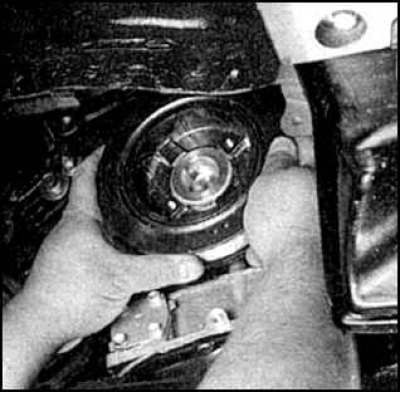
23. Remove the pulley by hand or using two screwdrivers to act as levers.
24. Remove the lower belt cover and gasket. On 3.4L engines, first remove the fan bracket.
25. Remove the belt from the drive sprocket.
26. Remove tensioner roller N1.
27. Check for a mark on the belt opposite the recess in the drive sprocket; if necessary, apply a new mark (if the belt is not changed).
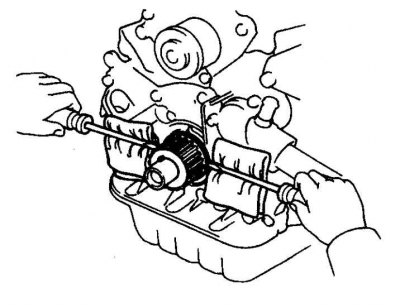
28. If necessary, remove the drive sprocket by hand or using two screwdrivers to act as levers.
Examination
1. Check the condition of the belt. If there are cracks, tears, cuts, sheared teeth, or if the service life has expired, replace the belt.
2. Check for oil leaks on the tensioner. The tensioner seal is in good condition if only slight traces of oil are observed on the plunger side.
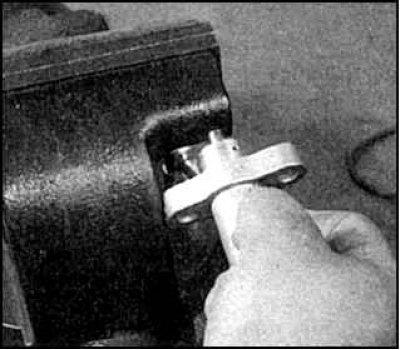
3. Check the plunger stroke by resting it against a stationary surface. If the plunger moves, replace the tensioner.
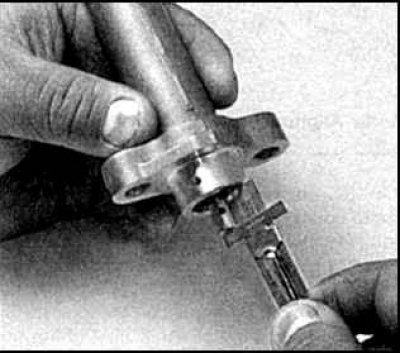
4. Check the tensioner plunger protrusion. If the protrusion is different from normal, replace the tensioner.
5. Check the tensioner rollers for free rotation.
Installation
1. Clean the front of the engine.
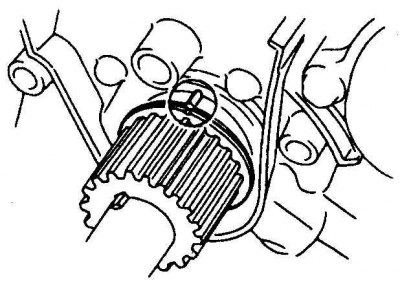
2. On 3.0L engines, align the marks on the drive sprocket crown with the marks on the oil pump housing. Install the drive sprocket with the flange facing the engine.
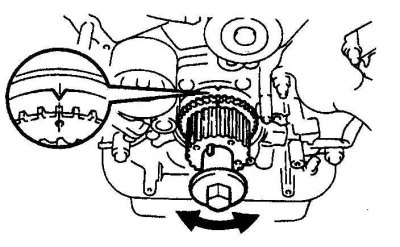
3. On 3.4L engines, be careful not to damage the crankshaft speed sensor insert on the drive sprocket. Check that the indicated marks are aligned.
4. Install belt tensioner roller No.1, having lubricated 2–3 threads of the tensioner bolt with friction compound. Tighten the bolt to the specified torque.
5. Put on the toothed belt, winding it on the drive sprocket. If you are installing a removed belt, align the marks on the belt, sprockets and covers that were applied during removal.
6. Place the guide cup on the crankshaft, with its convex surface facing the engine.
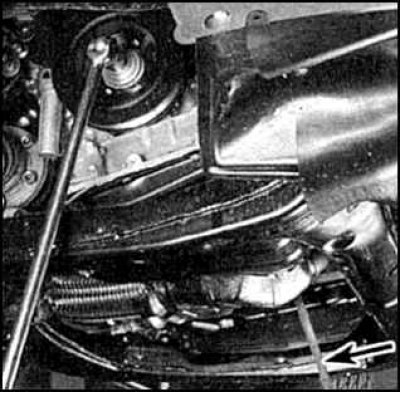
7. Install the crankshaft pulley and tighten the bolt to the specified torque while holding the crankshaft (arrow).
8. Install the upper tensioner pulley. Tighten the bolt and check the pulley for free rotation.
9. Install the left camshaft sprocket with the flange facing out, aligning the hole in the sprocket with the camshaft pin.
10. Tighten the sprocket bolt to the specified torque.
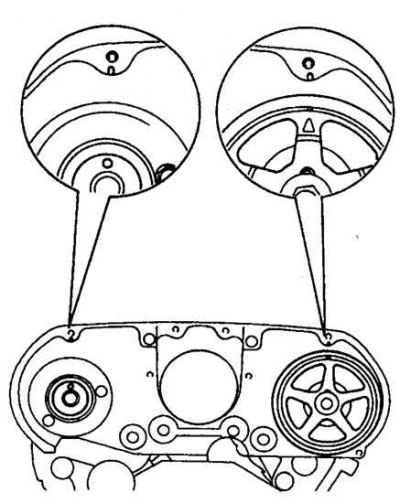 | 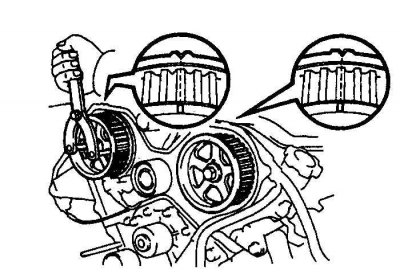 |
11. Check the marks again and make sure that the crankshaft has not turned relative to its original position (left - alignment of marks on a 3.0 L engine, right - alignment of marks on a 3.4 L engine). If you are putting on a removed belt, install it according to the marks made during removal. If the marks do not match, move the belt on the drive sprocket. The mark on the left camshaft sprocket should be facing up and match the mark on the rear belt cover.
12. The pin hole in the right camshaft sprocket should be facing up (for 12 hours). If necessary, remove the cylinder head cover (if it wasn't filmed) and turn the camshaft until the marks on the camshaft and on the rear cover are aligned.
13. Turn the left camshaft clockwise approximately one step between teeth. If you are putting on a removed belt, align the timing mark with the mark on the camshaft sprocket. Put the belt on the sprocket and turn the camshaft counterclockwise, returning it to its original position. The belt should now have a slight tension.
14. With the hole aligned with the pin, install the right camshaft sprocket with the flange portion facing inward.
15. Tighten the sprocket bolt while maintaining the position of the marks.
16. Place the belt on the sprocket, aligning the marks (if a removed belt is installed).
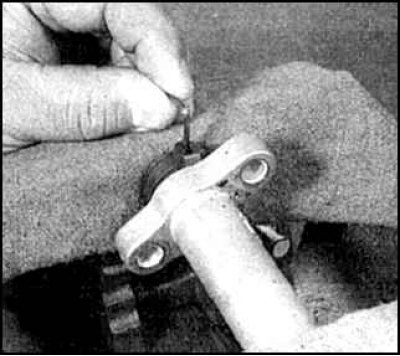
17. Clamp the tensioner in a vice and press the plunger in. Fix the plunger by inserting a 1.2 mm drill into the transverse through holes.
18. Install the tensioner and tighten the bolts.
19. Turn the crankshaft 2 revolutions and check the alignment of the marks. If the marks are not aligned, then repeat all the steps for installing the belt. Do not start the engine until you are completely sure that the belt is installed correctly.
20. Install the remaining parts in reverse order.