



Share information:
Overhaul of gasoline engines Toyota Land Cruiser 60/80

Engine dismantling and overhaul — general information
This subsection examines in detail the procedure for performing such work as dismantling the power unit from the vehicle and major repairs of the internal parts of the engines in question. Some of the procedures for...
This subsection examines in detail the procedure for performing such work as dismantling the power unit from the vehicle and major repairs of the internal parts of the engines in question. Some of the procedures for...
Engine specifications
Engines 2F and 3F-E (data for 3F-E engines are given in brackets) Compression: - standard 9.8 kgf/cm² (9.8) – the greatest difference in compression in the cylinders 2.0 kgf/cm² (2.0) Oil pressure: - at idle (600 rpm)...
Engines 2F and 3F-E (data for 3F-E engines are given in brackets) Compression: - standard 9.8 kgf/cm² (9.8) – the greatest difference in compression in the cylinders 2.0 kgf/cm² (2.0) Oil pressure: - at idle (600 rpm)...

Engine diagnostics using a vacuum gauge
1. Measuring vacuum is a reliable and relatively cheap way to diagnose an engine. The vacuum gauge readings can provide information about the condition of the piston group, the tightness of the cylinder head gaskets,...
1. Measuring vacuum is a reliable and relatively cheap way to diagnose an engine. The vacuum gauge readings can provide information about the condition of the piston group, the tightness of the cylinder head gaskets,...

Checking the compression in the cylinders
The results of the compression test in the engine cylinders allow us to judge the condition of the engine parts (pistons, rings, valves and seats, cylinder head gaskets). To obtain accurate test results, the engine must...
The results of the compression test in the engine cylinders allow us to judge the condition of the engine parts (pistons, rings, valves and seats, cylinder head gaskets). To obtain accurate test results, the engine must...
Dismantling the power unit
The engine is removed from the engine compartment by lifting, so the lifting equipment must be designed for the weight of the engine. The work must be carried out with an assistant who has certain skills. On injection...
The engine is removed from the engine compartment by lifting, so the lifting equipment must be designed for the weight of the engine. The work must be carried out with an assistant who has certain skills. On injection...

Removal and installation the engine
Removal 1. Decompress the fuel system and disconnect the battery from ground. 2. Remove the air filter. 3. Drain the coolant. 4. Identify and disconnect all wiring connectors, vacuum and fuel hoses from the engine....
Removal 1. Decompress the fuel system and disconnect the battery from ground. 2. Remove the air filter. 3. Drain the coolant. 4. Identify and disconnect all wiring connectors, vacuum and fuel hoses from the engine....
Alternatives to major repairs
When performing a major overhaul on your own, various options are possible. The determining factor is the condition of the cylinder block, which in some cases is advisable to replace. If the crank mechanism and cylinder...
When performing a major overhaul on your own, various options are possible. The determining factor is the condition of the cylinder block, which in some cases is advisable to replace. If the crank mechanism and cylinder...
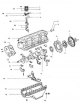
Engine disassembly procedure
Crank mechanism and piston group of 3F-E engines (the design of the 2F engine is similar) 1. Lower compression ring; 2. Oil scraper ring expander; 3. Finger; 4. Connecting rod head bushing; 5. Camshaft bearing; 6....
Crank mechanism and piston group of 3F-E engines (the design of the 2F engine is similar) 1. Lower compression ring; 2. Oil scraper ring expander; 3. Finger; 4. Connecting rod head bushing; 5. Camshaft bearing; 6....
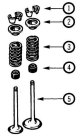
Cylinder head — disassembly, inspection and assembly
Valve Mechanism Parts 1. Rusks; 2. Plates; 3. Springs; 4. Umbrella caps; 5. Valves Disassembly Attention! It seems more expedient to purchase a new cylinder head than to disassemble, check and repair a previously used...
Valve Mechanism Parts 1. Rusks; 2. Plates; 3. Springs; 4. Umbrella caps; 5. Valves Disassembly Attention! It seems more expedient to purchase a new cylinder head than to disassemble, check and repair a previously used...
Valve repair — general information
Due to the complexity of the work and the need to use special tools and equipment, it is recommended that repairs to valves, seats and guide bushings be performed at a car service center. It is advisable to perform only...
Due to the complexity of the work and the need to use special tools and equipment, it is recommended that repairs to valves, seats and guide bushings be performed at a car service center. It is advisable to perform only...

Connecting rod and piston group — disassembly
Caution: Before removing the pistons and connecting rods, remove the cylinder head, oil pan and oil pump. 1. Remove the bead formed as a result of wear and carbon deposits at the top of the cylinder, having first...
Caution: Before removing the pistons and connecting rods, remove the cylinder head, oil pan and oil pump. 1. Remove the bead formed as a result of wear and carbon deposits at the top of the cylinder, having first...

Crankshaft — removal and inspection
Dismantling Attention! The crankshaft can only be removed after the engine has been removed from the vehicle. Remove the flywheel first (or leading disk), tensioner pulley, belt (chain), sump, oil receiver, oil pump,...
Dismantling Attention! The crankshaft can only be removed after the engine has been removed from the vehicle. Remove the flywheel first (or leading disk), tensioner pulley, belt (chain), sump, oil receiver, oil pump,...

Cleaning and checking the cylinder block
Telescopic bore gauge for measuring internal diameter Cleaning Attention! The cooling system channel plugs are tightly pressed into the cylinder block. 1. Remove lids with liners, label them and store separately. 2....
Telescopic bore gauge for measuring internal diameter Cleaning Attention! The cooling system channel plugs are tightly pressed into the cylinder block. 1. Remove lids with liners, label them and store separately. 2....

Cylinder honing
1. It is recommended to use a brush for honing. 2. Clamp the fixture into the electric drill. 3. Lubricate the cylinder surface well with oil, turn on the electric drill and periodically move it up and down in the...
1. It is recommended to use a brush for honing. 2. Clamp the fixture into the electric drill. 3. Lubricate the cylinder surface well with oil, turn on the electric drill and periodically move it up and down in the...

Connecting rods and pistons — check
1. Carefully clean the pistons from carbon deposits and carefully remove the rings. 2. Remove carbon deposits from piston ring grooves using a tool (photo on the left) or an old piston ring (photo on the right). 3....
1. Carefully clean the pistons from carbon deposits and carefully remove the rings. 2. Remove carbon deposits from piston ring grooves using a tool (photo on the left) or an old piston ring (photo on the right). 3....

Main and connecting rod bearings
Main and connecting rod bearings must be replaced during a major engine overhaul, but previously used bearings should be carefully checked to restore the general condition of the engine to the time of repair. The causes...
Main and connecting rod bearings must be replaced during a major engine overhaul, but previously used bearings should be carefully checked to restore the general condition of the engine to the time of repair. The causes...
Engine assembly procedure
The following assembly order is recommended for the engines in question: camshaft bearings (are pressed in at a car service center); piston rings; crankshaft and main bearings; pistons with connecting rods; oil pump;...
The following assembly order is recommended for the engines in question: camshaft bearings (are pressed in at a car service center); piston rings; crankshaft and main bearings; pistons with connecting rods; oil pump;...

Installing piston rings
1. Before installing new piston rings, sort the rings and check the joint clearance (that's on the left). To do this, push the ring with the bottom of the piston (photo on the right). The ring must be located at the...
1. Before installing new piston rings, sort the rings and check the joint clearance (that's on the left). To do this, push the ring with the bottom of the piston (photo on the right). The ring must be located at the...

Crankshaft — installation and inspection
Installation 1. Position the block so that the bottom is facing up. 2. Unscrew the cover bolts, remove the covers and arrange them in the order they were installed. 3. Remove the old liners from the covers and cylinder...
Installation 1. Position the block so that the bottom is facing up. 2. Unscrew the cover bolts, remove the covers and arrange them in the order they were installed. 3. Remove the old liners from the covers and cylinder...

Rear oil seal — installation
1. Check the condition of the crankshaft sealing journal. In case of deep wear at the seal edges, it is recommended to replace the crankshaft. 2. Clean the groove under the oil seal in the cylinder block, lubricate the...
1. Check the condition of the crankshaft sealing journal. In case of deep wear at the seal edges, it is recommended to replace the crankshaft. 2. Clean the groove under the oil seal in the cylinder block, lubricate the...

Connecting rods and pistons — installation and assembly
Piston ring joint arrangement 1. Upper disc of oil scraper ring; 2. Upper compression ring; 3. Lower disc of oil scraper ring; 4. Lower compression ring; 5. Oil scraper ring expander; 6. Notch (addressing the front of...
Piston ring joint arrangement 1. Upper disc of oil scraper ring; 2. Upper compression ring; 3. Lower disc of oil scraper ring; 4. Lower compression ring; 5. Oil scraper ring expander; 6. Notch (addressing the front of...
Starting the engine after repair and running-in
1. After completing assembly, double check the oil and coolant levels. 2. With the spark plugs removed and the ignition system turned off, turn the crankshaft until the oil pressure is registered by the sensor. 3. Screw...
1. After completing assembly, double check the oil and coolant levels. 2. With the spark plugs removed and the ignition system turned off, turn the crankshaft until the oil pressure is registered by the sensor. 3. Screw...
This section is available on: russian, bulgarian, belarusian, ukrainian, serbian, croatian, romanian, polish, slovak, hungarian
Similar sections for other Toyota models
➥ Overhaul of engines Toyota Camry XV10 (1991-1996)
➥ Engine overhaul Toyota Corona T190 (1992-1997)
➥ Engine overhaul Toyota 4Runner N120 (1989-1995)
➥ Engine overhaul Toyota Duet (1998-2004)
➥ Engine repair Toyota Carina T190 (1992-1996)
➥ Engine overhaul Toyota RAV 4 XA10 (1994-2000)
Link in different formats to this article
TEXTHTMLBB Code
- General information
- Introduction to the guide
- Controls and instruments
- Maintenance
- Power unit
- Petrol engines
- Diesel engines
- Cooling and heating
- Power and exhaust systems
- Engine electrical equipment
- Engine management systems
- Transmission
- Automatic gearbox
- Transmission line
- Chassis, running gear
- Brake system
- Car suspension
- Steering
- Body and interior
- Exterior (external elements)
- Interior (internal elements)
- Doors, locks and windows
- Electrical equipment
- Equipment and devices
- Electrical circuits
- General information
- User manual
- Maintenance
- Power unit
- Petrol engines 2F and 3F-E
- Petrol engines 1FZ-FE
- Engine overhaul
- Engine electrical equipment
- Cooling and heating
- Fuel system (carburetor)
- Fuel system (injector)
- Toxicity reduction system
- Transmission
- Car gearbox
- Clutch
- Transfer case
- Drive shafts and axles
- Chassis, running gear
- Brake system
- Car suspension
- Steering
- Body and interior
- Exterior and interior
- Doors, locks and windows
- Electrical equipment
- Equipment and devices
- Electrical circuits
- General information
- User manual
- Maintenance
- Power unit
- Engine adjustment
- Engine repair
- Fuel system
- Control system
- Turbocharging system
- Cooling and lubrication system
- Charge and start system
- Transmission
- Clutch
- Mechanical gearbox
- Automatic gearbox
- Transfer case
- Chassis, running gear
- Car suspension
- Brake system
- Steering
- Body and interior
- Body elements
- Heating and air conditioning
- Electrical equipment
- Equipment and devices
- Electrical circuits