



Note: Recommended frequency: every 24,000 km or 12 months.
Warning! Brake pads generate brake dust, which contains asbestos, which is harmful to health. Do not use compressed air or inhale the dust when cleaning brake pads.
Caution! Use only a special brake cleaner to clean brakes.
In addition to the established intervals, the brakes should be checked whenever a wheel is removed or if defects are suspected.
The main signs of brake failure are:
- the car pulls to one side during heavy braking;
- increased braking distance;
- loud squealing sound when braking;
- brake fluid leaks, usually onto the inside of a tire or wheel.
Disc brake pads have built-in wear indicators that emit a squealing or extraneous noise when the brake pads are worn to the limit (scratching) sound when braking. In this case, replace the brake pads immediately, otherwise the brake disc will be damaged.
Disc brakes
Experience shows that the front brake pads on the passenger side wear out the most, so the brake pads on the right front wheel should be checked.
Loosen the right front wheel lug nuts and apply the parking brake, then raise the front of the vehicle and support it on stands. Remove the right front wheel.
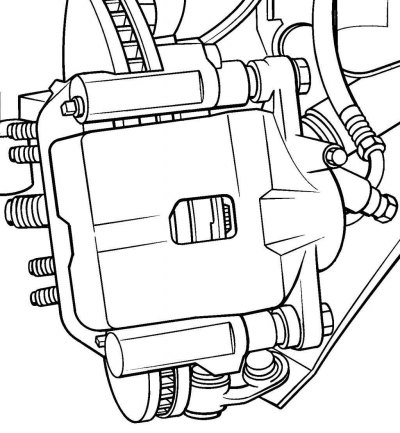
Figure 2.19. Hole on the disc brake caliper for checking the brake pads
Disc brakes have 2 brake pads installed in each caliper. The internal brake pads are visible through inspection holes in each caliper (figure 2.19). The outer brake pads are visible on the side of the caliper. Visually determine the thickness of the brake pads.
If the thickness of the brake pads is difficult to visually determine or if there is a suspicion that the pads are in poor condition, remove them for further inspection. If the brake pad lining is worn to the minimum thickness, replace all four brake pads as a set.
Use a caliper to measure the thickness of the brake disc. If the disc thickness is less than the maximum allowable, replace it. Also check the condition of the brake disc for cracks and scuffs.
Before installing the wheel, check the condition of the brake hoses and tubes.
Install the wheel and lower the vehicle.
Rear drum brakes
To check the thickness of the rear brake pads without removing the brake drums, remove the rubber plugs from the rear brake boot and shine a light
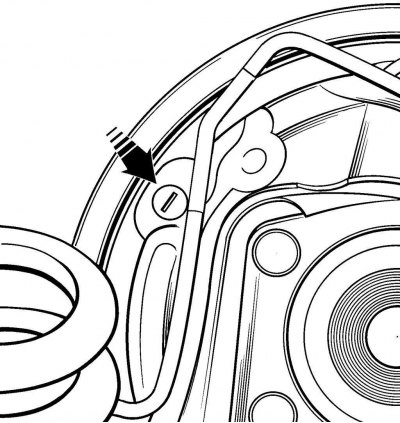
Figure 2.20. Location of the hole on the rear brake cover, closed with a rubber plug, for inspecting the rear brake pads
using a flashlight through the holes on the brake pads (figure 2.20). Visually determine the thickness of the brake pads.
If the thickness of the brake pads is difficult to visually determine or if there is a suspicion that the pads are in poor condition, remove them for further inspection.
Place the vehicle on a firm, level surface.
Place chocks under the front wheels to prevent the vehicle from rolling.
Loosen the rear wheel mounting bolts, raise the rear of the car and secure it on stands. Remove the rear wheels.
Remove the brake drums.
Use a caliper to measure the thickness of the rear brake pads. If the brake pad linings are 1.6 mm above the rivet heads, the brake pads are suitable for further use, otherwise replace all four brake pads as a set.
Replace the brake pads also if the pad linings are cracked, greasy, or contaminated with brake fluid.
Check the condition of the rear brake return and holding springs.
Remove the protective boots from the wheel brake cylinders and check for any brake fluid leaks. If there is brake fluid under the boots, replace the wheel cylinders.
Check the condition of the brake drums for cracks, scratches, deep grooves and signs of overheating. If the defects cannot be corrected, replace the brake drums.
Install the brake drums.
Install the wheels and lower the vehicle.
Vacuum brake booster
The brake booster reduces the force applied to the brake pedal, thereby making the car easier to control. The operating principle of the vacuum brake booster is based on the use of vacuum in the intake manifold. If the vacuum booster fails, the performance of the brake system is not affected, but significantly more force must be applied to press the brake pedal.
Press the brake pedal several times with the engine off to create a uniform pressure in the vacuum booster cavities, close to atmospheric pressure. At the same time, by the force applied to the pedal, determine whether the valve body is jammed. Stop the brake pedal in the middle of its travel and start the engine. If the vacuum booster is working properly, the brake pedal should move forward after starting the engine. If the pedal does not move forward, check the hose tip fastening, the connection of the tip flange fastening in the booster, the condition of the hose and the fitting.
Parking brake
Slowly tighten the parking brake lever until the lever rises 6-8 clicks. If not, adjust the parking brake.
Place the vehicle on a slope, apply the parking brake and move the gear shift lever to neutral. If the vehicle is securely held from rolling, the parking brake is working properly and is adjusted correctly.