



Note: Recommended frequency: every 24,000 km or 12 months.
Check performed on a parked vehicle
Set the front wheels to move straight ahead and, by slightly turning the steering wheel in different directions, determine the free play of the steering wheel. Free play is the angle the steering wheel can be turned before the front wheels begin to turn. Excessive free play can be caused by wear in the hub bearings, lower control arm ball joint, steering shaft universal joint, or steering gear.
Check the serviceability of the shock absorber by pressing on the corner of the body and releasing it sharply. The body should return to its original position after being released. If the body rises above its original position and continues to swing, most likely the shock absorber located on that side has failed and needs to be replaced. At the same time, replace the second shock absorber on this axle.
Check the shock absorber mount for wear.
Check performed on a raised vehicle
[The original text is posted on: ToyotaMan]
Place the vehicle on a lift and raise it to a height convenient for inspection.
Check tire wear and condition.
Check the condition of the universal joint between the steering shaft and the steering gear housing.
Check the steering gear housing for fluid leaks.
Visually inspect the ball joint and rack and pinion steering gear boots for cracks, wear and tear. Any damage to the covers will lead to loss of lubricant and the ingress of water and dirt, which will lead to rapid wear of the ball joints or steering mechanism.
While an assistant turns the steering wheel from side to side, check the steering components and assemblies for freedom of movement, wear, and secure fastening.
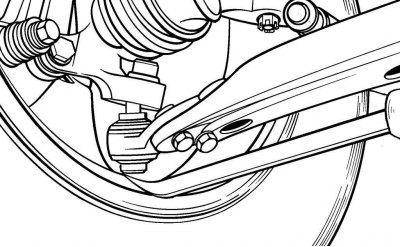
Figure 2.25. Using a crowbar to check the play in the lower control arm joints
Check the condition and play of the lower control arm joints by trying to move the arms up and down relative to the wheel rim using a crowbar (figure 2.25).
Take the front wheel with your hands at the 6 and 12 o'clock position and try to rock it in the vertical plane. Minor wheel play is acceptable. If the play is large, further inspection is necessary to determine the cause of the malfunction. Continue pumping the wheel while the assistant presses the brake pedal. If the play is eliminated or significantly reduced, then the hub bearings are probably damaged. If the play is still large, it means that the suspension connections and fasteners are worn out.
Now take the wheel with your hands in the "9 and 3 o'clock" position and try to swing it in a horizontal plane. Play in the horizontal plane can be caused by wear of the hub bearing or the ball joints of the steering rod. If the outer or inner ball joint is worn, play will be immediately noticeable.
At the rear of the vehicle, inspect the rear suspension arm bushings.