
Company Honda Company Ford Company Skoda Company Kia Company Mazda Company Mercedes Company Renault
English Русский
Български
Беларускі
Український
Српски
Hrvatski
Română
Polski
Slovenský
Magyar
Bookmark Articles Sitemap Contacts
ToyotaMan.ru


Camry Corolla Corona Carina Land Cruiser Highlander 4Runner RAV4 Others
Duet (1998-2004) Dyna Y50/Y60 (1984-1995)

Tips for driving in different conditions [Toyota Duet M100]

  • Main
  • Toyota
  • Duet (1998-2004)
  • General information
  • User manual
  • Tips for driving in different conditions
0

General recommendations


Attention:
  • Before driving, make sure that the parking brake is fully released and the corresponding indicator is off.
  • Do not keep your foot on the brake pedal while driving. This can lead to dangerous overheating and excessive wear of the brake discs and pads.
  • When driving down a long or steep hill, use engine braking. Remember that if you use the brakes too much, they may overheat and not work properly.
  • Be careful when accelerating or braking on slippery roads. Sudden acceleration or engine braking may cause the vehicle to skid or spin.
  • Avoid driving through deep water as large amounts of water entering the engine compartment may cause damage to the engine or electrical components.


1. Always slow down when there is a strong headwind. This will allow you to better control the car.

2. Washing your car or driving through water can cause your brakes to get wet. To check, make sure there is no traffic nearby and lightly press the brake pedal. If you do not feel normal braking, then the brakes are probably wet. To dry them, drive the car carefully, lightly pressing the brake pedal with the parking brake engaged. You should also dry the parking brake pads by partially engaging it (models with rear disc brakes). If the brakes still do not work reliably, contact a service center.

3. Drive slowly onto the curb and, if possible, at a right angle.

4. When parking on a slope, turn the front wheels so that they rest against the curb and the car does not roll. Apply the parking brake and set the automatic transmission selector to the "P" position or the manual transmission lever to the first or reverse gear position. Place wheel chocks under the wheels.


5. Do not use the parking brake if there is a possibility of it freezing, because snow or water accumulated around the parking brake mechanism may freeze, making it impossible to release it. When parking, place the automatic transmission selector in the "P" position or the manual transmission lever in the first or reverse gear position and place chocks under the rear wheels (if necessary).

6. Prevent ice and snow from accumulating in the wheel arches. Ice and snow that accumulate in the wheel arches can make it difficult to control the vehicle. When driving in winter conditions, periodically check the wheel arches and clean off any ice and snow that has accumulated there.
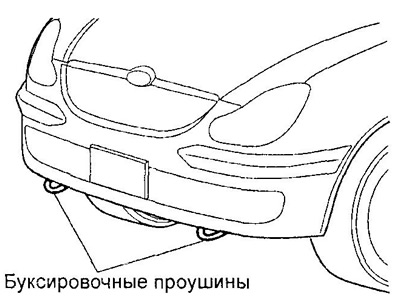


Type 1
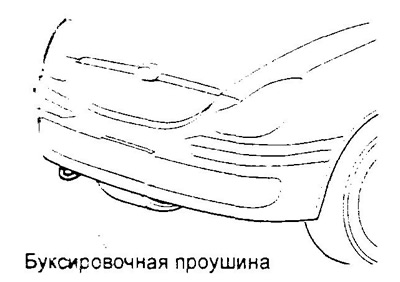


Type 2


Use extreme caution when towing your vehicle. Avoid sudden starts and abrupt maneuvers that may place excessive stress on the towing rope or chain. The loops, rope, or chain may break and cause serious injury or damage.


[The text is taken from the specified website: www.toyotaman.ru]

When towing a vehicle, perform the following operations:

1. Release the parking brake.

2. Set the gearshift lever to neutral or the automatic transmission selector to position "N".

3. The ignition key must be in the "ACC" position (the engine is not working) or "ON" (the engine is running).

Note: Do not remove the key from the ignition, as this will lock the steering wheel. If the engine is not running, the brake and steering boosters will not work, so the effort on the controls will be much greater than usual.


4. Use caution when towing a stuck vehicle. Stay clear of vehicles and the towing rope.
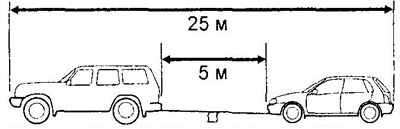


5. When towing using the full load method, use the transport eyes to secure the vehicle.

Note: Do not use the towing eyes for towing with a rope.
This article is available at: russian, bulgarian, belarusian, ukrainian, serbian, croatian, romanian, polish, slovak, hungarian
The article material has been checked: Kolokoltsev Grigory
Share information:
◀ Previous
Duet: User manual
Next ▶

Features of the transmission of 4WD models
Driving a car with a manual transmission
Driving a car with automatic transmission
Vehicle Stability Control (VSC)
Traction Control System (TCS)
Ignition switch — «KEY FREE» system
Engine start — «KEY FREE» system
If the engine does not start — the «KEY FREE» system
Starting the engine (if the spark plugs are «flooded») — «KEY FREE» system
Starting with an additional battery — the «KEY FREE» system
Similar articles on other Toyota models

➥ Tips for driving in different conditions Toyota Camry Vista V40 (1994-1998)
➥ Tips for driving in different conditions Toyota Corona T190 (1992-1997)
➥ Tips for driving in different conditions Toyota Carina T190 (1992-1996)
➥ Tips for driving in different conditions Toyota Cruiser 70 (1985-1996, diesel)
➥ Tips for driving on rough terrain Toyota RAV 4 XA10 (1994-2000)
➥ Fuel-efficient driving control device Toyota Corolla E80 (1983-1990)
Link in different formats to this article
Comments and feedback from visitors
No comments yet


Add two numbers 13 + 24


Duet (1998-2004) 
  • General information
  • User manual
  • Maintenance
  • Power unit
  • Petrol engines 1.0 l
  • Petrol engines 1.3 l
  • Engine overhaul
  • Cooling system
  • Lubrication system
  • Fuel injection system
  • Starting and charging system
  • Transmission
  • Clutch
  • Mechanical gearbox
  • Automatic gearbox
  • Drive shafts and cardan
  • Chassis, running gear
  • Car suspension
  • Steering
  • Brake system
  • Body and interior
  • Body elements
  • Heating and air conditioning
  • SRS security system
  • Electrical equipment
  • Equipment and devices
  • Electrical circuits
Dyna Y50/Y60 (1984-1995) 
  • Petrol engines «Y»
  • Checks and adjustments
  • Overhaul engine
  • Cooling and lubrication system
  • Fuel system
  • Starting and charging system
  • Ignition system
  • Diesel engines «L»
  • Engine repair
  • Cooling and lubrication system
  • Fuel system
  • Starting and charging system
  • Transmission
  • Clutch
  • Manual gearbox
  • Cardan shaft
  • Chassis, running gear
  • Car suspension
  • Brake system
  • Steering
  • Electrical equipment and body
  • Body elements
  • Equipment and devices
  • Electrical diagrams
ToyotaMan.ru © 2018–2026 • Mobile version • Interesting about Toyota • Administration • Sitemap: EN BG BY UA RS HR RO PL SK HU • Search system • Bookmark
Camry Vista-V40 • Camry XV10 • Camry XV20 • Camry XV30 • Corolla Verso-AR10 • Corolla E80 • Corona T190 • Carina T170 • Carina T190 • Land Cruiser J70 (diesel) • Land Cruiser J60 (petrol) • Land Cruiser J100 • Highlander XU20 (petrol) • 4Runner N120 • RAV4 XA10 • RAV4 XA20 • Duet M100 • Dyna Y50 •
We require cookies to enable some interactive features. Is that ok with you?