



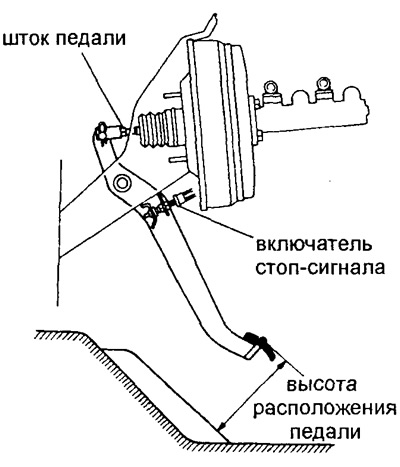
Pedal height
- DYNA 100 - 178 mm
- DYNA 150 - 183 mm
If necessary, adjust the pedal height.
2. Adjusting the pedal height:
a) Loosen the brake light switch.
b) Loosen the fork locknut.
c) Adjust the pedal height by rotating the pedal rod.
d) Tighten the brake light switch fasteners so that its housing slightly touches the pedal travel limiter.
d) After adjusting the pedal height, check and adjust the pedal free play.
c) Tighten the fork lock nut.
3. Check the pedal free play.
a) With the engine stopped, depress the brake pedal several times to ensure that there is no vacuum left in the booster.
b) Press the pedal until you start to feel resistance and measure the distance.
- Pedal free travel - 3-6 mm
4. If necessary, adjust the pedal free play.
a) Adjust the pedal free play by turning the pedal rod.
b) Make sure that there is free play even with the engine running, then check the pedal height.
5. Check that the pedal reserve travel is correct.
With the engine running and the parking brake lever released, depress the pedal and measure the reserve travel provided for it as shown.
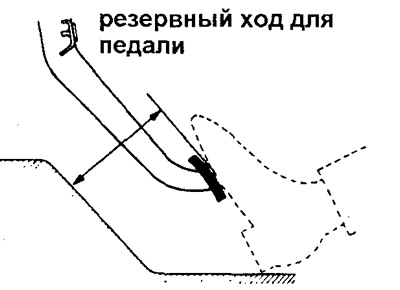
Reserve pedal travel from the floor panel at a force of 50 kg (490 N):
DYNA 100
Front drum brakes - not less than 80 mm
Front disc brakes:
- Petrol engine - not less than 75 mm
- Diesel engine - not less than 70 mm
View the original source on the website: www.ToyotaMAN.ru
DYNA 150
Front drum brakes:
- without automatic gap adjuster - not less than 52
- with automatic clearance regulator - not less than 79 mm
Front disc brakes:
- Petrol engine - not less than 68 mm
- Diesel engine - not less than 59 mm
With small diameter brake drums:
- Petrol engine - not less than 78 mm
- Diesel engine - not less than 68 mm
If there is a discrepancy, you need to find the fault in the brake system.