



Recommendation: if any work is carried out on the brake system, or if there is a suspicion of air in the brake lines, the brake system must be bled.
Warning: Do not allow brake fluid to come into contact with painted surfaces. Wash it off immediately.
1. Fill the reservoir with brake fluid.
Check the fluid level in the reservoir after bleeding the brake system on each wheel. Add brake fluid as needed.
2. Bleeding the master brake cylinder.
a) Disconnect the brake pipes from the master cylinder. Place a container underneath to drain the brake fluid.
b) Slowly depress the brake pedal and hold it in the depressed position.
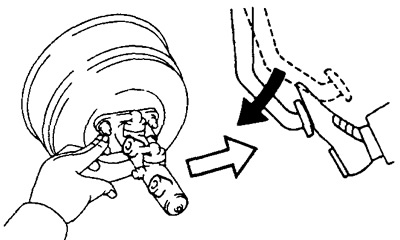
c) After plugging the outlet holes with your fingers, release the brake pedal.
d) Repeat operations "b" and "c" three or four times.
d) Connect the brake pipes to the master cylinder.
3. Connect the vinyl tube to the nipple of the wheel brake cylinder. Lower the other end of the tube into a container half filled with brake fluid.
Recommendation: you need to start releasing air from the wheel brake cylinder that has the longest hydraulic line.
4. Bleed the air from the line.
a) Slowly pump the brake pedal several times.
b) While the assistant is pressing the pedal, loosen the brake bleeder screw so that brake fluid starts to flow out. Then tighten the screw.
c) Repeat this procedure until the flowing liquid no longer contains air bubbles.
The original can be read on the website: ToyotaMan.ru
- Tightening torque of the nipple - 11 Nm
5. Repeat the procedure for each wheel cylinder.
6. Bleed the air from the load-sensing brake force distribution valve.