



Cleaning the radiator
Using a water or steam cleaner, remove dirt from the radiator core.
Warning: If high pressure cleaning is used (3.0 -3.5 MPa), care must be taken not to deform the radiator core fins.
Checking the condition of the radiator
1. Check the radiator cap.
Using the device, increase the pressure until the steam valve opens, which should correspond to a pressure of 0.75 kg/cm² (74 kPa) to 1.05 kg/cm² (103 kPa). Make sure that the pressure on the indicator does not drop sharply if its value is below 0.6 kg/cm² (59 kPa). Measure the opening pressure of the steam valve. If the test does not show compliance with the specified limits, replace the plug.
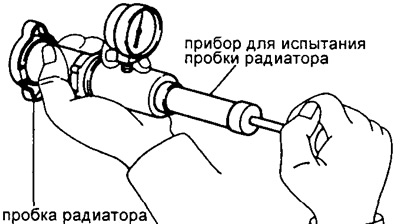
2. Check the cooling system for leaks.
a) Fill the radiator with coolant and install the device.
b) Warm up the engine.
c) Increase the pressure to 1.2 kgf/cm² (118 kPa), make sure that the pressure does not drop.
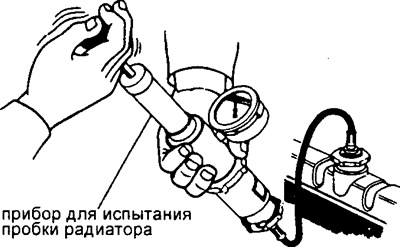
If the pressure drops, check the system for leaks from the hoses, radiator, or water pump. If no external leaks are found, check the heater core, engine block, and cylinder head.
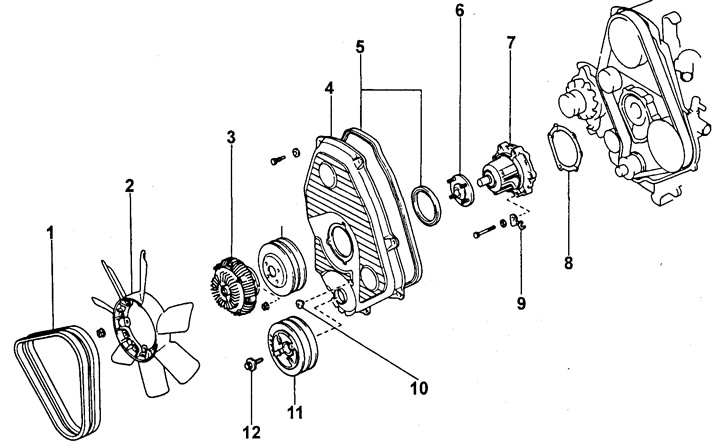
1 - drive belt,
2 - fan,
3 - viscous coupling,
4 - timing belt cover No.1,
5 - gasket,
6 - pulley seat,
7 - water pump,
8 - gasket,
9 - spring bracket,
10 - plug,
11 - crankshaft pulley,
12 - bolt M. 3.167 Nm.