Company Honda Company Ford Company Skoda Company Kia Company Mazda Company Mercedes Company Renault
English Русский
Български
Беларускі
Український
Српски
Hrvatski
Română
Polski
Slovenský
Magyar
Bookmark Articles Sitemap Contacts
ToyotaMan.ru


Camry Corolla Corona Carina Land Cruiser Highlander 4Runner RAV4 Others
Camry XV30 (2001-2006) Camry XV20 (1996-2001) Camry XV10 (1991-1996) Camry Vista V40 (1994-1998)

Installing pistons and connecting rods, checking bearing clearances [Toyota Camry XV10]

  • Main
  • Camry
  • XV10 (1991-1996)
  • Power unit
  • Overhaul of engines
  • Installing pistons and connecting rods, checking bearing clearances
0


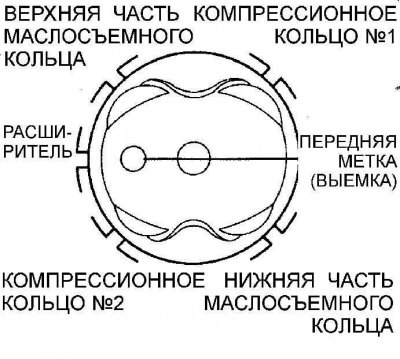
Location of piston ring locks on the piston


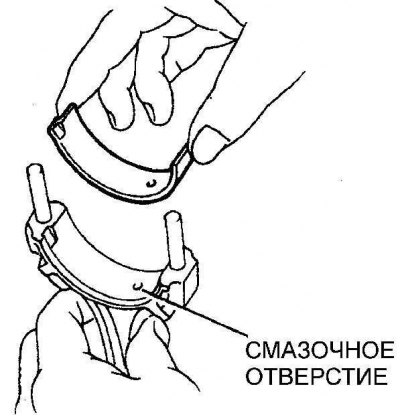
1. Clean the back of the bearing and its installation place in the connecting rod and the connecting rod cap. The lubrication holes in the connecting rod and bearing should be aligned.


2. Install the piston ring locks on the pistons as shown in the figure Location of piston ring locks on the piston.

3. Remove the rubber hose sections from the connecting rod lower head mounting studs.

The material is reprinted from an online resource www.ToyotaMAN.ru

4. Lubricate the pistons and piston rings with clean engine oil.

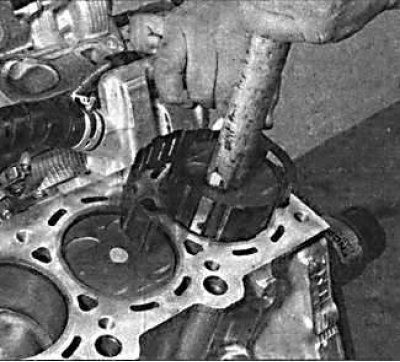
5. Compress the piston rings onto the piston using a special piston ring compressor.

6. Turn the crankshaft to the top dead center position of the first cylinder and apply a thin layer of oil to the cylinder walls.
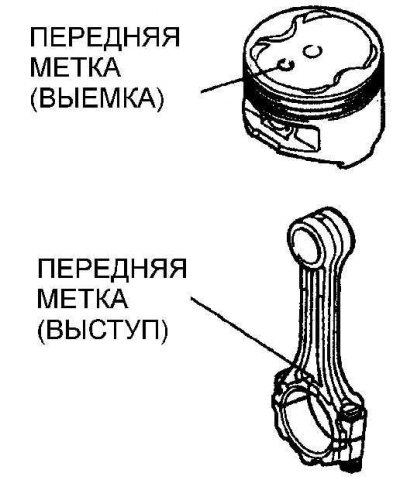


7. Insert the piston with the ring compressing device into the top of the first cylinder, with the notch on the piston facing the toothed belt.

8. Using a wooden block or the handle of a hammer, push the piston into the cylinder.

9. Check the alignment of the connecting rod lower head with the crankshaft journal. If necessary, tighten the piston with the connecting rod and install the connecting rod lower head with the liner on the crankshaft journal.

10. Check the connecting rod bearing clearance.

11. Clean the back of the bearing and its installation area in the connecting rod and the connecting rod cap.
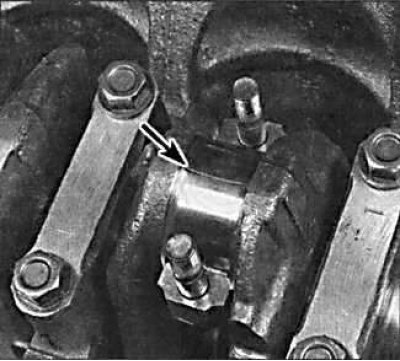


12. To check the operating clearance of the connecting rod lower end bearing, use the Plastigage method. In this case, a round plastic rod is used, which is compressed between the bearing shell and the crankshaft journal. After removing the connecting rod bearing cap, the deformed plastic rod is measured with a special template, which is included with the Plastigage. The procedure for using Plastigage is as follows. Install the connecting rods on the crankshaft without lubrication. The crankshaft journals and bearings must be completely clean and dry. Cut several pieces of plastic rod and install them on each crankshaft journal. Install the caps with the lower bearing shells and tighten the mounting bolts to the specified torque.
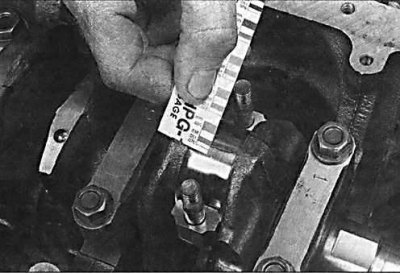


13. When measuring the clearance using the Plastigage method, do not rotate the engine crankshaft. Unscrew the lower connecting rod cap, remove it and apply the scale ruler printed on the package to the deformed plastic rod. By comparing the width of the deformed plastic rod with the reference width on the scale ruler, determine the clearance value. Finally, carefully clean off any traces of Plastigage material from the bearings and crankshaft.
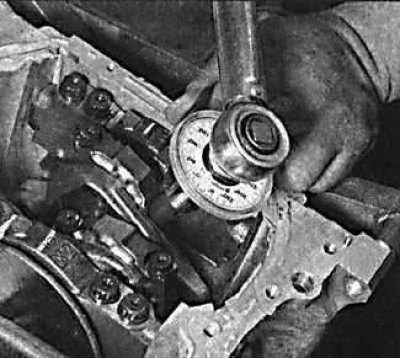


14. Apply a thin layer of engine oil to the working surfaces of the connecting rod bearings and install the connecting rod on the crankshaft journal. Install the lower connecting rod cap and tighten the mounting nuts to the required torque.

15. Install the remaining pistons and connecting rods in the same manner.
This article is available at: russian, bulgarian, belarusian, ukrainian, serbian, croatian, romanian, polish, slovak, hungarian
The article material has been checked: Mitrofanova Elena
Share information:
◀ Previous
Camry XV10: Overhaul of engines
Next ▶

Installing the rear crankshaft seal ring
Installing the crankshaft and checking the bearing clearances
Installing piston rings
Sequence of engine assembly during major repairs
Checking the balancer assembly play (engine 5S-FE)
Installing the balancer assembly (engine 5S-FE)
Starting the engine after major repairs
Similar articles on other Toyota models

➥ Checking pistons and connecting rods Toyota Carina T170 (1988-1992)
➥ Checking the condition of connecting rods and pistons Toyota 4Runner N120 (1989-1995)
➥ Connecting rods and pistons — check Toyota Cruiser 60/80 (1980-1997, petrol)
➥ Pistons and connecting rods — removal Toyota Highlander 1 (2000-2007, petrol)
➥ Pistons and connecting rods — removal Toyota RAV 4 XA20 (2000-2005)
➥ Assessment of the technical condition of connecting rods,… Toyota Dyna Y50/Y60 (1984-1995)
Link in different formats to this article
Comments and feedback from visitors
No comments yet


Add two numbers 16 + 25


Camry XV30 (2001-2006) 
  • User manual
  • Vehicle description
  • Keys, locks and alarms
  • Governing bodies
  • Salon equipment
  • Driving and operation
  • Maintenance
  • Power unit
  • 4-cylinder engine
  • Control system (I4)
  • Engine overhaul (I4)
  • 6-cylinder engine
  • Control system (V6)
  • Engine overhaul (V6)
  • Transmission
  • Clutch
  • Mechanical gearbox
  • Automatic gearbox
  • Drive mechanism
  • Chassis, running gear
  • Wheels and tires
  • Car suspension
  • Steering
  • Brake system
  • Body and interior
  • Exterior (external elements)
  • Doors, locks and windows
  • Air conditioning and heater
  • Electrical equipment
  • Equipment and devices
  • Power devices
  • Electrical circuits
Camry XV20 (1996-2001) 
  • General information
  • Controls and instruments
  • Driving and operation
  • Daily care
  • Maintenance
  • Power unit
  • 4-cylinder engine
  • 6-cylinder engine
  • Engine overhaul
  • Engine electrical equipment
  • Cooling system
  • Heating and ventilation
  • Fuel system
  • Exhaust system
  • Transmission
  • Mechanical gearbox
  • Automatic gearbox
  • Clutch
  • Chassis, running gear
  • Suspension and axle shafts
  • Steering
  • Brake system
  • Body and interior
  • Exterior (external elements)
  • Interior (internal elements)
  • Doors, locks and windows
  • Electrical equipment
  • Equipment and devices
  • Electrical circuits
Camry XV10 (1991-1996) 
  • General information
  • User manual
  • Maintenance
  • Power unit
  • 4-cylinder engine
  • 6-cylinder engine
  • Overhaul of engines
  • Cooling and heating
  • Fuel system
  • Engine electrical equipment
  • Control system
  • Transmission
  • Mechanical gearbox
  • Automatic gearbox
  • Clutch and drive shafts
  • Chassis, running gear
  • Brake system
  • Car suspension
  • Steering
  • Body and interior
  • Exterior (external elements)
  • Interior (internal elements)
  • Doors, locks and windows
  • Electrical equipment
  • Equipment and devices
  • Headlights and lighting
  • Electrical circuits
Camry Vista V40 (1994-1998) 
  • General information
  • User manual
  • Maintenance
  • Power unit
  • Petrol engines
  • Diesel engines
  • Engine overhaul
  • Cooling and lubrication system
  • Fuel system (diesel)
  • Fuel injection (petrol)
  • Engine electrical equipment
  • Transmission
  • Clutch and cardan
  • Automatic gearbox
  • Chassis, running gear
  • Front suspension
  • Rear suspension
  • Steering
  • Brake system
  • Body and interior
  • Body elements
  • Air conditioning and heater
  • SRS security system
  • Electrical equipment
  • Equipment and devices
  • Electrical circuits
ToyotaMan.ru © 2018–2026 • Mobile version • Interesting about Toyota • Administration • Sitemap: EN BG BY UA RS HR RO PL SK HU • Search system • Bookmark
Camry Vista-V40 • Camry XV10 • Camry XV20 • Camry XV30 • Corolla Verso-AR10 • Corolla E80 • Corona T190 • Carina T170 • Carina T190 • Land Cruiser J70 (diesel) • Land Cruiser J60 (petrol) • Land Cruiser J100 • Highlander XU20 (petrol) • 4Runner N120 • RAV4 XA10 • RAV4 XA20 • Duet M100 • Dyna Y50 •
We require cookies to enable some interactive features. Is that ok with you?