



a) Using a scraper, clean the piston bottom from carbon deposits.
b) Using the broken ring, clean the ring grooves.
c) Using solvent and a soft brush, clean the piston.
Note: Do not use a wire brush.
2. Check the piston diameter and the clearance between the piston and the cylinder.
Please note: all measurements must be taken at 20°C.
a) Using a micrometer, measure the piston diameter at a distance of 28 mm or 24 mm from the top surface of the piston crown in a plane perpendicular to the axis of the piston pin and passing through its center.
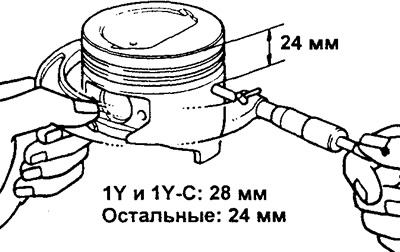
Piston diameter:
- Nominal - 85.915-85.945 mm
- Oversize (O/S) increased by 0.50 mm - 86.415-86.445 mm
- Oversize (O/S) increased by 0.75 mm - 86.665-86.695 mm
- Oversize (O/S) increased by 1.00 mm - 86.915-86.945 mm
b) Measure the cylinder diameter in the transverse direction, subtract the piston diameter size from the cylinder diameter size and calculate the clearance.
- Gap - 0.075 - 0.095 mm
If the clearance is greater than the allowable limit, replace the piston or rebore all four cylinders and replace all four pistons.
3. Check the gap between the ring and the piston groove using a feeler gauge.
- Gap - 0.03-0.07 mm
If the clearance is outside the permissible limits, replace the piston.
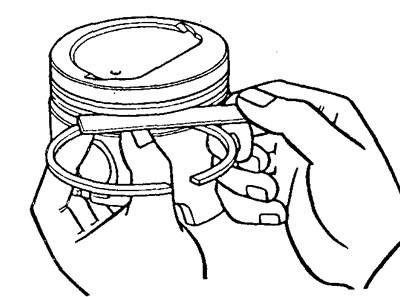
4. Check the piston ring gap.
a) Install the ring into the cylinder.
b) Using a piston, push the ring to a depth of 94 mm, 102 mm or 110 mm from the parting plane of the cylinder block.
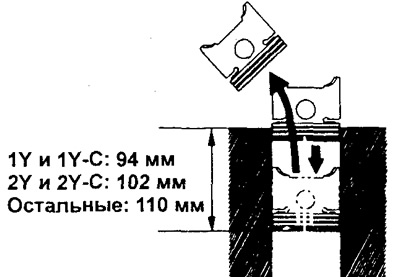
c) Using a feeler gauge, measure the gap in the lock.
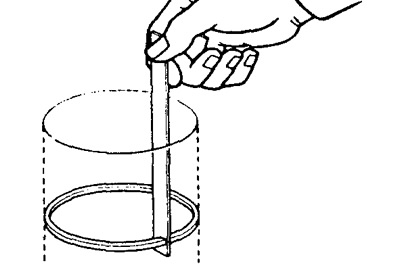
Nominal clearance in the lock:
- rings No.1 - 0.22-0.51 mm
- rings No.2 - 0.15-0.47 mm
- oil scraper ring - 0.13-0.50 mm
Maximum clearance in the lock:
- rings No.1 - 1.11 mm
- rings #2 - 1.07 mm
- oil scraper ring - 1.10 mm
If the clearance is greater than the maximum, replace the piston ring. If the clearance is greater than the maximum even with a new ring, bore all four cylinders and use oversize piston rings.
5. Check the connecting rods.
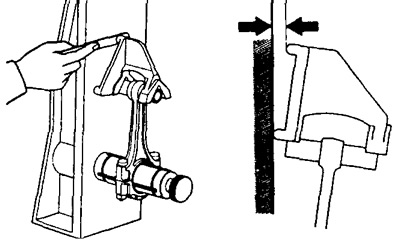
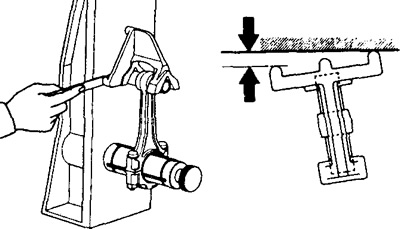
Using a crank tester, check the cranks for bending and twisting.
Maximum bending is 0.05 mm per 100 mm of connecting rod length.
If the bending value is greater than this value, replace the connecting rod.
Maximum twist is 0.15 mm per 100 mm of connecting rod length.
If the twist value is greater than this value, replace the connecting rod.
Caution: When replacing the connecting rod, install the same bearing number that is stamped on the cover of the new connecting rod.