
Company Honda Company Ford Company Skoda Company Kia Company Mazda Company Mercedes Company Renault
English Русский
Български
Беларускі
Український
Српски
Hrvatski
Română
Polski
Slovenský
Magyar
Bookmark Articles Sitemap Contacts
ToyotaMan.ru


Camry Corolla Corona Carina Land Cruiser Highlander 4Runner RAV4 Others
Duet (1998-2004) Dyna Y50/Y60 (1984-1995)

Diagnostics of sensors of systems for improving vehicle controllability [Toyota Duet M100]

  • Main
  • Toyota
  • Duet (1998-2004)
  • Chassis, running gear
  • Brake system
  • Diagnostics of sensors of systems for improving vehicle controllability
0
Note: When diagnosing speed sensors, the brake system operates as normal (vehicle handling enhancement systems not working).


1. Conduct diagnostics of the vehicle's control improvement systems.

2. If there is no malfunction, the ABS indicator will display sensor diagnostic codes.

3. Turn off the ignition and remove the jumper between the terminals of the diagnostic connector.

4. Make sure the selector is in the "P" position and turn on the ignition. The ABS buzzer should sound and the ABS indicator should flash.

5. Initialize the lateral movement sensor, deceleration sensor and brake master cylinder pressure sensor.

a) Place the vehicle stationary on a horizontal surface. Press the "TCS OFF" switch.

b) When the initialization mode is turned on, the "TCS OFF" indicator will light up and the buzzer will sound.

c) Do not press the brake pedal for more than 1 second. During this time, the pressure sensor in the master brake cylinder will be initialized. After initialization, the buzzer will turn on and off.

d) Press the brake pedal with a force of about 10 kg until the buzzer sounds. During this time, the lateral movement sensor, deceleration sensor and master cylinder pressure sensor will be initialized.

d) Release the brake pedal. The "TCS OFF" indicator should go out.

6. Initialize the steering wheel position sensor.

a) Set the steering wheel to the straight-ahead position. Press the brake pedal.

b) Turn the steering wheel all the way to the right, return it to the straight-ahead position, then all the way to the left and back to the straight-ahead position.


7. Set the automatic transmission selector to the "R" position, start the engine and move the selector to the "D" position. This will test the reverse sensor of the engine start prohibition switch.

8. Drive forward on a level surface at a speed of about 20 km/h for more than 5 seconds, then turn 90° without changing the driving speed. This will test the lateral displacement sensor and the deceleration sensor.

9. After checking all the blinking sensors, the test is completed and the ABS indicator stops blinking.

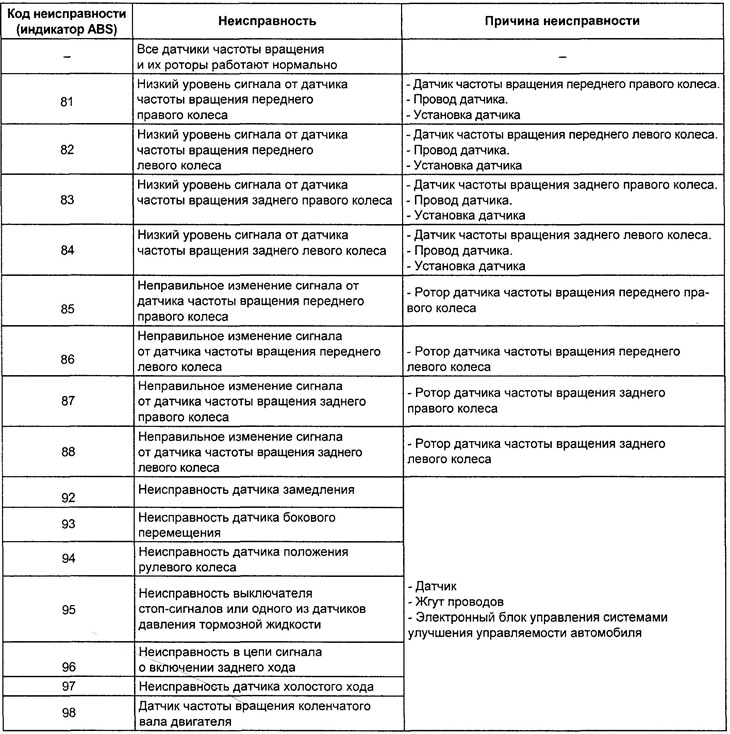
10. After stopping the vehicle, install a jumper between the "ECUT" and "E" terminals of the diagnostic connector and read the fault codes by the flashing of the ABS indicator (see the table "Fault codes for sensors of vehicle control systems").

Note.
  • During normal operation, the indicator flashes 2 times per second.
  • If there are two or more fault codes, the lowest one will be displayed first.


11. Turn off the ignition and remove the jumper from the diagnostic connector terminals.
This article is available at: russian, bulgarian, belarusian, ukrainian, serbian, croatian, romanian, polish, slovak, hungarian
The article material has been checked: Kolokoltsev Grigory
Share information:
◀ Previous
Duet: Brake system
Next ▶

Resetting fault codes
Checking vehicle handling improvement systems
Checking the ABS circuit
Rear wheel speed sensors
Removal and installation the deceleration sensor
Pressure modulator — diagnostics
Control relays — diagnostics
Diagnostics of front wheel speed sensors
Rear Wheel Speed Sensors — Diagnostics
Brake Master Cylinder Pressure Sensors
Similar articles on other Toyota models

➥ Diagnostics of faults in vehicle components and systems Toyota Cruiser 100 (1998-2007)
➥ Checking mechanical transmission systems: test on a fully… Toyota Carina T190 (1992-1996)
➥ Vehicle keys Toyota Camry XV20 (1996-2001)
➥ Control of ventilation and air conditioning systems Toyota Corolla E80 (1983-1990)
➥ Vehicle identification Toyota Corona T190 (1992-1997)
➥ Vehicle identification Toyota Highlander 1 (2000-2007, petrol)
Link in different formats to this article
Comments and feedback from visitors
No comments yet


Add two numbers 21 + 47


Duet (1998-2004) 
  • General information
  • User manual
  • Maintenance
  • Power unit
  • Petrol engines 1.0 l
  • Petrol engines 1.3 l
  • Engine overhaul
  • Cooling system
  • Lubrication system
  • Fuel injection system
  • Starting and charging system
  • Transmission
  • Clutch
  • Mechanical gearbox
  • Automatic gearbox
  • Drive shafts and cardan
  • Chassis, running gear
  • Car suspension
  • Steering
  • Brake system
  • Body and interior
  • Body elements
  • Heating and air conditioning
  • SRS security system
  • Electrical equipment
  • Equipment and devices
  • Electrical circuits
Dyna Y50/Y60 (1984-1995) 
  • Petrol engines «Y»
  • Checks and adjustments
  • Overhaul engine
  • Cooling and lubrication system
  • Fuel system
  • Starting and charging system
  • Ignition system
  • Diesel engines «L»
  • Engine repair
  • Cooling and lubrication system
  • Fuel system
  • Starting and charging system
  • Transmission
  • Clutch
  • Manual gearbox
  • Cardan shaft
  • Chassis, running gear
  • Car suspension
  • Brake system
  • Steering
  • Electrical equipment and body
  • Body elements
  • Equipment and devices
  • Electrical diagrams
ToyotaMan.ru © 2018–2026 • Mobile version • Interesting about Toyota • Administration • Sitemap: EN BG BY UA RS HR RO PL SK HU • Search system • Bookmark
Camry Vista-V40 • Camry XV10 • Camry XV20 • Camry XV30 • Corolla Verso-AR10 • Corolla E80 • Corona T190 • Carina T170 • Carina T190 • Land Cruiser J70 (diesel) • Land Cruiser J60 (petrol) • Land Cruiser J100 • Highlander XU20 (petrol) • 4Runner N120 • RAV4 XA10 • RAV4 XA20 • Duet M100 • Dyna Y50 •
We require cookies to enable some interactive features. Is that ok with you?