Contents: Table 1.40. Vehicle equipment with…↓ Frontal collision airbags ↓ Airbags that fill up in two stages ↓ Front airbag sensor ↓ Driver's seat position sensor ↓ Driver's knee airbag ↓ Switch in the driver's seat belt…↓ Airbag switch ↓ Table 1.41. Main differences (from…↓
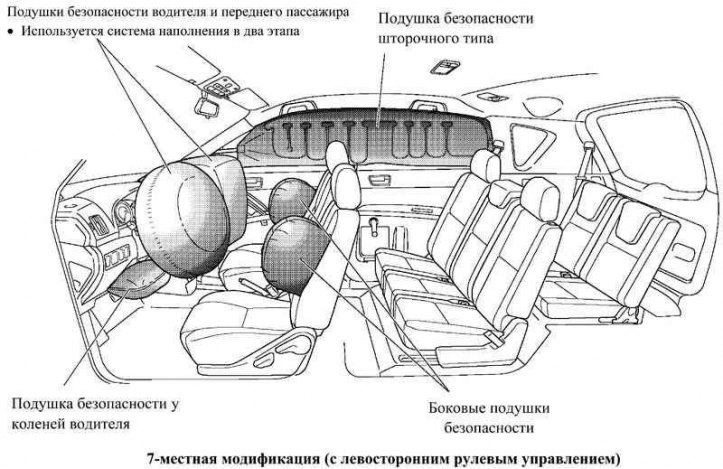
Fig. 1.108. Airbags of the Toyota Corolla Verso
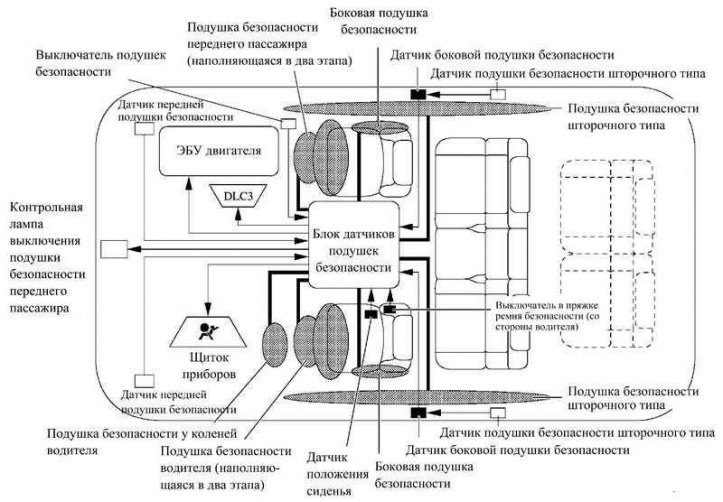
Fig. 1.109. Block diagram of the Toyota Corolla Verso car security system
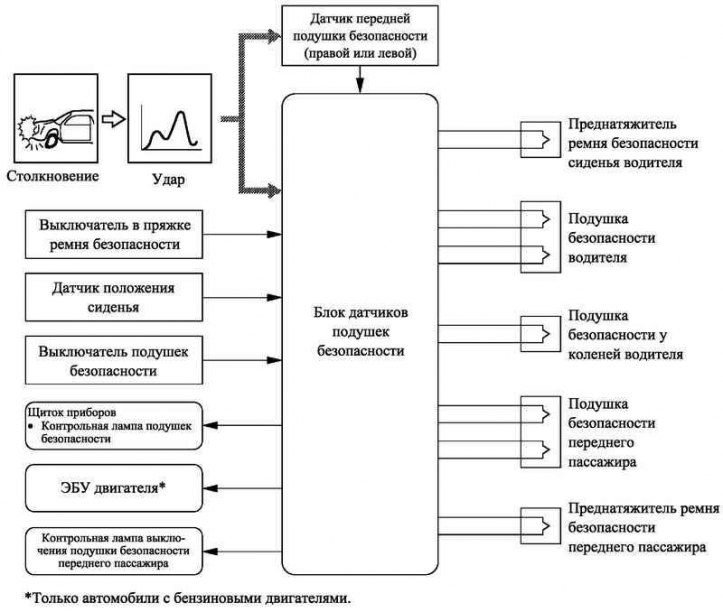
Fig. 1.110. Block diagram of the frontal airbag system
In addition to the seat belts, the vehicle is equipped with dual-stage driver and front passenger airbags to improve head and chest protection for the driver and front passenger. The airbag control system regulates the inflation of the airbags based on the severity of the impact, the position of the seat, and whether the seat belts are fastened.
In addition to the seat belts, the car is equipped with a driver's knee airbag, which provides additional protection for the driver in the event of a frontal collision.
All models are equipped as standard with an airbag switch that allows the deployment of the front and front passenger side airbags to be disabled if necessary.
Side airbags and curtain airbags protect the head and chest of the driver, front passenger and passengers in the outer rear seats in the event of a side impact.
As a measure to prevent power failure in the event of a collision, a backup power supply consisting of a capacitor and a voltage converter is installed in the airbag sensor unit (direct current to direct current converter).
The airbag sensor unit has a fuel shut-off control circuit that shuts off the fuel pump when any of the airbags is deployed (only on cars with petrol engines).
The new Corolla Verso uses an airbag system that includes the equipment listed in Table 1.40.
Table 1.40. Vehicle equipment with airbags

* Available on request for vehicles in TERRA grade
+: Standard equipment
Frontal collision airbags
In case of frontal collisions, three airbags are provided: for the driver, front passenger and at the driver's knees. The airbags are inflated simultaneously. The front airbags for the driver and front passenger are inflated in two stages.
The airbag control system regulates the inflation of the airbags depending on the severity of the impact, the position of the seat and whether the seat belts are fastened.
Airbags that fill up in two stages
To ensure two-stage inflation, the airbags are equipped with 2 sets of initiators and gas generators. The airbag sensor unit allows optimizing the airbag inflation process by delaying the initiators.
Front airbag sensor
The front airbags use an electrical sensor (acceleration sensor).
The acceleration sensor is placed in the front airbag sensor. Depending on the vehicle's deceleration during a frontal collision, the sensor is deformed and an electrical signal is generated. Accordingly, the force of the initial impact can be determined quite accurately.
Driver's seat position sensor
The seat position sensor, installed on the driver's seat guide, determines the longitudinal position of the seat. In addition, a shielding plate is installed on the seat guide, which allows the position of the seat to be determined.
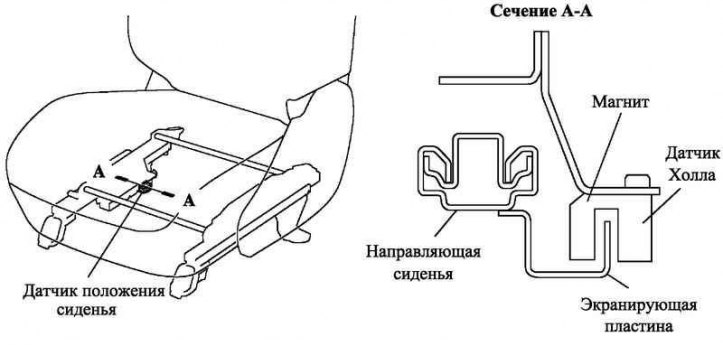
Fig. 1.111. Driver's seat position sensor
The seat position sensor uses a Hall sensor and a magnet on the back (fig. 1.111).
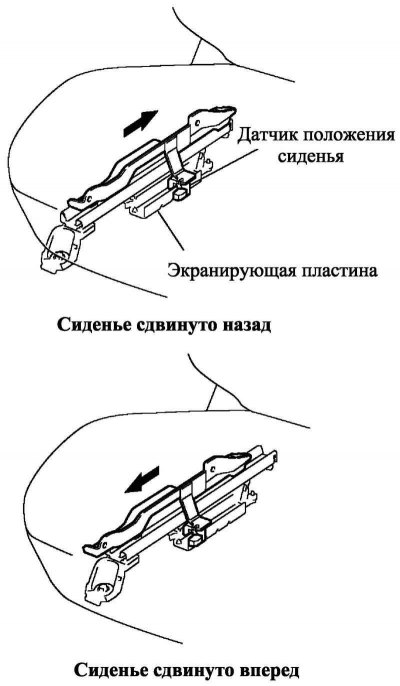
Fig. 1.112. Seat shielding plate
If the shielding plate is inside the position sensor (between the Hall sensor and the magnet), the position sensor detects that the seat has been moved back. If the shield plate is outside the position sensor, the sensor signals that the seat has been moved forward (fig. 1.112).
Driver's knee airbag
The driver's knee airbag, located under the dashboard in front of the driver's seat, consists of a bracket, cover, initiator and airbag shell.
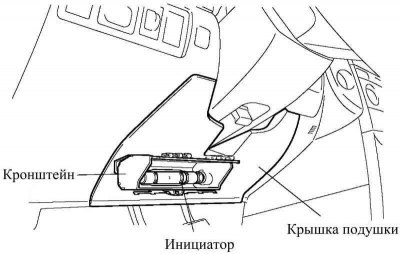
Fig. 1.113. Driver's knee airbag
In a frontal collision, the driver's knee airbag is inflated by a signal from the airbag sensor unit. It helps protect the driver by keeping the legs from sliding forward (fig. 1.113).
Switch in the driver's seat belt buckle
The seat belt buckle sensor, consisting of an ejector with a plate, a Hall sensor and two magnets, is built into the front seat belt buckle.
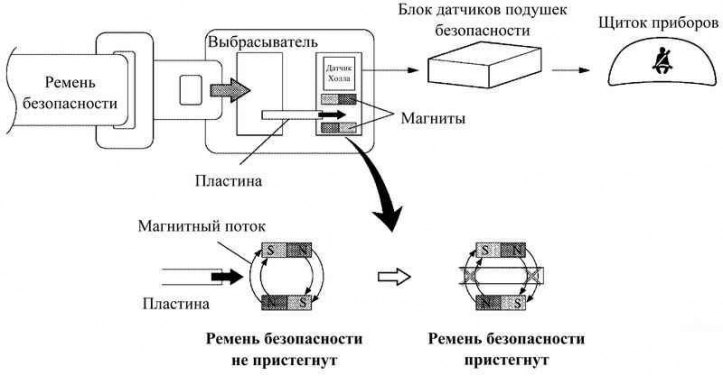
Fig. 1.114. Switch in the driver's seat belt buckle
The ejector with the plate interrupts the magnetic flow between two magnets. The Hall sensor transmits this change to the airbag sensor unit (fig. 1.114).
Airbag switch
A switch is included as standard to disable the deployment of the front passenger airbags and side airbags. The switch should be used if you do not want these airbags to inflate, for example if a child seat is installed in the front seat.
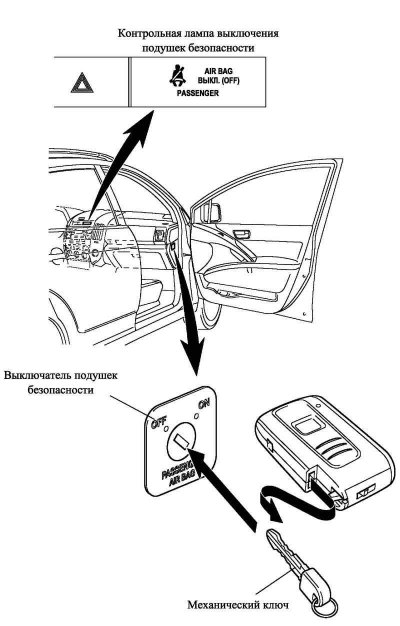
Fig. 1.115. Airbag switch
The switch is installed on the passenger side of the front panel. It can be switched on and off with a mechanical key provided with the remote control. If the airbag switch is set to the "Off" position. ("OFF"), the front and side passenger airbags will not work in the event of a collision (fig. 1.115).
If the front passenger airbags are deactivated, a warning light in the center of the instrument panel will come on.
Table 1.41. Main differences (from the previous model)