
- Do not bend or twist the timing belt.
- Do not allow the toothed belt to come into contact with oil or water.
- Do not stretch the timing belt when installing or removing the camshaft sprocket bolt.
2 Check the timing belt for below defects as shown in the figure
- A) Check the correct installation of the timing belt
- Check the timing belt cover gaskets for damage and correct installation
- b) If the belt teeth are damaged or cracked, check that the camshaft and fluid pump are not jammed.
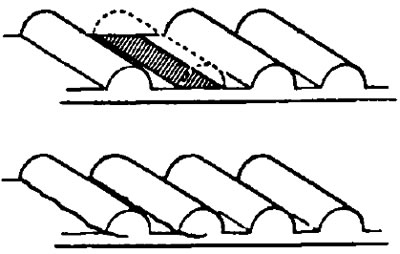
- V) If there is significant wear on the non-working side of the belt, check for nicks on the side of the tensioner pulley.
- G) If wear or damage is found on only one side of the belt and the pulleys are correctly positioned.
- d) If there is significant wear on the belt teeth, check the toothed belt cover for damage. If necessary, replace the timing belt.
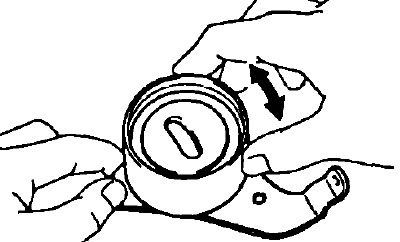
3. Check up a tension roller and an intermediate pulley.
- A) Check roller and pulley surfaces for smooth rotation. Replace if necessary.
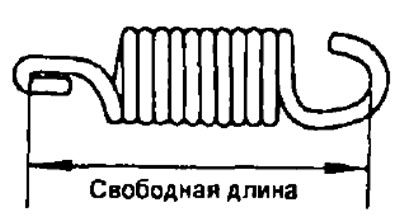
4. (3S-FE, 4A-FE, 4S-FE, 5E-FE. 7A-FE) Check the tension roller spring. Measure the free length of the spring (see picture), as well as the force required for a given deformations (stretch marks) springs ("installation" an effort)
Spring free length:
- 3S-FE, 4S-FE - 46.0mm
- 2C, 2C-T - 51.9 mm
- 4A-FE - 35.3mm
- 5E-FE - 38.4mm
- 7A-FE - 31.8mm
If the free length is not correct, replace the idler pulley spring.
Reinforcement required to increase the length of the spring to "installation" states.
- 3S-FE, 4S-FE (50.5 mm) - 32-37 N
- 2S, 2S-T (63.0 mm) - 42 N
- 4A-FE (43.6 mm) - 35-39 N
- 5E-FE (47.4 mm) - 32 N
- 7A-FE (37.6 mm) - 47.5-51.5 N
If the length of the spring and/or "installation" force is out of specification, replace the spring.