



Note: Check and adjust the valve clearance on a cold engine
1. Disconnect the crankcase ventilation hoses from the cylinder head cover.
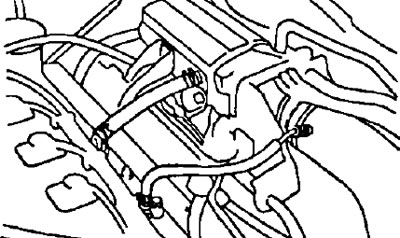
2. Disconnect the engine wiring harness from the intake manifold.
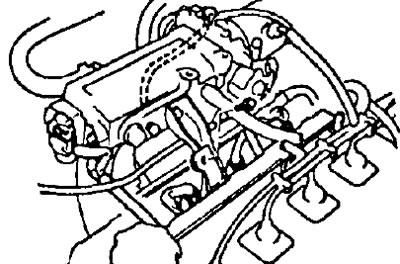
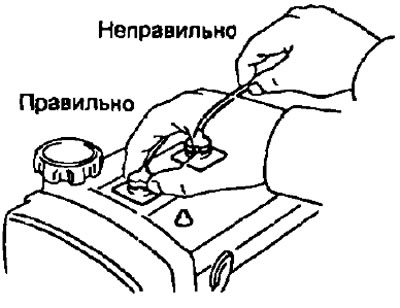
3. Disconnect the high-voltage wires from the spark plugs.
Note: Straining or bending the drive may cause internal damage.
4. Remove the cylinder head cover
- a) Remove the oil filler cap.
- b) Unscrew the five nuts and remove the sealing washers.
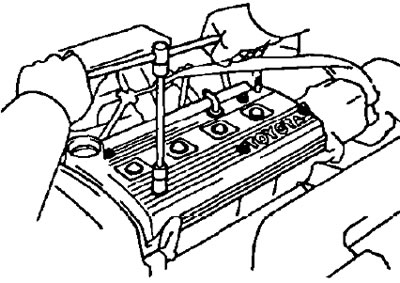
- c) Remove the cylinder head cover and gasket.
Note: Place the seals in reverse order so that they are in their original positions when installed. This will reduce the chance of oil leakage due to reuse of seals.
5. Set the piston of cylinder No.1 to TDC of the compression stroke.
- a) Turn the crankshaft pulley and align its mark with the timing mark "O" on timing belt cover No.1.
- b) Check that the valve tappets of cylinder #1 are free and that the valve tappets of cylinder #4 are tight. If not, rotate the crankshaft one revolution (360°) and align the mark as indicated above.
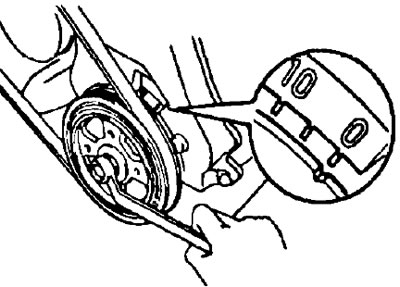
6. Check the valve clearance
- a) Check the clearance in the valve drive indicated in the figure.
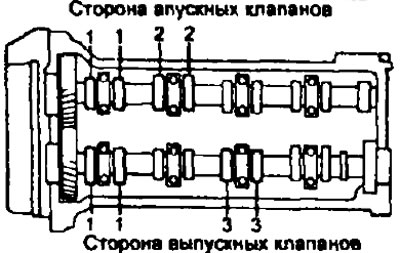
- Using a feeler gauge, measure the clearance between the tappet and the camshaft.
- Record the valve clearance measurements. They will be used later to determine the required shim size for replacement.
- Valve clearance (cold engine):
- inlet - 0.15-0.25 mm
- outlets - 0.31-0.41 mm
- b) Rotate the crankshaft one revolution (360°) and align the marks as indicated above.
- c) Measure the clearance in the valve drive indicated in the figure.
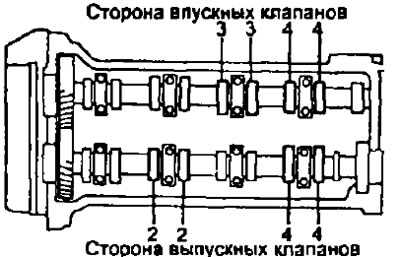
7. Adjust the valve clearance.
- a) Remove the adjusting washer. Turn the crankshaft so that the cam lobe is facing up.
- Set the tappet mark so that the adjusting washer can be removed with a small screwdriver.
The material is republished from an online website: ToyotaMan.ru
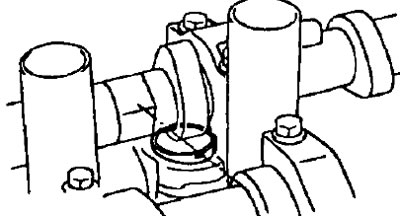
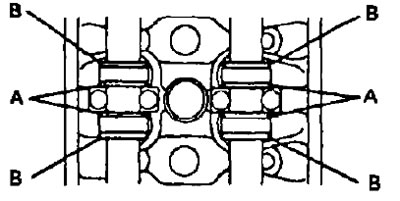
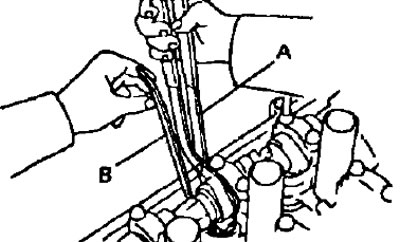
- Using the special tool, press the tappet and place the special tool (B) between the camshaft and the tappet. Remove the special tool (A).
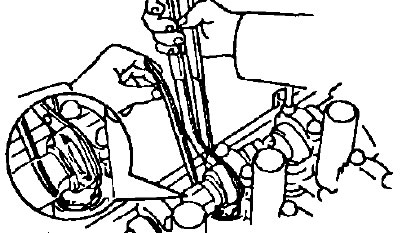
Notes:
- Install the special tool (A) in any of the locations indicated by A and B in the figure.
- To easily remove the adjusting shim, install the special tool (B) on the pushrod so that there is enough space to remove the adjusting shim.
- Remove the adjusting washer using a small screwdriver and a magnetic rod.
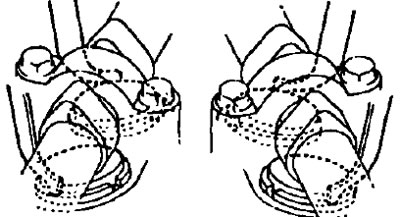
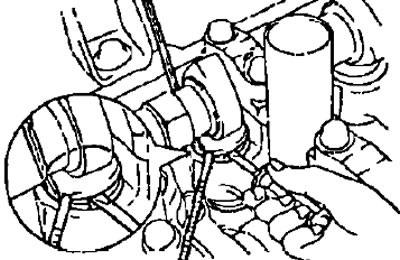
- b) Determine the size of the new adjusting washer using the following method:
- Using a micrometer, measure the thickness of the removed adjusting shim
- Calculate the thickness of the new adjusting shim so that the valve clearance is within the specified values.
- Thickness of the removed adjusting washer - T
- Measured valve clearance - A
- Thickness of the new adjusting washer - N
- inlet — N=T+(A-0.20 mm)
- outlet - N=T+(A-0.36 mm)
- Select a new shim with a thickness as close to the calculated value as possible.
Note: There are 17 sizes of adjusting washers (thickness values) from 2.50 mm to 3.30 mm in 0.05 mm increments.
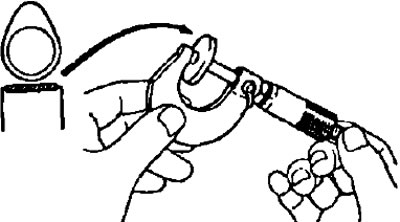
- c) Install a new adjusting washer
- Install a new adjusting washer into the tappet. Using the special tool (A), press the tappet and remove the special tool (B).
- d) Recheck the valve clearance
8. Install the cylinder head cover.
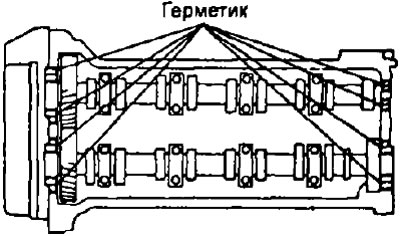
- a) Remove the old sealing material and apply sealant to the cylinder head as shown in the figure.
- 6) Install the gasket and then the cylinder head with five sealing washers
- Tightening torque - 7 Nm
- c) Install the oil filler cap.
9. Connect the high-voltage wires by tightening the bolt securing the high-voltage wire holders to the cylinder head cover.
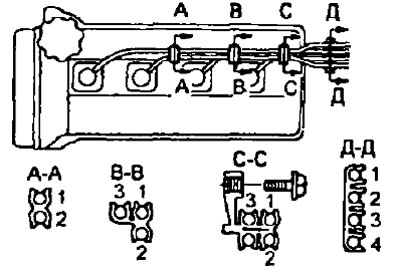
10. Install the engine wiring harness and its protection, securing it with a bolt.
11. Connect the crankcase ventilation hoses.