



Contents: Test on "D" range ↓ Checking the operation of the torque…↓ Check for range "2" ↓ Testing on the "L" range ↓ Test on the "R" range ↓ Check in the "P" range ↓
Note: Before starting the test, warm up the transmission fluid to a temperature of 50-80°C.
Test on "D" range
Move the selector to the "D" range and press the accelerator pedal all the way down.
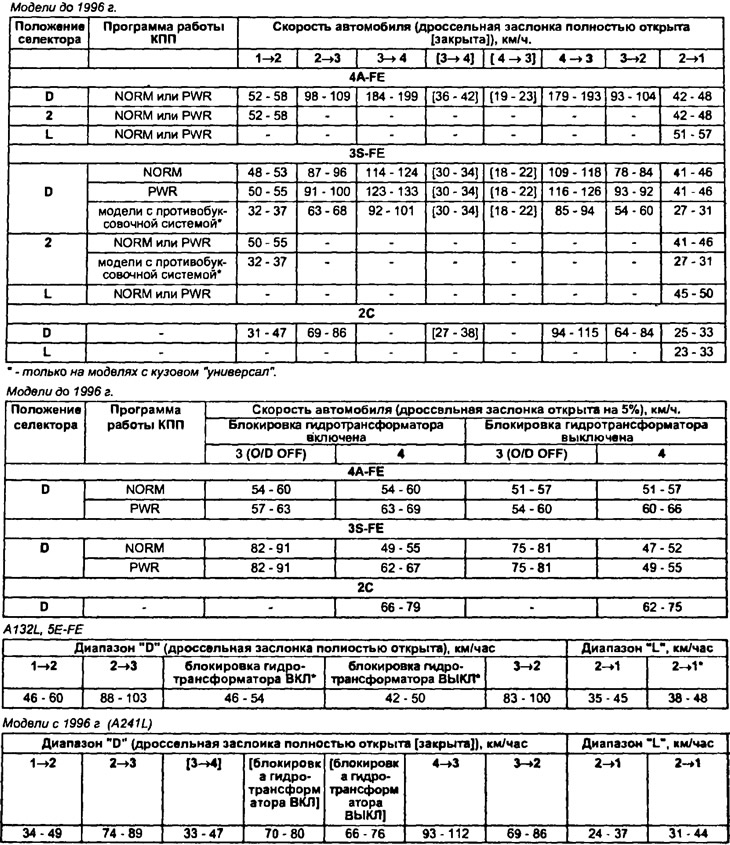
1. Check for the presence of 1→2, 2→3, 3→4 switching and that the switching moments correspond to the values given in Table 5.
Table 5. Switching moments

Analysis of results.
Note: the A132L automatic transmission does not have 3→4 switching, since it is three-stage.
- a) No switching 1→2:
- electromagnetic valve #2 is faulty,
- the 1→2 switching valve is stuck.
- b) No switching 2→3:
- electromagnetic valve #1 is faulty,
- the 2→3 switching valve is stuck.
- c) No switching 3→4:
- the 3→4 switching valve is stuck,
- d) Switching points do not correspond to Table 5:
- the throttle valve control cable is not adjusted,
- the throttle valve, 1→2 switching valve, 2→3 switching valve, 3→4 switching valve, etc. are faulty.
- d) No torque converter lock-up:
- the electromagnetic valve controlling the torque converter lock-up clutch is jammed,
- the locking valve is faulty
- hydraulic transformer;
- e) A245E: Controlled slip clutch lock does not work:
- the electromagnetic valve for controlling the quality of the torque converter lockup is jammed,
- the locking relay valve is stuck.
2. Similarly, check for any jolting or slipping of the friction control elements when shifting 1→2, 2→3 and 3→4.
Analysis of results.
If you feel strong jolts when shifting:
- the pressure in the main line is too high,
- the hydraulic accumulator is faulty,
- check valve defect.
3. When operating in third or overdrive gear, in the "D" range, check for any abnormal noise or vibration.
Note: Noise and vibration may be caused by imbalance of the driveshaft, differential, transformer, etc.
4. Check the operation of the forced downshift (kick-down), 2→3→2, 4→Z and the compliance of the switching torques with the values given in Table 5. Analyze the results.
If the downshift speeds do not correspond to the table, then:
- incorrect adjustment of the throttle cable,
- the throttle valve, 1→2 switching valve, 2→3 switching valve, 3→4 switching valve, etc. are faulty.
5. Check for any jolts or slippage when forced downshifting.
Checking the operation of the torque converter lock-up
1. When driving in upshift at a steady speed, locking should occur at approximately 70 km/h (for A132L - 55 km/h).
2. Lightly press the accelerator pedal: the rotation speed should not change abruptly. If there is a abrupt change, there is no locking.
Check for range "2"
1. Move the selector to position "2", press the accelerator pedal all the way down. Check for 1→2 switching and that the switching moment corresponds to the value specified in Table 5.
Please note: Range "2" does not have overdrive or lock-up mode.
2. When driving in 2nd gear after the load is released, the engine braking mode should be in place. If there is no engine braking, then the brake providing the engine braking mode in 2nd gear is faulty.
3. Check the noise and vibration levels during upshifting and downshifting.
Testing on the "L" range
1. When driving in the "L" range, there should be no upshifts - the car should only move in first gear.
2. When the load is dropped (releasing the accelerator pedal) there should be engine braking. If there is no engine braking, the first gear and reverse gear brakes are faulty.
3. Check the level of noise and vibration when accelerating and decelerating the vehicle.
Test on the "R" range
Move the selector to the "R" position, press the accelerator pedal all the way down. Check for slippage of the friction controls.
Check in the "P" range
Position the vehicle on a slope (at least 5°), move the selector to position "P" and release the parking brake: the locking mechanism latch should hold the vehicle.