



- a) Warm up the transmission fluid to operating temperature (50-80°C).
- b) Unscrew the service plug of the gearbox housing and connect a pressure gauge in its place.
Caution: Perform the check in pairs - one person should watch the wheels or wheel stops while the other performs the check.
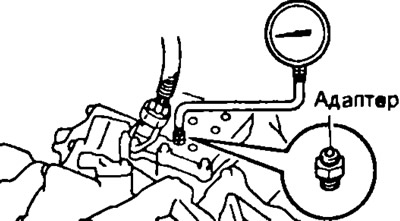
2. Measure the pressure.
- a) Start driving by pressing the accelerator pedal halfway or more. Check the change in pressure in the line. Pressure 294-588 kPa.
- b) Release the accelerator pedal. Measure the pressure in the line. The pressure is 9.8 kPa or less.
Attention:
- Make sure there is no wheel slippage when performing the check.
- Conduct the check at an automatic transmission temperature of 50-80°C.
3. Measure the pressure in the line when the solenoid valve is open (voltage is applied)
- a) To measure, perform additional operations,
- prepare an additional connector,
- connect wires, 1-2 m long, to terminals "1" and "3" of the connector,
- connect the 24W pump as shown in the picture.
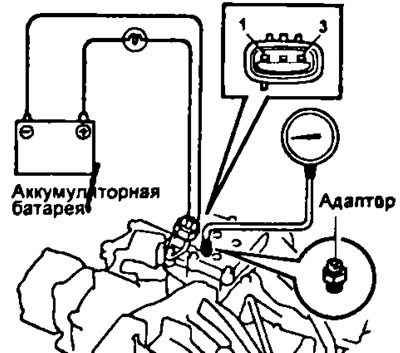
- b) Connect the positive terminal of the battery to terminal "1" and the negative terminal to terminal "3".
- c) Measure the pressure at idle speed and maximum speed.
4. Analysis of the test results:
- a) The pressure value for all conditions above those indicated in Table 4:
- the interaxle differential lock control valve is faulty,
- b) If the measured values for all states are less than those specified, then:
- the oil pump is faulty,
- the interaxle differential lock control valve is faulty,
- c) If the measured values are lower or higher than those indicated with the adapter connected, then:
- the center differential lock control valve is faulty.
Table 4.
| Engine operating mode | Adapter | Line pressure, kPa |
| Idle mode | connected | 363-422 |
| Maximum rotation speed | connected | 735-863 |
| All modes | not connected | 9.8 or less |