



- a) Warm up the automatic transmission fluid to operating temperature (50-80°C).
- b) Unscrew the service plug of the gearbox housing and connect a pressure gauge in its place.
Caution: Perform the check in pairs: one person should observe the wheels or wheel stoppers and the other should perform the check.
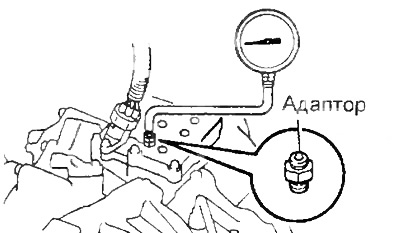
2. Measure the pressure.
a) Start driving by pressing the accelerator pedal halfway or more. Check the change in pressure in the line.
- Pressure - 294 kPa
c) Release the accelerator pedal. Measure the pressure in the line.
- Pressure - 98 kPa or less
Attention:
- Before starting the test, make sure there are no obstacles on the road.
- Make sure there is no wheel slippage when performing the check.
- Conduct the test at a temperature of the automatic transmission fluid of 50-80°C.
3. Measure the pressure in the line when the solenoid valve is open (voltage is applied).
a) To measure, perform additional operations:
- prepare an additional connector;
- connect wires, 2-3 m long, to terminals "1" and "3" of the connector;
- connect the 24W lamp as shown in the picture.
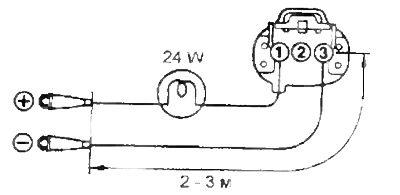
b) Connect the wire from the positive terminal of the battery to terminal "1" and the wire from the negative terminal to terminal "3".
c) Measure the pressure at idle speed and with the accelerator pedal fully depressed.
4. Analysis of the test results:
a) If the pressure for all conditions is higher than specified in the table "Pressure in the line of the interaxle differential lock clutch", then:
- the center differential lock valve is faulty.
b) If the measured values for all states are less than those specified, then:
- the pump is faulty,
- the center differential lock valve is faulty.
c) If the measured values are lower or higher than those indicated, with the adapter connected, then:
- the center differential lock valve is faulty.
Table. Pressure in the line of the interaxle differential lock clutch
