
Company Honda Company Ford Company Skoda Company Kia Company Mazda Company Mercedes Company Renault
English Русский
Български
Беларускі
Український
Српски
Hrvatski
Română
Polski
Slovenský
Magyar
Bookmark Articles Sitemap Contacts
ToyotaMan.ru


Camry Corolla Corona Carina Land Cruiser Highlander 4Runner RAV4 Others
Cruiser 100 (1998-2007) Cruiser 60/80 (1980-1997, petrol) Cruiser 70 (1985-1996, diesel)

Altitude Compensation System (2L-T if equipped) [Toyota Land Cruiser J70]

  • Main
  • Land Cruiser
  • J70 (1985-1996)
  • Power unit
  • Engine adjustment
  • Altitude Compensation System (2L-T if equipped)
0

Check on the car


Type 1


Note: Removal and installation of measuring instruments should only be carried out with the engine stopped.


1. Preparation

Install vacuum gauges in the gap of the throttle actuator hoses (on the intake manifold).
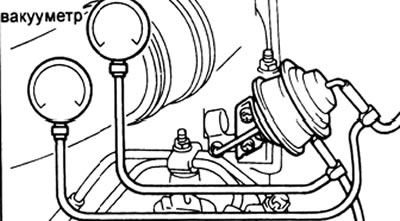


2. Verification (low altitude operation)

Note: Low altitudes include altitudes up to 800 m above sea level (pressure over 700 mm Hg).


a) Start the engine at idle speed: the drive rod should retract under the action of vacuum on one of the drive diaphragms.

b) Press the accelerator pedal - the vacuum on the drive diaphragm will disappear, and the drive rod should extend.
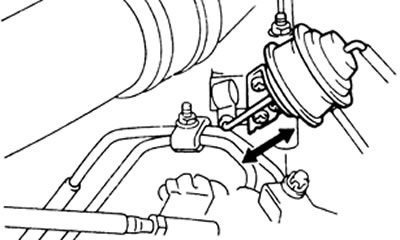


c) Turn off the ignition; a vacuum should appear on both diaphragms and the drive rod should retract.


d) Gradually the drive rod should return to its original position.

3. Verification (high altitude operation).

The test must be carried out at an altitude of more than 800 m above sea level and a pressure below 690 mm Hg.

Under these conditions, the diaphragm rod should not move under any engine operating mode, and therefore, a vacuum should not occur on the diaphragm.

Type 2


1. Preparation.

Install a vacuum gauge into the gap in the diaphragm hose of the damper drive.
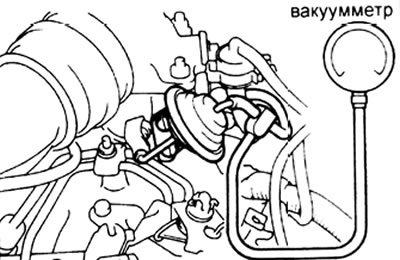


2. Checking the work.

a) Start the engine: the vacuum on the diaphragm should be zero.

This material is taken from a resource (www.ToyotaMAN.ru)

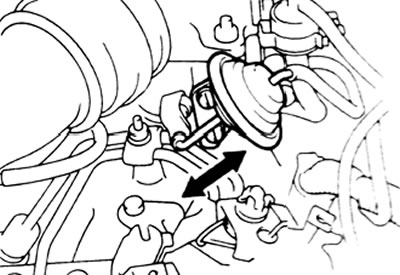
b) Stop the engine: the vacuum on the diaphragm should move the drive rod and, over time, the rod should return to its original position.
This article is available at: russian, bulgarian, belarusian, ukrainian, serbian, croatian, romanian, polish, slovak, hungarian
The article material has been checked: Mitrofanova Elena
Share information:
◀ Previous
Cruiser 70: Engine adjustment
Next ▶

Adjusting the idle speed with the air conditioner on
Adjusting idle speed and maximum speed
Checking and adjusting the injection advance angle (except 2L-T models…
Checking and adjusting the injection advance angle (2L-T models with a…
Adjusting the clearances in the valve timing mechanism
Checking the elements of the altitude compensation system
Checking the end of compression stroke pressure
Similar articles on other Toyota models

➥ Precautions when operating vehicles equipped with the SRS… Toyota Duet (1998-2004)
➥ Engine immobilizer system Toyota Camry XV20 (1996-2001)
➥ Ventilation system control Toyota Corolla E80 (1983-1990)
➥ Anti-lock braking system (ABS) Toyota Corona T190 (1992-1997)
➥ Navigation system Toyota Carina T190 (1992-1996)
➥ Engine electrical system Toyota Highlander 1 (2000-2007, petrol)
Link in different formats to this article
Comments and feedback from visitors
No comments yet


Add two numbers 11 + 13


Cruiser 100 (1998-2007) 
  • General information
  • Introduction to the guide
  • Controls and instruments
  • Maintenance
  • Power unit
  • Petrol engines
  • Diesel engines
  • Cooling and heating
  • Power and exhaust systems
  • Engine electrical equipment
  • Engine management systems
  • Transmission
  • Automatic gearbox
  • Transmission line
  • Chassis, running gear
  • Brake system
  • Car suspension
  • Steering
  • Body and interior
  • Exterior (external elements)
  • Interior (internal elements)
  • Doors, locks and windows
  • Electrical equipment
  • Equipment and devices
  • Electrical circuits
Cruiser 60/80 (1980-1997, petrol) 
  • General information
  • User manual
  • Maintenance
  • Power unit
  • Petrol engines 2F and 3F-E
  • Petrol engines 1FZ-FE
  • Engine overhaul
  • Engine electrical equipment
  • Cooling and heating
  • Fuel system (carburetor)
  • Fuel system (injector)
  • Toxicity reduction system
  • Transmission
  • Car gearbox
  • Clutch
  • Transfer case
  • Drive shafts and axles
  • Chassis, running gear
  • Brake system
  • Car suspension
  • Steering
  • Body and interior
  • Exterior and interior
  • Doors, locks and windows
  • Electrical equipment
  • Equipment and devices
  • Electrical circuits
Cruiser 70 (1985-1996, diesel) 
  • General information
  • User manual
  • Maintenance
  • Power unit
  • Engine adjustment
  • Engine repair
  • Fuel system
  • Control system
  • Turbocharging system
  • Cooling and lubrication system
  • Charge and start system
  • Transmission
  • Clutch
  • Mechanical gearbox
  • Automatic gearbox
  • Transfer case
  • Chassis, running gear
  • Car suspension
  • Brake system
  • Steering
  • Body and interior
  • Body elements
  • Heating and air conditioning
  • Electrical equipment
  • Equipment and devices
  • Electrical circuits
ToyotaMan.ru © 2018–2026 • Mobile version • Interesting about Toyota • Administration • Sitemap: EN BG BY UA RS HR RO PL SK HU • Search system • Bookmark
Camry Vista-V40 • Camry XV10 • Camry XV20 • Camry XV30 • Corolla Verso-AR10 • Corolla E80 • Corona T190 • Carina T170 • Carina T190 • Land Cruiser J70 (diesel) • Land Cruiser J60 (petrol) • Land Cruiser J100 • Highlander XU20 (petrol) • 4Runner N120 • RAV4 XA10 • RAV4 XA20 • Duet M100 • Dyna Y50 •
We require cookies to enable some interactive features. Is that ok with you?