



Note: Please perform this test for 3-5s to avoid damaging the stator winding.
1. Checking the pull-in winding of the traction relay.
a) Disconnect the winding wire from the starter terminal "C".
b) Connect the wires from the battery to the terminals of the traction relay as shown in the figure. Make sure that the overrunning clutch gear has moved outward.
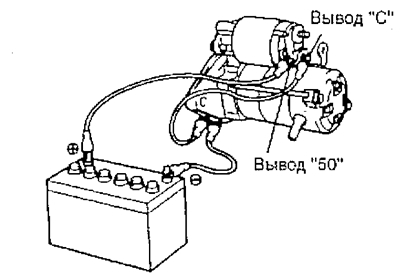
0.8 kW (A series)
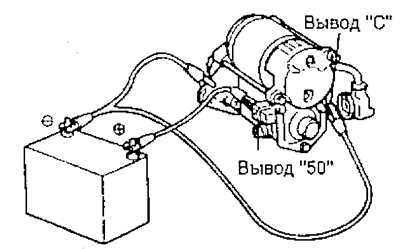
1.2 kW (a series, S series)
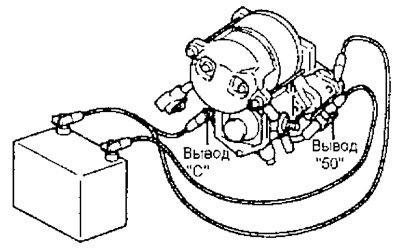
1.4 kW (2C)
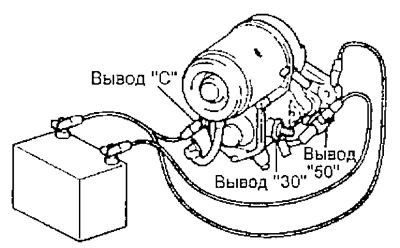
2.2 kW (2C)
If the overrunning clutch pinion does not extend, replace the traction relay assembly.
2. Checking the holding winding. With the connection made as in the previous step and the overrunning clutch pinion extended, disconnect the (-) wire from terminal "C". Check that the pinion remains extended. If the pinion returns inward, replace the traction relay assembly.
3. Check if the overrunning clutch pinion gear returns. Disconnect the (-) wire from the traction relay housing. Check if the overrunning clutch pinion gear has retracted inward. If the overrunning clutch pinion gear has not retracted, replace the traction relay assembly.
4. Check the starter operation without load.
a) Connect the wires from the battery and from the ammeter to the starter as shown in the figure, and also connect the winding wire to the starter terminal "C".
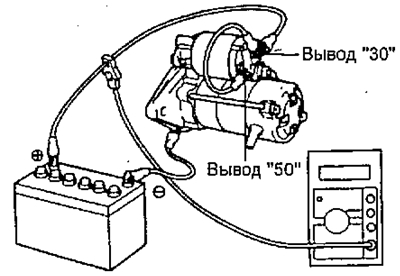
0.8 kW (A series)
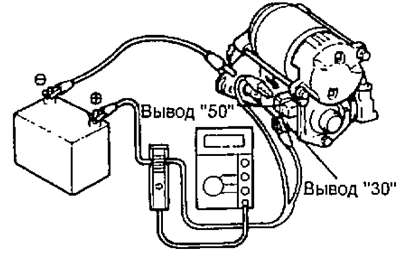
1.2 kW (a series, S series)
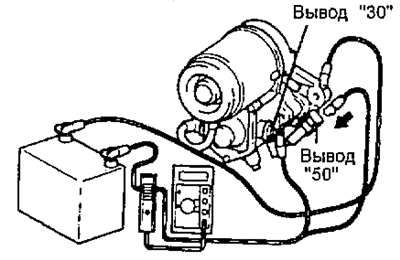
2.2 kW (2C)
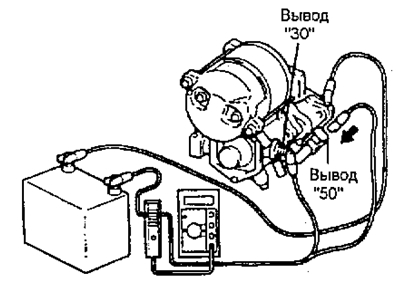
1.4 kW (2C)
b) Check that the starter armature rotates evenly and the drive gear of the overrunning clutch is extended. Measure the current with an ammeter.
Nominal current (at 11.5 V):
- except starter 2.2 kW - 90 A
- starter 2.2 kW (2C) - 120 A