



Contents: Malfunction #1: No switching ↓ Problem #2: Gear shifting occurs…↓ Fault No.3: no upshift shifts (after…↓ Malfunction #4: No torque converter…↓ Malfunction #5 (A245E): No lock-up…↓
Caution: Do not open the control unit cover unnecessarily, (if you touch the pin of an integrated circuit, it may be damaged by static electricity).
Malfunction #1: No switching
1. Warm up the engine to 80°C and the gearbox to 50-80°C.
2. Connect the voltmeter to the "TT" and "E₁" terminals of the diagnostic connector.
3. If the voltage at the "TT" terminal does not change proportionally to the degree of opening of the throttle valve, then check the voltage between the "STP" ("B/K") and "E₁" terminals of the automatic transmission control unit connector at different positions of the brake pedal.
Normal voltage:
- models before 1996:
- brake pedal pressed: 10-14 V
- brake pedal released: 0 V
- models since 1996:
- brake pedal pressed: 7.5-14 V
- brake pedal released: 0-1.5 V
- a) If the voltage is normal, then:
- break in the power cable of the automatic transmission control unit.
- throttle Position Sensor Circuit Malfunction;
- open circuit or short circuit in the "TT" wire.
- b) If the voltage differs from the specified one, there is a malfunction in the brake light switch circuit.
4. Disconnect the solenoid valve connector and perform a road test. The transmission should operate in the following gears:
- Range "D": 4th gear
- Range "2": 3 (A540N-4) gear
- Range "L": 1 gear
If the gearbox does not work as specified, there is a gearbox malfunction.
5. Connect the solenoid valve connector and measure the voltage at the "TT" and "E1" terminals of the diagnostic connector.
- a) If the voltage changes smoothly from 0 V to 7 V then:
- gearbox faulty;
- the electromagnetic valves are faulty.
- b) If the voltage changes from 0 V to 5 V, then see fault No.3.
- c) If the voltage changes from 0 to 2 V, then on the "D" range, check the voltage between terminals "2" and "E₁" of the automatic transmission control unit connector.
Nominal voltage:
- models before 1996: 10-14 V
- models since 1996: 7.5-14 V
If the voltage is not normal, replace the automatic transmission control unit. If the voltage is normal, there is a fault in the start inhibit switch circuit.
- d) If the voltage does not change (0 V), then on the "D" range, check the voltage between the "L" and "E₁" terminals of the control unit connector.
Nominal voltage:
- models before 1996: 10-14 V
- models since 1996: 7.5-14 V
If the voltage is not normal, replace the automatic transmission control unit.
If the voltage is normal, there is a fault in the start inhibit switch circuit.
Problem #2: Gear shifting occurs either too late or too early
1. Warm up the engine to 80°C and the gearbox to 50-80°C.
2. Connect the voltmeter to the "TT" and "E₁" terminals of the diagnostic connector.
3. If the voltage at the "TT" terminal does not change proportionally to the degree of opening of the throttle valve, then check the voltage between the "STP" ("B/K") and "E₁" terminals of the automatic transmission control unit connector at different positions of the brake pedal: Normal voltage:
- models before 1996
- brake pedal released 0 V
- brake pedal pressed: 10-14 V
- models since 1996.
- brake pedal released: 0-1.5 V
- brake pedal pressed: 7.5-14 V
- a) If the voltage is normal then:
- break in the power cable of the automatic transmission and engine control unit.
- malfunction in the throttle position sensor circuit.
- open circuit or short circuit in the "TT" wire.
- b) If the voltage is different, there is a fault in the brake light switch circuit.
4 Models before 1996 If the voltage at the "TT" terminal changes proportionally to the degree of opening of the throttle valve, then the control unit or automatic transmission is faulty.
5 Models since 1996 If the voltage at the "TT" terminal changes proportionally to the degree of opening of the throttle valve, then check the voltage between the "PWR" and "E1" terminals (since 1996 - also "MANU" and "E1") of the automatic transmission control unit connector and the engine.
Voltage at the position of the switch for selecting the automatic transmission operating mode
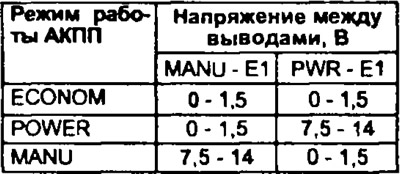
If the voltage is not normal, then the automatic transmission mode selection switch is faulty.
If the voltage is normal, then the automatic transmission and engine control unit is faulty, or the automatic transmission is faulty.
Fault No.3: no upshift shifts (after warming up)
1. Carry out a road test with the solenoid valve block connector disconnected, moving the selector sequentially from position "L" to positions "2" and "D". The gearbox should upshift. If upshifts do not occur, the gearbox is faulty.
2. Connect solenoid valve connector and check for voltage changes at pin "Tt" diagnostic connector (normally from 0 to 4 V).
- a) If the voltage changes smoothly from 0 V to 7 V then:
- gearbox faulty;
- the electromagnetic valves are faulty.
- b) If the voltage changes smoothly from 0 V to 2 V, then on the "D" range check the voltage between terminals "2" and "E1" of the automatic transmission control unit connector and the engine. Voltage:
- models before 1996: 10-14 V
- models since 1996: 7.5-14 V
If the voltage is not normal, replace the automatic transmission and engine control unit.
If the voltage is normal, there is a fault in the start inhibit switch circuit.
- c) If the voltage does not change (0 V), then on the "D" range check the voltage between the "L" and "E₁" terminals of the automatic transmission control unit connector. Voltage:
- models before 1996: 10-14 V
- models since 1996: 7.5-14 V
If the voltage is not normal, replace the automatic transmission and engine control unit.
If the voltage is normal:
- malfunction in the start inhibit switch circuit;
- malfunction of the start inhibit switch.
3. Check the voltage between terminals "OD2" and "E1" of the automatic transmission control unit connector and the engine at different positions of the overdrive switch.
Voltage at switch position:
- "ON"
- models before 1996: 10-14 V
- models since 1996: 9-14 V
- "OFF"
- models before 1996: 0 V
- models since 1996: not more than 3 V
If the voltage differs from the nominal value, then there is a fault in the overdrive switch circuit.
Models since 1996. If the voltage is normal, then the automatic transmission control unit is faulty.
4. Models before 1996. Check the voltage between the "ODi" terminals (models before 1996) and "E1" of the automatic transmission and engine control unit connector. If the voltage differs from the nominal value, replace the automatic transmission and engine control unit. Voltage is about 5 V.
5. Models before 1996. If the voltage between terminals "OD," and "E," of the automatic transmission control unit connector and the engine with the electronic cruise control unit connector disconnected (cruise control) differs from the nominal value, then replace the electronic cruise control unit (cruise control). Otherwise, replace the electronic control unit of the automatic transmission and engine or the wiring harness of the electronic control unit of cruise control (cruise control).
Malfunction #4: No torque converter lock-up (after warming up)
1. Warm up the engine to a temperature of 80°0 and the gearbox to 50-80°C.
2. Perform a road test. Connect a voltmeter to the pins "Tt" and "E1" of the diagnostic connector. Measure the voltage when locking the torque converter. If it is 7 V, then:
- filled the electromagnetic valve controlling the torque converter lock-up clutch,
- gearbox faulty;
- the torque converter lockup clutch is faulty.
3. Check the voltage between the terminals "STP" ("B/K") and "E1" of the automatic transmission control unit connector and the engine at different positions of the brake pedal; Normal voltage:
- Models before 1996:
- brake pedal released 0 V
- brake pedal pressed 10-14 8
- Models since 1996:
- the brake pedal is released no more than 1.5 V
- brake pedal pressed 7.5-14 V
- a) If the voltage is normal, there is a malfunction in the throttle position sensor circuit or in the power supply circuit of the electronic control unit of the automatic transmission and engine.
- b) If the voltage differs from the specified one, there is a malfunction in the brake light switch circuit.
Malfunction #5 (A245E): No lock-up of the torque converter with controlled slip clutch (after warming up)
1. Warm up the engine to 80°C and the gearbox to 50-80°C.
2. Measure the voltage between the terminals "THW" and "E1" of the electronic control unit connector. Normal voltage is 0.7-1.0 V
If the voltage differs from the norm, then there is an open or short circuit in the engine coolant temperature sensor circuit or a malfunction of the engine coolant temperature sensor.
3. Check the voltage between the terminals "TNO" ("OIL") and "E1" of the electronic control unit connector. Normal voltage is 2 V.
If the voltage is not normal, there is an open or short circuit in the automatic transmission fluid temperature sensor circuit.
4. Check the voltage between terminals "OD2" and "E1" of the control unit connector at different positions of the overdrive switch: Voltage at switch position:
- "ON": 9-14 V
- "OFF": no more than 3 V
If the voltage differs from the nominal value, then the engine start prohibition switch is faulty.
5. Check the voltage between the terminals "PWR" and "E1" (since 1996 - also "MANU" and "E1") of the automatic transmission control unit connector and the engine.
Voltage at the position of the automatic transmission mode selection switch
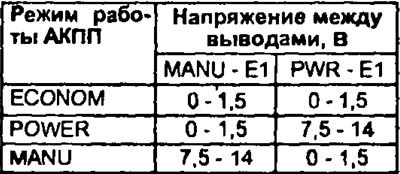
If the voltage differs from the nominal value, then the automatic transmission mode selection switch is faulty.
6. Check the voltage between the terminals of "Tt" and "E1" of the diagnostic connector.
Normal voltage:
- throttle valve closed no more than 0.6 V
- throttle open 7.6-8.7 V
If the voltage is not normal, check the voltage between the "STP" and "E1" terminals of the automatic transmission control unit connector and the engine.
(See the source on the internet resource: ToyotaMan.ru)
Normal voltage:
- the brake pedal is released no more than 1.5 V
- brake pedal pressed 7.5-14 V
- a) If the voltage is not normal, the brake light switch is faulty.
- b) If the voltage is normal, then there is an open or short circuit in the throttle position sensor wiring or the throttle position sensor is faulty.
7. Disconnect the connector of the electronic control unit of the automatic transmission and the engine. Check the resistance between the terminals "NC2+" and "NC2-" of the connector of the electronic control unit of the automatic transmission and the engine. Resistance 560-680 Ohm.
If the resistance differs from the nominal value, then there is an open or short circuit in the circuit of speed sensor No.2 or speed sensor No.2 is faulty.
8. Check the resistance between the terminals "SL" and "E1" of the electronic control unit connector. Resistance 11-15 Ohm.
If the resistance differs from the nominal value, there is an open or short circuit in the circuit of the electromagnetic valve controlling the torque converter lock-up clutch, or a malfunction of the valve itself.
9. Check the resistance between the terminals "SLU+" and "SLU-" of the automatic transmission control unit connector and the engine. Resistance is 5.1-5.5 Ohm.
If the resistance differs from the nominal value, then there is an open or short circuit in the electromagnetic valve circuit for controlling the quality of the lock, or a malfunction of the valve itself.
10. Check the voltage between terminals "TT" and "E1" of the diagnostic connector.
The voltage when the brake pedal is pressed is no more than 2.7 V.
If the voltage does not correspond to the nominal value, replace the automatic transmission fluid.
11. Switch the overdrive switch to the "OFF" position, the automatic transmission mode selection switch to the "OFF" position (nORM mode), air conditioner switch to the "OFF" position.
12 Accelerate the vehicle to 60 km/h and release the accelerator pedal. If the voltage between terminals "TT" and "E1" of the diagnostic connector corresponds to the specified value until the vehicle speed drops to 30 km/h, then:
- the automatic transmission is faulty.
- the electromagnetic valve controlling the torque converter lock-up clutch is sticking.
- the electromagnetic valve for controlling the quality of the torque converter lockup is sticking. Voltage 2.7-3.4 V.
If the voltage does not correspond to the specified value, then the automatic transmission and engine control unit is faulty.