Caution: Do not open the control unit cover unnecessarily (if you touch the pin of an integrated circuit, it may be damaged by static electricity).
1. Checking the signal from the throttle position sensor.
a) Turn on the ignition. Do not start the engine.
b) Connect the voltmeter to the diagnostic connector terminals "TT" and "E1".
Table. Gearbox operating modes in case of normal operation of electromagnetic valves (solenoids) and the failure of one or two of them
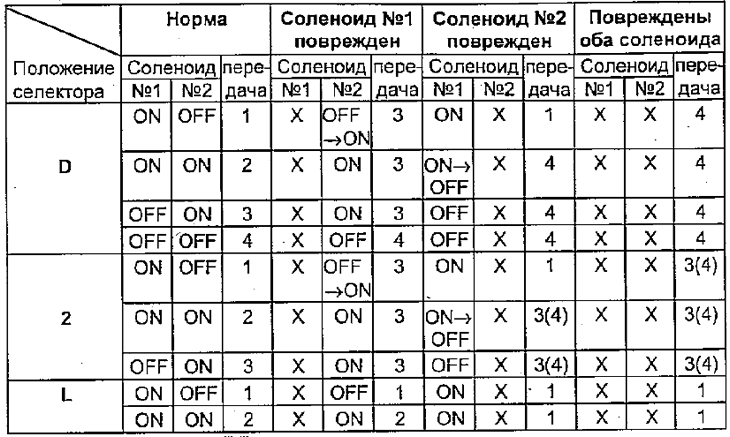
Note: "X" marks indicate a malfunction. () - for A540H.
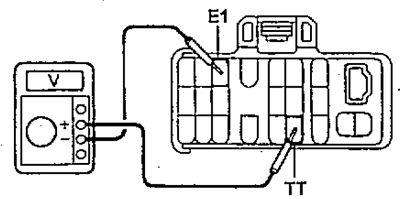
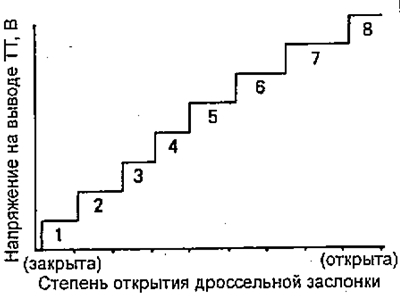
c) By pressing the accelerator pedal smoothly, check the voltage change. If the voltage does not change as shown in the figure, the sensor or its circuit is faulty.
2. Check the brake light switch circuit.
a) Press the accelerator pedal all the way down, the voltage at the "TT" terminal should correspond to the nominal value.
- Nominal voltage - 7.6 -8.7 V
b) Press the brake pedal and check the voltage at the "TT" terminal:
Nominal voltage:
- brake pedal pressed - no more than 0.5 V
- brake pedal released - 7.6-8.7 V
c) If the measured voltage differs from the specified one, then the brake light switch is faulty.
3. Check the moments of upshifting.
a) Warm up the engine to a coolant temperature of 80°C.
b) Set the overdrive switch to the "ON" position.
c) Set the selector to position "D" and the automatic transmission mode switch to the "NORMAL" position.
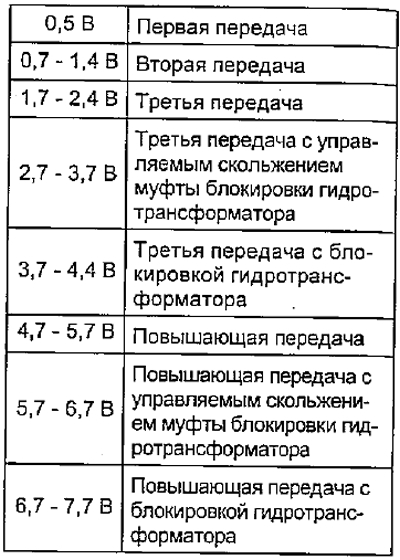
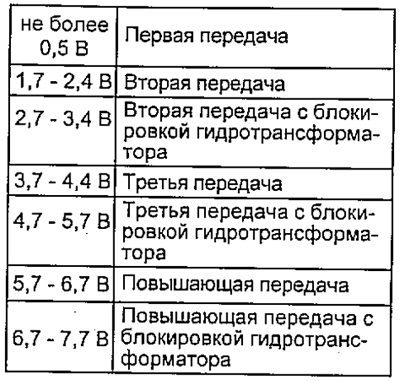
d) During road tests (speed over 10 km/h) check the voltage change at the "TT" terminal of the automatic transmission and engine control unit connector during upshifts.
d) If the voltage increases from 0 V to 7 V, then everything is normal (see table).
Except A245E since 1996.
The text is quoted from the source website (Toyotaman.ru)
A245E since 1996.