



Attention! Before performing the work, prepare two bolts with a 6x1 mm thread and a length of 16–20 mm, which will be used as auxiliary ones during disassembly (see below).
Removal
1. Remove the cylinder head cover (see subsection 3.2.3).
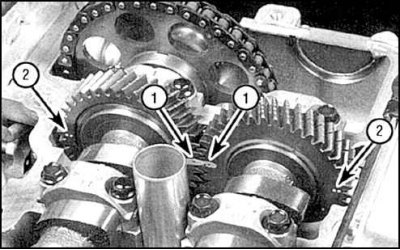
2. Set the piston of the 1st cylinder to the TDC of the compression stroke. Make sure that the dot marks (1) on the driving and driven gears of the camshafts are aligned and located on the same line of the parallel split plane of the cylinder head and cover, and the marks (2) are facing different directions. Otherwise, check that the TDC mark of the crankshaft is aligned with the zero division of the scale and turn the crankshaft by 1 revolution.
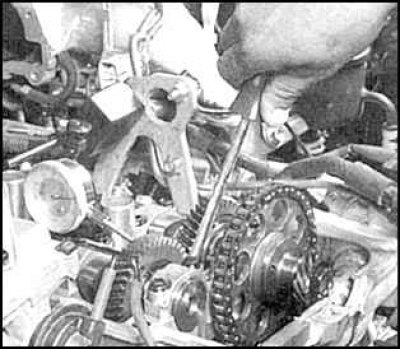
3. Measure the axial play of each of the camshafts. If the play exceeds the maximum permissible amount, the camshaft and / or cylinder head must be replaced.
4. Remove the ignition distributor (see subsection 3.4.6).
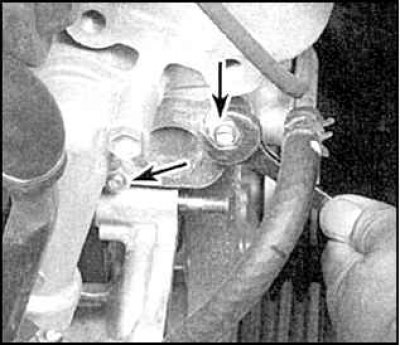
5. Remove the tensioner cover bolts (indicated by arrows).
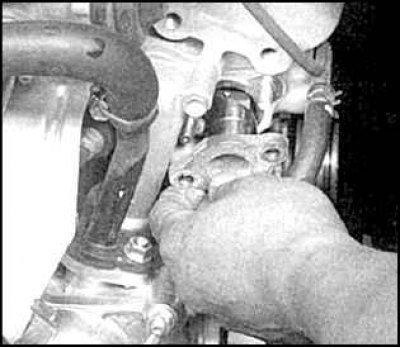
6. Remove the tensioner from the front cover.
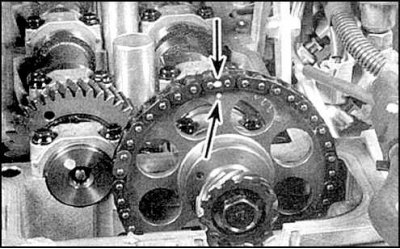
7. Mark the chain link opposite the dot mark (indicated by arrows).
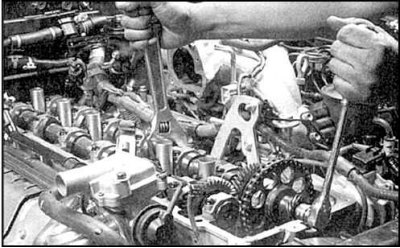
8. Unscrew the sprocket bolt, holding the camshaft with a wrench by the special flats.
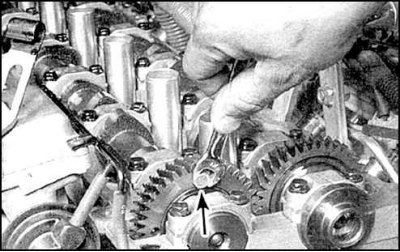
9. Remove the distributor drive gear. Carefully remove the sprocket (indicated by the arrow) and the chain from the camshaft and leave them on the guides.
Exhaust camshaft
1. First remove the exhaust camshaft, after securing the auxiliary gear spring.
Attention! Remove the camshafts one by one, keeping them parallel to the cylinder head plane. Otherwise, the lug on the cylinder head, which ensures the standard axial clearance of the camshaft, may be damaged.
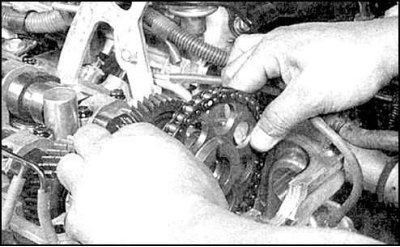
2. To fix the spring, turn the camshaft so that the technological hole for the auxiliary bolt faces vertically upwards. Attach the auxiliary gear to the main gear with a pre-prepared bolt with an M6 thread and a length of 16–20 mm.
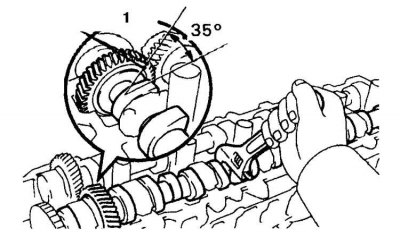
3. Turn the intake camshaft so that the marks (1) of the gears are shifted at an angle of 35° relative to the horizontal axis.
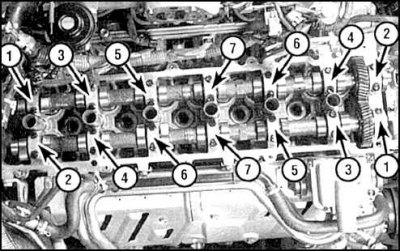
4. Move the camshaft back, gradually and evenly unscrew the bolts of the camshaft journal cover N1 (the sequence of removing the camshaft journal covers is indicated by numbers).
5. Carefully loosen cover bolts 2, 3, 5 and 7, loosening the left and right bolts evenly. Do not loosen cover bolts 4 and 6.
6. Carefully unscrew the bolts of covers 4 and 6, ensuring that the camshaft is lifted uniformly relative to the cylinder head plane. If the camshaft is released at an angle, tighten the bolts of covers 4 and 6, install covers 1, 2, 3, 5 and 7 and repeat the procedure. Achieve parallel release of the camshaft.
Intake camshaft
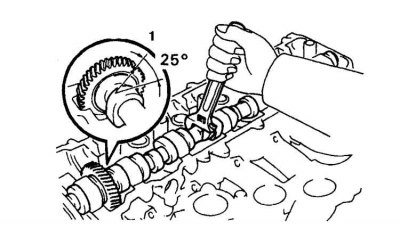
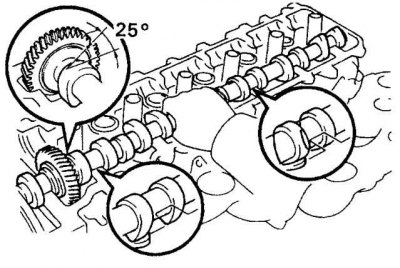
1. Turn the intake camshaft so that the marks (1) of the gears are shifted by an angle of 25° relative to the horizontal axis.
2. Move the camshaft forward, gradually and evenly unscrew the cover bolts N1.
3. Carefully loosen cover bolts 3, 4, 6 and 7, loosening the left and right bolts evenly. Do not loosen cover bolts 2 and 5.
4. Carefully unscrew the bolts of covers 2 and 5, ensuring that the camshaft is lifted uniformly relative to the cylinder head plane. If the camshaft is released at an angle, tighten the bolts of covers 4 and 6, install covers 1, 3, 4, 6 and 7 and repeat the procedure. Ensure that the camshaft is released in parallel. Remove the intake camshaft.
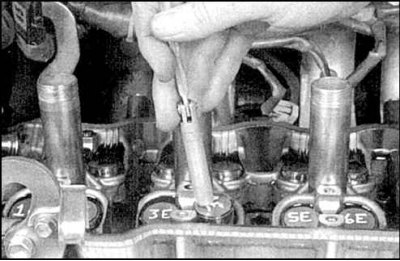
5. Wipe the oil off the tappet adjusting washers, mark them with a marker and remove the tappets and adjusting washers.
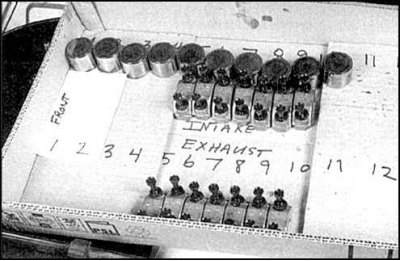
6. Store the bearing journal caps, tappets and washers in the order in which they were installed.
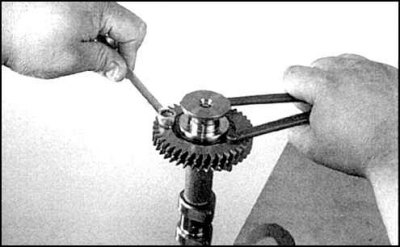
7. Clamp the intake camshaft in a vice by the hexagonal journal. Using a wrench with two stop pins, turn the auxiliary gear clockwise, then unscrew the auxiliary bolt securing the main and auxiliary gears and carefully release the force, allowing the auxiliary gear to turn counterclockwise until the spring is completely released.
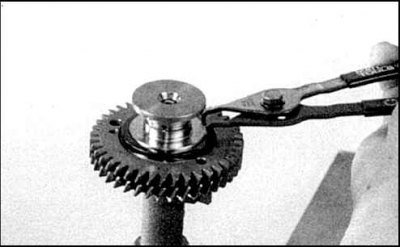
8. Remove the auxiliary gear retaining ring.
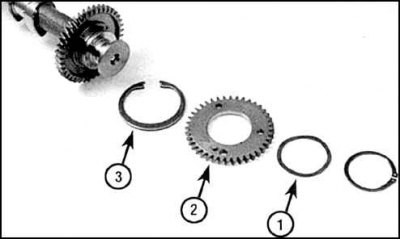
9. Remove the spring washer (1), auxiliary gear (2) and auxiliary gear spring (3).
Examination
Installing camshaft journal covers
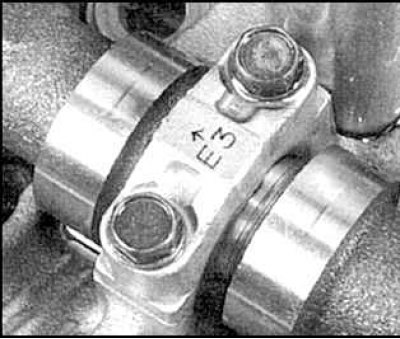
The camshaft journal covers are marked with numbers and orientation arrows that should point towards the front of the engine.
Determining the clearance in the bearing journals of the camshafts
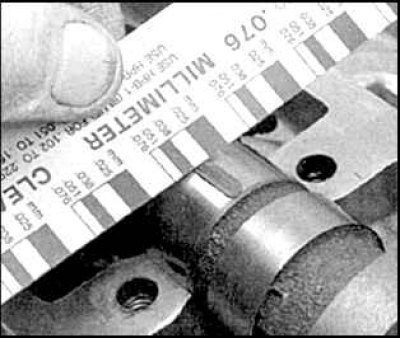
The clearance in the camshaft bearing journals is determined by the width of the crushed plastic calibration wire.
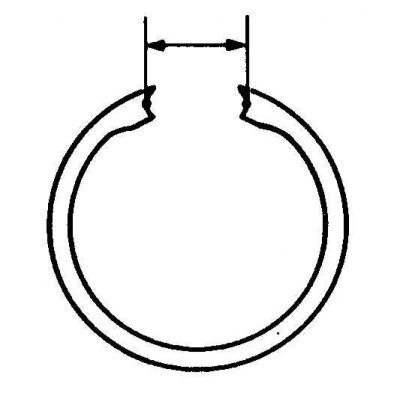
1. Measure the distance between the ends of the auxiliary gear spring in a free state and compare with the standard. If the distance differs from the standard, replace the spring.
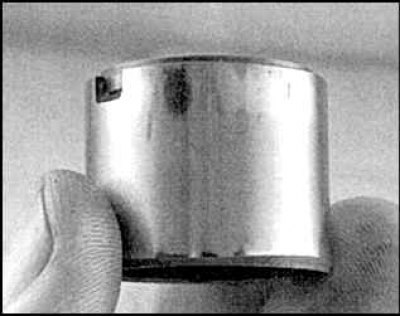
2. Check the condition of the tappets. Chips and deep wear are not allowed.
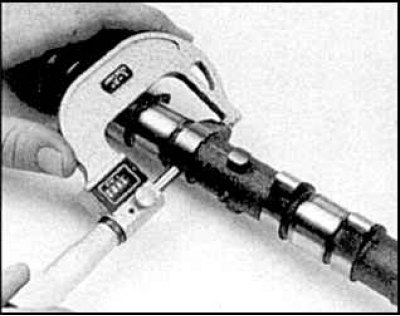
3. Check the bearing journals and camshaft cams for signs of wear - grooves, pits, metal drag and signs of overheating (painted areas of bluish color). Check for peeling of the hardened layer on each cam. Measure the size of each camshaft cam and compare with the standard. If the size of at least one of the cams is smaller than the standard, replace the camshaft. Mark with a marker and remove the tappets and adjusting washers.
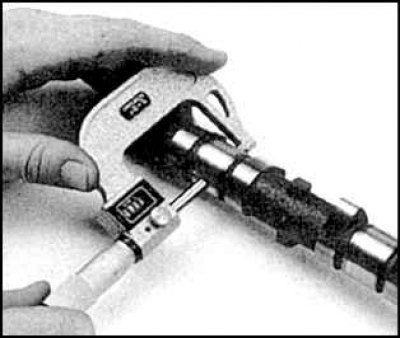
4. Measure the diameter of the camshaft bearing journals and compare with the standard. If the diameter of at least one bearing journal is less than the standard, replace the camshaft.
5. Check the bearing journal clearances for each camshaft as follows:
- clean the camshaft bearing journals and bearing journal caps in solvent;
- carefully place the camshaft in the cylinder head without the tappets, adjusting washers and auxiliary gear. No oil is allowed on the journals;
- place pieces of plastic calibration wire across each camshaft bearing journal;
- install the camshaft journal caps so that the arrows point toward the front of the engine (see fig. Installing camshaft bearing journal covers);
- tighten the bolts to the specified torque by turning each bolt 1/4 turn at a time;
Caution! Turning the camshaft with the plastic gauge inserted is not permitted.
- unscrew the bolts and remove the covers;
- compare the width of the crushed wire (at the widest point) with a scale on the packaging (see fig. Determining the clearance in the bearing journals of the camshafts);
- if the gap in at least one of the journals exceeds the norm, then the camshaft and (or) cylinder head must be replaced;
- use your fingernail or a credit card to scrape off any remaining plastic, being careful not to scratch the support neck or the inside surface of the lid.
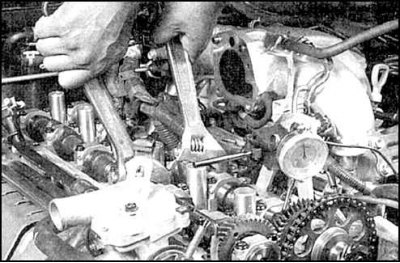
6. With the bearing journal covers temporarily installed, check the clearance in the engagement of the camshaft gears. Holding one of the camshafts by the hexagonal journal with a wrench, check the amount of movement of the gear of the other camshaft. Compare the result with the standard. If the clearance is higher than the standard, replace both camshafts.
Installation
Intake camshaft
1. Lubricate and install the tappets and adjusting washers in their original places, having previously lubricated them with molybdenum grease.
2. Lubricate the bearing journals and camshaft lobes with molybdenum grease. Lubricate the thrust portion of the intake camshaft.
3. Install the intake camshaft into the cylinder head so that cams 1 and 4 face down.
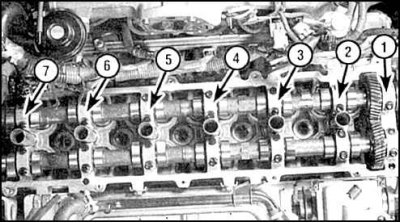
4. Move the camshaft forward and install bearing journal caps 2 and 5, observing the numbering and orientation of the arrows, which should be directed towards the front of the engine.
5. Slightly tighten the covers of bearing journals 2 and 5.
6. Install covers 3, 4, 6, 7 and, observing the sequence, slightly tighten the cover bolts until they touch the cylinder head.
7. Install cover 1 and tighten both bolts evenly.
8. Tighten all cover bolts to the specified torque in several stages.
Exhaust camshaft
1. Assemble the exhaust camshaft with springs and auxiliary gear, secure all parts with a retaining ring.
2. Install the tappets and adjusting washers in their original places, after lubricating them with molybdenum grease.
3. Lubricate the camshaft journals and cams with molybdenum grease.
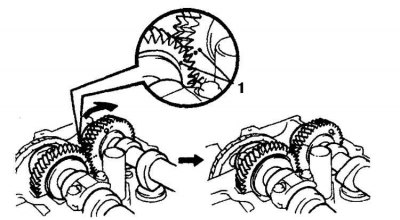
4. Align the marks on the camshaft gears (1 - alignment). These marks should be located 180° relative to their position when removing the camshafts.
5. It should be taken into account that the design of the valve timing of the engine in question does not allow for tension connections. The cap bolts should be tightened in this position, after which the camshaft should be turned back to set it to the position corresponding to TDC, in which the contact surfaces touch evenly, without interference from the forces of the springs acting on the cams.
6. Rotate the exhaust camshaft over the intake camshaft and install it in place. Rotate the camshaft in both directions to ensure proper seating in the journals.
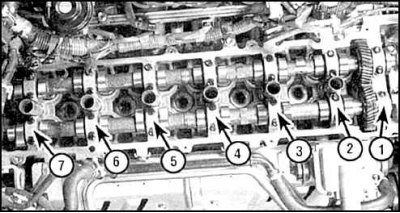
7. Install covers 4 and 6, observing the numbering and orientation of the arrows, which should be directed towards the chain.
8. Tighten caps 4 and 6 slightly.
9. Install covers 2, 3, 5, 7 and, observing the sequence, slightly tighten the cover bolts.
10. Install cover 1 and tighten both bolts evenly.
11. Tighten all cover bolts to the specified torque in several stages.
12. Turn the camshafts so that the auxiliary bolt is at the top and unscrew the bolt. Make sure that the camshafts rotate smoothly.
13. Align the camshafts so that the position of the marks corresponds to TDC. Make sure that the notch in the crankshaft pulley is aligned with the TDC division of the scale.
14. Install the chain with the sprocket, checking that the marks applied during disassembly match. Tighten the bolt.
15. Install the chain tensioner, replacing the gasket. Press the tensioner, screw in and tighten the nuts.
16. Install the remaining parts in reverse order. Adjust the valve clearances (see subsection 2.29).