
Company Honda Company Ford Company Skoda Company Kia Company Mazda Company Mercedes Company Renault
English Русский
Български
Беларускі
Український
Српски
Hrvatski
Română
Polski
Slovenský
Magyar
Bookmark Articles Sitemap Contacts
ToyotaMan.ru


Camry Corolla Corona Carina Land Cruiser Highlander 4Runner RAV4 Others
Cruiser 100 (1998-2007) Cruiser 60/80 (1980-1997, petrol) Cruiser 70 (1985-1996, diesel)

Wheels and tires — general information [Toyota Land Cruiser J100]

  • Main
  • Land Cruiser
  • J100 (1998-2007)
  • Chassis, running gear
  • Car suspension
  • Wheels and tires — general information
0

Tyre sizes


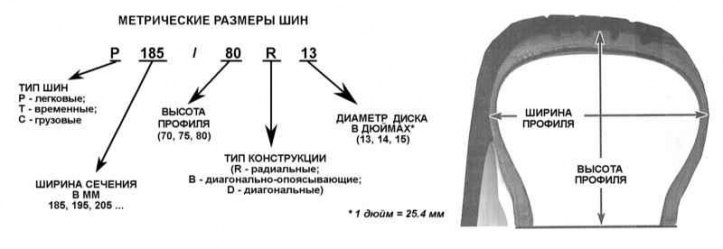
The wheels of all the models of cars described in this Manual are equipped with radial tires of metric size with fiberglass or steel cord (refer to the illustration above). Installing tires of a different size on a vehicle may affect its handling and ride comfort.

Attention! Never install tires of different designs on one vehicle axle! It is recommended to replace tires on both wheels of one axle at the same time. If only one wheel is replaced, make sure that the replacement tire matches the size of the pair.


Maintaining the correct tire pressure is extremely important for the vehicle's handling. Check your tire inflation pressure regularly, at least once a month (see chapter Vehicle settings and routine maintenance). Also check the pressure before every long trip.

Wheel disks are subject to replacement in case of deformation, violation of the tightness of the tubeless tires on them, severe corrosion damage, violation of vertical symmetry, development to an oval shape of the bolt holes, as well as in case of constant spontaneous loosening of the fastening nuts. It is not recommended to carry out restorative repair of damaged disks using welding or riveting.


Wheel deformation is usually associated with running over curbs during careless parking of the car. It is unacceptable to continue operating a car with bent wheels - the wheel must be repaired at a tire shop. To check the condition of the wheels, jack up the car and place it on supports. Visually inspect the wheels for cracks and signs of deformation.

An important factor determining the parameters of movement and braking of the car is the balancing of the wheels as a whole. Violation of this parameter can significantly reduce the controllability of the vehicle, not to mention a noticeable reduction in the service life of the tires. Each time after replacing a tire, the wheel is subject to balancing in a tire shop.

The material is reprinted from an online resource [www.toyotaman.ru]
This article is available at: russian, bulgarian, belarusian, ukrainian, serbian, croatian, romanian, polish, slovak, hungarian
The article material has been checked: Evdokimov Evgeniy
Share information:
◀ Previous
Cruiser 100: Car suspension
Next ▶

Removal and installation rear suspension arms
Removal and installation the rear suspension coil spring
Removal and installation the reaction rod
Removal and installation the rear anti-roll bar
Removal and installation rear shock absorbers
Wheel alignment angles
Similar articles on other Toyota models

➥ Wheels and tires — check and rotation Toyota Camry XV10 (1991-1996)
➥ Brakes, tires and wheels Toyota Corolla E80 (1983-1990)
➥ Wheels and tires — general information Toyota Highlander 1 (2000-2007, petrol)
➥ Wheels and tires — general information Toyota RAV 4 XA10 (1994-2000)
➥ Features of using aluminum wheels Toyota Corona T190 (1992-1997)
➥ Features of using aluminum wheels Toyota Carina T190 (1992-1996)
Link in different formats to this article
Comments and feedback from visitors
No comments yet


Add two numbers 45 + 39


Cruiser 100 (1998-2007) 
  • General information
  • Introduction to the guide
  • Controls and instruments
  • Maintenance
  • Power unit
  • Petrol engines
  • Diesel engines
  • Cooling and heating
  • Power and exhaust systems
  • Engine electrical equipment
  • Engine management systems
  • Transmission
  • Automatic gearbox
  • Transmission line
  • Chassis, running gear
  • Brake system
  • Car suspension
  • Steering
  • Body and interior
  • Exterior (external elements)
  • Interior (internal elements)
  • Doors, locks and windows
  • Electrical equipment
  • Equipment and devices
  • Electrical circuits
Cruiser 60/80 (1980-1997, petrol) 
  • General information
  • User manual
  • Maintenance
  • Power unit
  • Petrol engines 2F and 3F-E
  • Petrol engines 1FZ-FE
  • Engine overhaul
  • Engine electrical equipment
  • Cooling and heating
  • Fuel system (carburetor)
  • Fuel system (injector)
  • Toxicity reduction system
  • Transmission
  • Car gearbox
  • Clutch
  • Transfer case
  • Drive shafts and axles
  • Chassis, running gear
  • Brake system
  • Car suspension
  • Steering
  • Body and interior
  • Exterior and interior
  • Doors, locks and windows
  • Electrical equipment
  • Equipment and devices
  • Electrical circuits
Cruiser 70 (1985-1996, diesel) 
  • General information
  • User manual
  • Maintenance
  • Power unit
  • Engine adjustment
  • Engine repair
  • Fuel system
  • Control system
  • Turbocharging system
  • Cooling and lubrication system
  • Charge and start system
  • Transmission
  • Clutch
  • Mechanical gearbox
  • Automatic gearbox
  • Transfer case
  • Chassis, running gear
  • Car suspension
  • Brake system
  • Steering
  • Body and interior
  • Body elements
  • Heating and air conditioning
  • Electrical equipment
  • Equipment and devices
  • Electrical circuits
ToyotaMan.ru © 2018–2026 • Mobile version • Interesting about Toyota • Administration • Sitemap: EN BG BY UA RS HR RO PL SK HU • Search system • Bookmark
Camry Vista-V40 • Camry XV10 • Camry XV20 • Camry XV30 • Corolla Verso-AR10 • Corolla E80 • Corona T190 • Carina T170 • Carina T190 • Land Cruiser J70 (diesel) • Land Cruiser J60 (petrol) • Land Cruiser J100 • Highlander XU20 (petrol) • 4Runner N120 • RAV4 XA10 • RAV4 XA20 • Duet M100 • Dyna Y50 •
We require cookies to enable some interactive features. Is that ok with you?