
Company Honda Company Ford Company Skoda Company Kia Company Mazda Company Mercedes Company Renault
English Русский
Български
Беларускі
Український
Српски
Hrvatski
Română
Polski
Slovenský
Magyar
Bookmark Articles Sitemap Contacts
ToyotaMan.ru


Camry Corolla Corona Carina Land Cruiser Highlander 4Runner RAV4 Others
Cruiser 100 (1998-2007) Cruiser 60/80 (1980-1997, petrol) Cruiser 70 (1985-1996, diesel)

Fuel tank — removal and installation [Toyota Land Cruiser J60]

  • Main
  • Land Cruiser
  • J60 (1980-1997)
  • Power unit
  • Fuel system (carburetor)
  • Fuel tank — removal and installation
0
Contents: Removal and installation ↓ Fuel tank cleaning and repair ↓

Fuel tank of FJ60, FJ62 series vehicles
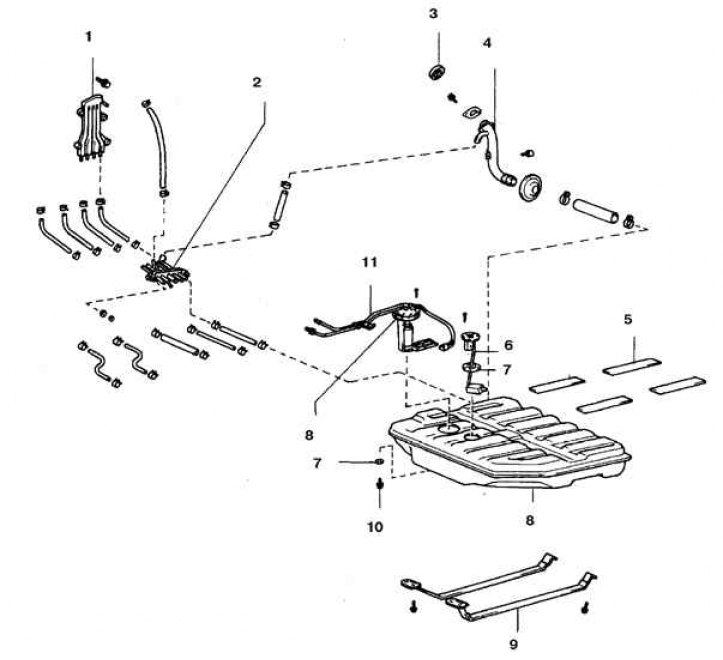


1. Vapor separator; 2. Tube connector; 3. Cork; 4. Filler neck; 5. Buffers; 6. Fuel level sensor; 7. Gasket; 8. Tank; 9. Tie-down straps; 10. Drain plug; 11. Fuel pump


Fuel tank of FJ80 series vehicles
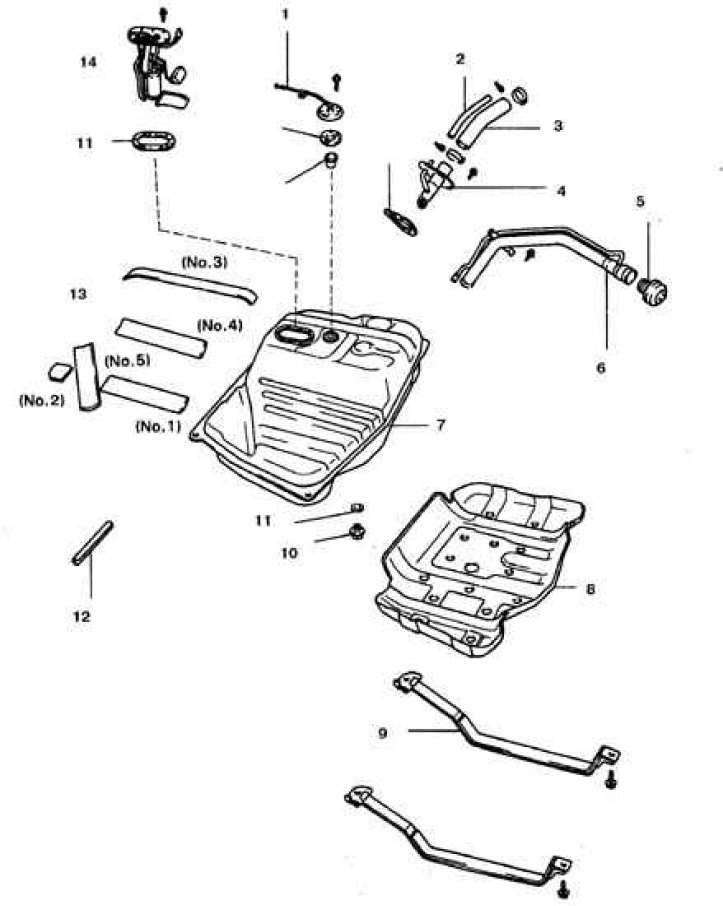


1. Ventilation tube; 2. Hose; 3. Inlet hose; 4. Neck pipe; 5. Cork; 6. Inlet pipe of the neck; 7. Tank; 8. Tank shield; 9. Tie-down straps; 10. Drain plug; 11. Gasket; 12. Overlay; 13. Buffers; 14. Pump and fuel level sensor


Removal and installation


Attention! When performing work, observe fire safety regulations.


Warning! Remove the fuel tank after it is completely empty. Some cars have a drain plug in the tank. If there is no drain plug, empty the tank by driving and then letting the engine idle, or drain the gasoline through a hose with a rubber hand pump (available for sale).


1. Unscrew the filler cap of the tank to relieve residual pressure.

2. Disconnect the battery from ground.

3. Drain the gasoline.

4. Raise the vehicle and place it on stands.

5. Disconnect from the tank and plug the hoses and tubes.

6. Loosen the clamp and disconnect the neck from the tank.

7. Unscrew the nuts and remove the tank shield.

8. Place a support under the tank.

9. Disconnect the tie straps and set them aside.

10. Lower the tank slightly and disconnect the connectors and ground wire.

11. Remove the tank.

12. Some vehicles are equipped with an additional tank, which is removed in exactly the same order.

The material is reprinted from an online resource [www.TOYOTAMAN.ru]

13. Installation is carried out in reverse order.

Fuel tank cleaning and repair


Any repairs to the fuel tank or fuel filler neck must be carried out by qualified personnel who have experience in organizing and carrying out such work.

If the tank is removed from the vehicle, it should not be placed in a location where sparks or open flames could ignite the fumes escaping from the tank.
This article is available at: russian, bulgarian, belarusian, ukrainian, serbian, croatian, romanian, polish, slovak, hungarian
The article material has been checked: Evdokimov Evgeniy
Share information:
◀ Previous
Cruiser 60/80: Fuel system (carburetor)
Next ▶

Checking the condition of hoses and tubes
Fuel Pump and Fuel Pressure — Checking
Fuel pump — removal and installation
Fuel level sensor — checking and replacement
Air filter — removal and installation
Throttle Cable — Removal and Installation
Checking and disassembling the carburetor
Similar articles on other Toyota models

➥ Fuel tank cap Toyota Camry XV20 (1996-2001)
➥ Fuel tank cap release lever Toyota Corolla E80 (1983-1990)
➥ Fuel tank and fuel lines Toyota Corona T190 (1992-1997)
➥ Removal and installation the fuel tank Toyota Carina T190 (1992-1996)
➥ Fuel Tank Cleaning and Repair — General Information Toyota Highlander 1 (2000-2007, petrol)
➥ Fuel tank cap Toyota 4Runner N120 (1989-1995)
Link in different formats to this article
Comments and feedback from visitors
No comments yet


Add two numbers 45 + 26


Cruiser 100 (1998-2007) 
  • General information
  • Introduction to the guide
  • Controls and instruments
  • Maintenance
  • Power unit
  • Petrol engines
  • Diesel engines
  • Cooling and heating
  • Power and exhaust systems
  • Engine electrical equipment
  • Engine management systems
  • Transmission
  • Automatic gearbox
  • Transmission line
  • Chassis, running gear
  • Brake system
  • Car suspension
  • Steering
  • Body and interior
  • Exterior (external elements)
  • Interior (internal elements)
  • Doors, locks and windows
  • Electrical equipment
  • Equipment and devices
  • Electrical circuits
Cruiser 60/80 (1980-1997, petrol) 
  • General information
  • User manual
  • Maintenance
  • Power unit
  • Petrol engines 2F and 3F-E
  • Petrol engines 1FZ-FE
  • Engine overhaul
  • Engine electrical equipment
  • Cooling and heating
  • Fuel system (carburetor)
  • Fuel system (injector)
  • Toxicity reduction system
  • Transmission
  • Car gearbox
  • Clutch
  • Transfer case
  • Drive shafts and axles
  • Chassis, running gear
  • Brake system
  • Car suspension
  • Steering
  • Body and interior
  • Exterior and interior
  • Doors, locks and windows
  • Electrical equipment
  • Equipment and devices
  • Electrical circuits
Cruiser 70 (1985-1996, diesel) 
  • General information
  • User manual
  • Maintenance
  • Power unit
  • Engine adjustment
  • Engine repair
  • Fuel system
  • Control system
  • Turbocharging system
  • Cooling and lubrication system
  • Charge and start system
  • Transmission
  • Clutch
  • Mechanical gearbox
  • Automatic gearbox
  • Transfer case
  • Chassis, running gear
  • Car suspension
  • Brake system
  • Steering
  • Body and interior
  • Body elements
  • Heating and air conditioning
  • Electrical equipment
  • Equipment and devices
  • Electrical circuits
ToyotaMan.ru © 2018–2026 • Mobile version • Interesting about Toyota • Administration • Sitemap: EN BG BY UA RS HR RO PL SK HU • Search system • Bookmark
Camry Vista-V40 • Camry XV10 • Camry XV20 • Camry XV30 • Corolla Verso-AR10 • Corolla E80 • Corona T190 • Carina T170 • Carina T190 • Land Cruiser J70 (diesel) • Land Cruiser J60 (petrol) • Land Cruiser J100 • Highlander XU20 (petrol) • 4Runner N120 • RAV4 XA10 • RAV4 XA20 • Duet M100 • Dyna Y50 •
We require cookies to enable some interactive features. Is that ok with you?