
Company Honda Company Ford Company Skoda Company Kia Company Mazda Company Mercedes Company Renault
English Русский
Български
Беларускі
Український
Српски
Hrvatski
Română
Polski
Slovenský
Magyar
Bookmark Articles Sitemap Contacts
ToyotaMan.ru


Camry Corolla Corona Carina Land Cruiser Highlander 4Runner RAV4 Others
Cruiser 100 (1998-2007) Cruiser 60/80 (1980-1997, petrol) Cruiser 70 (1985-1996, diesel)

Checking the condition of the suspension and steering components [Toyota Land Cruiser J100]

  • Main
  • Land Cruiser
  • J100 (1998-2007)
  • General information
  • Maintenance
  • Checking the condition of the suspension and steering components
0
Contents: Checks performed without lifting the…↓ Checks performed with the wheels off…↓
Note: The condition of the suspension and steering components should be checked regularly, as their wear or damage can cause a reduction in the service life of the tires, lead to a decrease in vehicle controllability and an increase in fuel consumption. Detailed illustrative material is also presented in Chapter Suspension and steering.


Checks performed without lifting the wheels off the ground


1. Park the vehicle on a flat, horizontal area, if possible with a hard surface, and turn the front wheels in a straight line. Pull the steering wheel slightly in both directions. Excessive play indicates possible wear on wheel bearings, steering column main and intermediate shaft joint clamps, steering knuckle bearings for all-wheel drive models, or tie rod tips. There is also a possibility of adjustment failure or damage to the rack and pinion components (see chapter Suspension and steering).

2. Symptoms such as excessive vehicle rocking when driving on uneven roads or when turning, steering wheel jamming, etc. may also indicate wear or damage to suspension or steering components.

3. To assess the condition of the shock absorbers, press down on one of the corners of the car. When you release the corner, the body should return to its original position, making no more than one or two oscillations. Listen for creaking and other extraneous noises emitted by the suspension during oscillatory movements of the body. For more details, see Chapter Suspension and steering. Excessive amount of body rocking when releasing the corner, as well as refusal to return it to its original position, indicate the need to replace the shock absorbers. Proceeding in a similar manner, check each of the four shock absorbers in turn.


Checks performed with the wheels off the ground


1. Jack up the car and place it on supports.

2. Check the tire treads for signs of uneven wear (see section Checking the condition of the tires and their inflation pressure), estimate the tire inflation pressure.
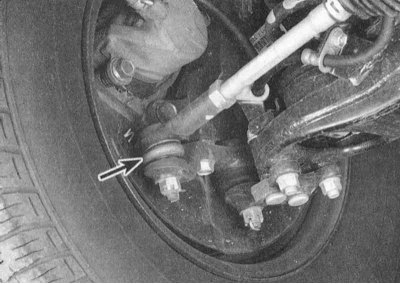


3a. Assess the condition of the steering column universal joints. Check the steering gear and drive shaft boots for signs of grease leaks. Check the tightness of the tie rod ends. Check the condition of the components and the tightness of their fasteners.
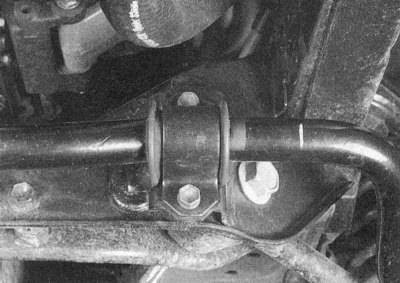


3b. Assess the degree of wear of the rubber components of the suspension and steering gear (refer to accompanying illustrations). Ask an assistant to turn the steering wheel and visually assess the amount of play in the steering gear. Try to identify the cause of the existing slack, make the necessary repairs, or replace the defective components.


4. Manually rotating the front wheels, try to determine the condition of the wheel bearings by ear, make sure there is no play when rotating the wheels. Grasp the wheel at the 12 and 6 o'clock positions and tug it in the axial plane; the presence of any noticeable free play indicates a weakening of the wheel bearing preload. If necessary, disassemble the hubs to visually assess the condition of the bearings and pack them with fresh grease (for more details, see Section Checking the condition, lubricating and adjusting the front hubs and wheel bearings). Full information on the design of hub assemblies and wheel bearings is given in Chapter Suspension and steering.

5. Using a pry bar, assess the condition of the bearings of the steering knuckle assemblies. If play is detected, the bearings should be examined in more detail, replaced, or filled with fresh grease.

The text is quoted from the source website: www.ToyotaMAN.ru

6. Assess the degree of wear of the universal joints and sliding couplings of the cardan shafts (see chapter Transmission line).

7. Inspect the differential and transfer case housing surfaces for signs of developing leaks.
This article is available at: russian, bulgarian, belarusian, ukrainian, serbian, croatian, romanian, polish, slovak, hungarian
The article material has been checked: Evdokimov Evgeniy
Share information:
◀ Previous
Cruiser 100: Maintenance
Next ▶

Wheel rotation (rearrangement)
Checking the condition and replacing the windshield wipers
Checking the condition and replacing the hoses located in the engine…
Checking the condition of the cooling system components
Checking, servicing and charging the battery
Lubrication of chassis components
Checking the condition of the exhaust system components
Checking the lubrication level in the transfer case
Checking the differential lubrication level
Checking the condition of seat belts
Similar articles on other Toyota models

➥ Checking the condition of the suspension and steering Toyota RAV 4 XA10 (1994-2000)
➥ Checking the steering and suspension Toyota Camry XV20 (1996-2001)
➥ Checking the steering suspension Toyota 4Runner N120 (1989-1995)
➥ Checking the technical condition of the cardan shaft… Toyota Dyna Y50/Y60 (1984-1995)
➥ Steering and front suspension Toyota Corolla E80 (1983-1990)
➥ Checking tire pressure and condition Toyota Corona T190 (1992-1997)
Link in different formats to this article
Comments and feedback from visitors
No comments yet


Add two numbers 14 + 47


Cruiser 100 (1998-2007) 
  • General information
  • Introduction to the guide
  • Controls and instruments
  • Maintenance
  • Power unit
  • Petrol engines
  • Diesel engines
  • Cooling and heating
  • Power and exhaust systems
  • Engine electrical equipment
  • Engine management systems
  • Transmission
  • Automatic gearbox
  • Transmission line
  • Chassis, running gear
  • Brake system
  • Car suspension
  • Steering
  • Body and interior
  • Exterior (external elements)
  • Interior (internal elements)
  • Doors, locks and windows
  • Electrical equipment
  • Equipment and devices
  • Electrical circuits
Cruiser 60/80 (1980-1997, petrol) 
  • General information
  • User manual
  • Maintenance
  • Power unit
  • Petrol engines 2F and 3F-E
  • Petrol engines 1FZ-FE
  • Engine overhaul
  • Engine electrical equipment
  • Cooling and heating
  • Fuel system (carburetor)
  • Fuel system (injector)
  • Toxicity reduction system
  • Transmission
  • Car gearbox
  • Clutch
  • Transfer case
  • Drive shafts and axles
  • Chassis, running gear
  • Brake system
  • Car suspension
  • Steering
  • Body and interior
  • Exterior and interior
  • Doors, locks and windows
  • Electrical equipment
  • Equipment and devices
  • Electrical circuits
Cruiser 70 (1985-1996, diesel) 
  • General information
  • User manual
  • Maintenance
  • Power unit
  • Engine adjustment
  • Engine repair
  • Fuel system
  • Control system
  • Turbocharging system
  • Cooling and lubrication system
  • Charge and start system
  • Transmission
  • Clutch
  • Mechanical gearbox
  • Automatic gearbox
  • Transfer case
  • Chassis, running gear
  • Car suspension
  • Brake system
  • Steering
  • Body and interior
  • Body elements
  • Heating and air conditioning
  • Electrical equipment
  • Equipment and devices
  • Electrical circuits
ToyotaMan.ru © 2018–2026 • Mobile version • Interesting about Toyota • Administration • Sitemap: EN BG BY UA RS HR RO PL SK HU • Search system • Bookmark
Camry Vista-V40 • Camry XV10 • Camry XV20 • Camry XV30 • Corolla Verso-AR10 • Corolla E80 • Corona T190 • Carina T170 • Carina T190 • Land Cruiser J70 (diesel) • Land Cruiser J60 (petrol) • Land Cruiser J100 • Highlander XU20 (petrol) • 4Runner N120 • RAV4 XA10 • RAV4 XA20 • Duet M100 • Dyna Y50 •
We require cookies to enable some interactive features. Is that ok with you?