



Contents: Cleaning the radiator ↓ Radiator check ↓
Cleaning the radiator
Using water or a steam cleaner, clean the radiator core. Caution: When using a high-pressure cleaner, be careful not to damage the tubes and fins of the radiator core. In particular, at a pressure of 30 - 35 kgf / cm² (2940 - 3430 kPa) it is necessary to hold the sprayer at a distance of 40 - 50 cm from the radiator surface.
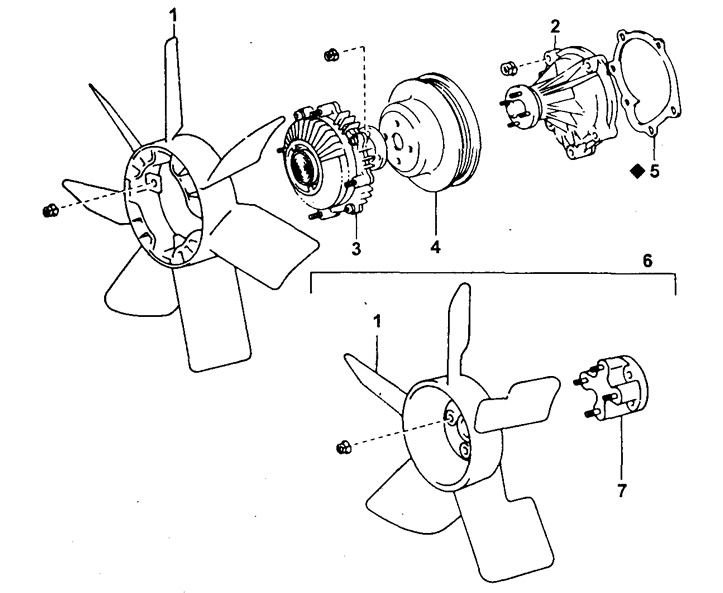
Details.
1 - fan,
2 - coolant pump,
3 - viscous fan drive clutch,
4 - coolant pump drive pulley,
5 - gasket,
6 - variant of fan drive without viscous coupling,
7 - fan drive shaft (drive without viscous coupling),
♦ - a part that cannot be reused.
Radiator check
1. Check the radiator cap or expansion tank.
[View the original source on the website: ToyotaMan.ru]
Using a tester, check the opening of the steam valve, which should open in the pressure range of 0.75 - 1.05 kg/cm² (74 - 103 kPa). Ensure that the plug is tight when the pressure drops below 0.6 kg/cm² (59 kPa).
If there are any problems, replace the plug.
2. Check the cooling system for leaks.
a) Fill the system with coolant and attach the radiator tester.
b) Warm up the engine.
c) Create a pressure of 1.2 kg/cm² (118 kPa) in the cooling system with a tester, make sure that the pressure does not drop. If the pressure drops, try to establish leaks in the radiator, hoses, pump. If no external leak sources are found, check the radiator core, cylinder block, cylinder head and intake manifold.